
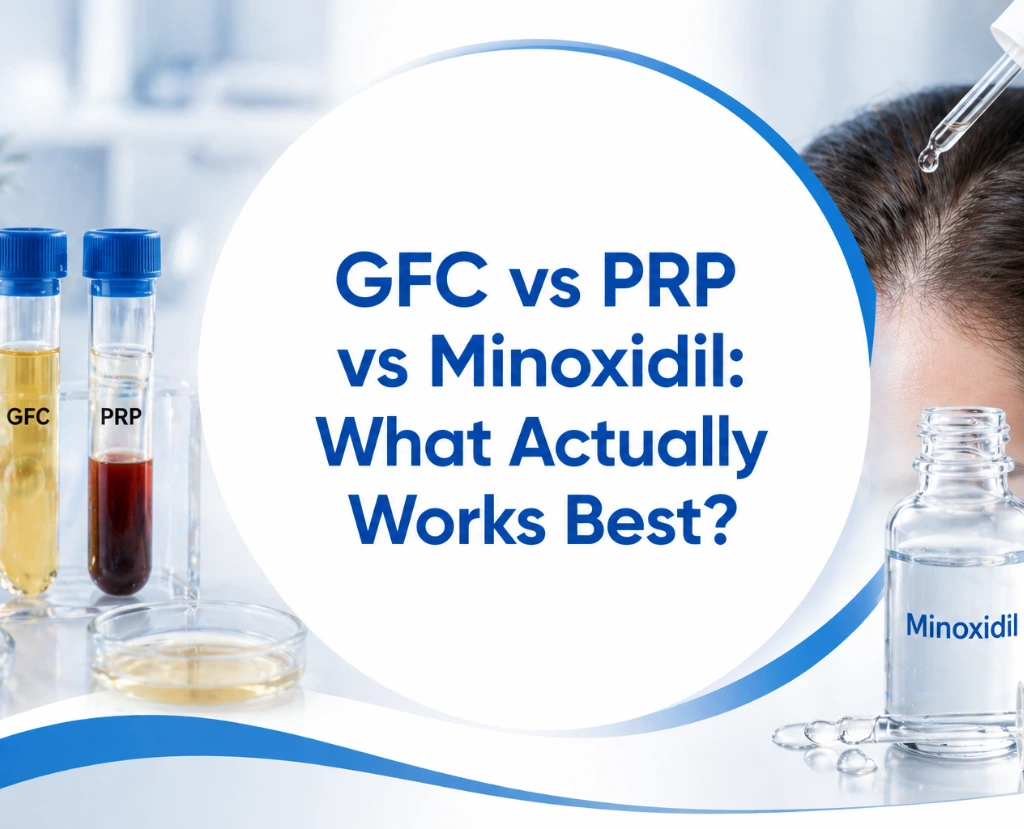
GFC vs PRP vs Minoxidil: What Actually Works Best?
Three treatments consistently appear in conversations about hair loss: Minoxidil — the long-standing over-the-counter standby — and the newer, regenerative approaches of PRP and GFC therapy. Each has its advocates, its evidence base, and its limitations. But for someone trying to make an informed decision about their own hair, what matters is not popularity — it is clinical efficacy, suitability, and long-term outcomes.
At Cosmeticstar in Leeds, we believe every patient deserves an honest, evidence-grounded comparison rather than marketing language. This blog breaks down how GFC, PRP, and Minoxidil work, what the clinical evidence says about each, and which scenarios each treatment is best suited to.
How Each Treatment Works
Minoxidil — Mechanism of Action
Minoxidil is a topical vasodilator — it works by widening blood vessels in the scalp, which improves blood flow to hair follicles and prolongs the anagen (growth) phase. It does not target the hormonal or genetic drivers of hair loss directly. Originally developed as an oral medication for hypertension, its hair growth side effect led to topical formulations becoming widely available for androgenetic alopecia.
Minoxidil requires continuous, indefinite use. Clinical studies demonstrate that the majority of patients who discontinue Minoxidil experience a return of hair loss within three to six months — often rapidly reverting to the state they were in before starting treatment. It does not alter the underlying biology of the hair follicle; it temporarily supports it.
PRP Hair Treatment — Mechanism of Action
PRP therapy concentrates the patient’s own platelet-derived growth factors and delivers them directly to the scalp via microinjections. These growth factors — including PDGF, VEGF, and IGF-1 — bind to follicular stem cell receptors and trigger genuine biological changes: extended anagen phase, increased dermal papilla cell activity, improved scalp angiogenesis, and reduced follicular inflammation.
Unlike Minoxidil, PRP addresses the biological environment of the follicle directly. Improvements achieved through PRP are not immediately lost upon cessation of treatment — though maintenance sessions are recommended to sustain and build upon results over time.
GFC Therapy — Mechanism of Action
GFC represents a significant refinement of the PRP process. Through a more sophisticated centrifugation protocol, GFC isolates a higher concentration of targeted growth factors whilst removing the red blood cells, inflammatory white blood cells, and platelet-poor components that dilute standard PRP. The result is a more potent, more precise biological preparation that delivers a stronger growth factor signal to follicular receptors with a reduced inflammatory response.
GFC hair therapy in Leeds at Cosmeticstar is particularly well suited to patients seeking more pronounced results, those who have experienced modest outcomes from PRP, or those with scalp sensitivity who have not tolerated standard PRP well.
Clinical Comparison: Efficacy, Duration, and Suitability
Efficacy
Multiple randomised controlled trials have demonstrated that PRP produces statistically significant improvements in hair density, follicular diameter, and hair growth rate compared to placebo.
GFC studies — though a younger body of evidence — consistently show superior results to PRP in terms of hair density improvements per session, attributed to the higher growth factor concentration.
Minoxidil shows measurable improvement in approximately 40–60% of users, with results that plateau after approximately twelve months and reverse upon discontinuation.
Duration of Results
Minoxidil: results require ongoing daily application indefinitely. Discontinuation leads to progressive reversal.
PRP: results develop over three to six months and can be maintained with sessions every six to twelve months.
GFC: similar to PRP but with stronger and often faster results per session, requiring fewer total sessions for equivalent outcomes. Exosome therapy can further extend results when combined with either PRP or GFC.
Side Effect Profile
Minoxidil: systemic absorption through the scalp can cause unwanted facial hair growth, scalp irritation, and — with the oral formulation — cardiovascular effects. Initial shedding in the first four to eight weeks is common and frequently alarming for patients.
PRP and GFC: side effect profiles are minimal given the autologous nature of the treatment. Both use the patient’s own biological material, significantly reducing the risk of adverse reactions. Mild scalp sensitivity for twenty-four hours post-treatment is the most commonly reported experience.
Suitability
Minoxidil is broadly suitable for most adults with androgenetic alopecia but is contraindicated in pregnancy and for patients with certain cardiovascular conditions.
PRP and GFC in Leeds are suitable for a wider range of hair loss causes — including hormonal, nutritional, and stress-related loss — and are safe during most life stages (with specific exceptions discussed below).
Which Is Right for You?
- If you are at an early stage of hair loss and want a biologically targeted approach without daily medication — PRP or GFC in Leeds is likely your most effective option.
- If you want the most potent non-surgical treatment available, particularly if previous PRP produced limited results — GFC is the recommended step up.
- If you are seeking a temporary, low-commitment supplement to clinical treatment — Minoxidil can be used alongside PRP or GFC but should not replace it.
- If your hair loss has a hormonal or nutritional component — PRP and GFC address the scalp environment directly, whilst Minoxidil does not target these root causes.
Treatment Options at Cosmeticstar, Leeds
PRP Hair Treatment
Autologous growth factor therapy — clinically supported, safe, and effective across a broad range of hair loss causes. Learn about PRP Hair Treatment in Leeds.
GFC Hair Therapy
The refined, higher-concentration alternative to PRP — delivering stronger results with greater precision and fewer sessions. Explore GFC Hair Therapy in Leeds.
Exosome Therapy
For patients seeking the most advanced regenerative option — particularly effective for persistent or complex hair loss. Discover Exosome Therapy in Leeds.
IV Drip Therapy
Systemic nutritional support to optimise the internal environment for hair growth. View our IV Drip Therapy in Leeds.
Vitamin Injections
Targeted correction of nutritional deficiencies affecting follicular health. Learn about our Vitamin Injections in Leeds.
Prevention and Maintenance
- Do not rely on Minoxidil alone as a long-term solution — it does not address the underlying biology of hair loss.
- Consider combining GFC or PRP with internal wellness support for a more comprehensive approach.
- Maintain treatment results with periodic review sessions and ongoing scalp health monitoring.
- Have your blood work checked — nutritional deficiencies can significantly limit the response to all three treatments.
Make an Informed Decision — Consult Cosmeticstar in Leeds
Choosing between GFC, PRP, and Minoxidil is not something that should be left to online research alone. A clinical consultation at Cosmeticstar in Leeds will give you a clear, personalised assessment of which treatment — or combination of treatments — is best suited to your specific hair loss pattern, stage, and goals. Chat now — click the link and you will be redirected straight to WhatsApp.
Conclusion
Minoxidil, PRP, and GFC each have a role in hair restoration — but they are not equally effective, equally targeted, or equally sustainable. For patients seeking a treatment that addresses the biology of hair loss rather than simply masking it, PRP and GFC hair therapy in Leeds offer a scientifically grounded, results-focused alternative with a superior long-term profile. Cosmeticstar in Leeds is here to help you choose with clarity and confidence.
Privacy Notice: Your data is handled in accordance with UK GDPR. Please review our Privacy Policy for full details.
Disclaimer: This blog is for educational purposes only. Always consult a qualified professional before beginning any treatment.
Frequently Asked Questions
Q: Can I use Minoxidil alongside PRP or GFC treatment?
A: Yes — many patients use Minoxidil as a supplementary measure between clinical sessions, though it should not substitute for the regenerative treatment itself.
Q: Why does hair loss return after stopping Minoxidil?
A: Minoxidil does not alter the follicle’s biology — it temporarily improves blood flow. When discontinued, the follicle reverts to its pre-treatment state.
Q: How does GFC compare to PRP in terms of number of sessions needed?
A: GFC typically requires fewer sessions to achieve equivalent results due to its higher growth factor concentration — this is discussed individually at consultation.
Q: Is Minoxidil safe to use long-term?
A: Topical Minoxidil is generally well-tolerated long-term, though systemic absorption can cause side effects in some patients, particularly with higher-strength formulations.