
Why Your Hair Sheds Before Improving After PRP
One of the most commonly reported — and frequently misunderstood — experiences following PRP hair treatment is an initial increase in shedding. Patients who are already anxious about their hair loss understandably find this alarming. If you have recently begun PRP treatment in Leeds and noticed more hair falling out than usual, this blog will explain precisely why this happens, what it means biologically, and why it is, in most cases, a sign that the treatment is working as intended.
At Cosmeticstar in Leeds, we prepare every patient for this possibility during their pre-treatment consultation. Understanding the biology behind it removes the anxiety — and helps you stay committed to the process at the point when many patients are tempted to stop.
The Hair Growth Cycle: A Quick Recap
Every hair follicle on your scalp operates on a cyclical pattern: anagen (active growth), catagen (transition), and telogen (resting). At the end of the telogen phase, the old hair strand is shed and a new growth cycle begins. Under normal conditions, approximately 85 to 90 percent of your follicles are in the anagen phase at any given time, with the remainder resting.
In hair loss conditions, this balance is disrupted — more follicles spend time in telogen, and the anagen phase becomes progressively shorter. The result is increased shedding and reduced density over time.
Why PRP Can Trigger a Shedding Phase
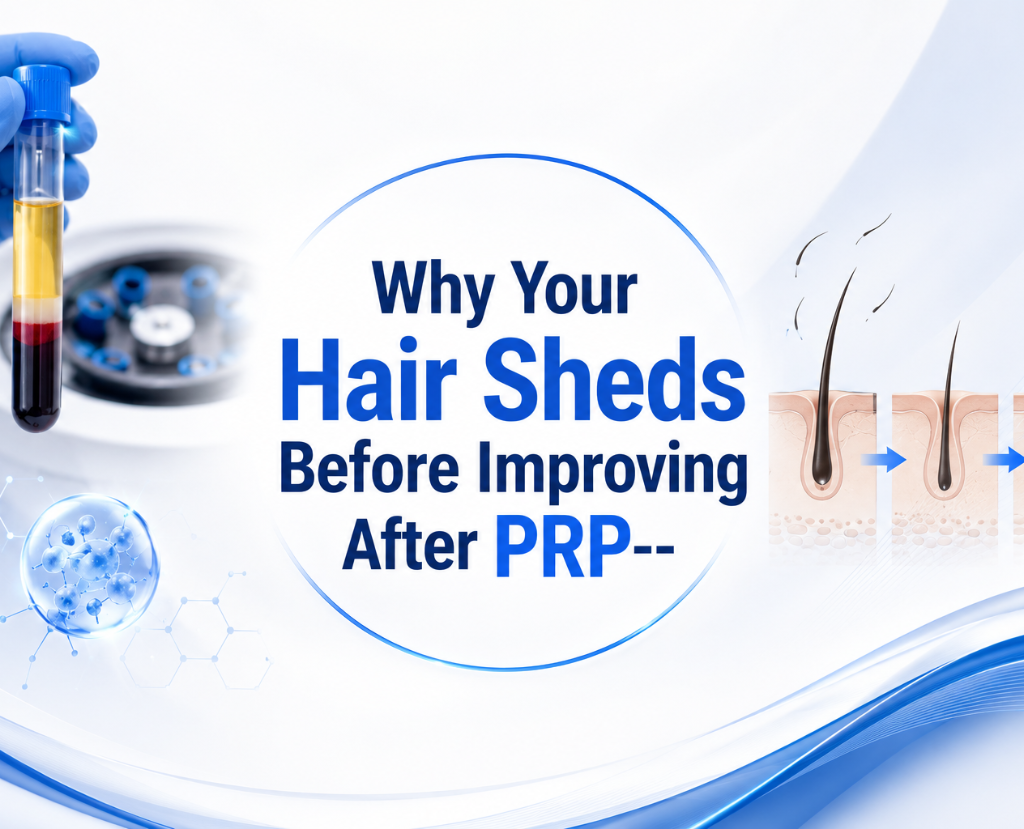
When growth factors from PRP are introduced to the scalp, they do not simply add hair directly. Instead, they initiate a biological reset of the hair growth cycle in affected follicles. Here is what happens at the follicular level:
- Growth factors stimulate dermal papilla cells, signalling dormant or telogen-phase follicles to transition back into the anagen phase
- For a follicle to begin a new, healthier growth cycle, it must first shed the old, miniaturised hair strand it is currently holding
- This ejection of old strands — often finer and weaker than healthy hair — creates a temporary increase in visible shedding
- Once the old strand is released, the follicle begins producing a new, thicker hair shaft in its place
This process is sometimes referred to as a ‘purge’ phase — and whilst it may look like hair loss, it is biologically the opposite: it is the follicle preparing to grow better quality hair.
When Does Shedding After PRP Typically Occur?
Initial shedding after PRP treatment most commonly begins within two to six weeks of the first session and may last for four to eight weeks. It is rarely uniform across the scalp — patients often notice increased shedding in specific areas, which typically correlates with the zones where follicles were most actively stimulated during treatment.
The shedding phase is generally followed by a stabilisation period and then, over the following months, by visible improvements in density, strand thickness, and hair quality. Most patients at Cosmeticstar in Leeds notice meaningful positive changes between months three and five of their treatment course.
When Should You Be Concerned?
Not all post-PRP shedding is a positive sign. If shedding continues beyond eight to ten weeks without any signs of improvement, or if it is accompanied by scalp irritation, tenderness, or patchy loss, it is important to contact your treating clinician for a review. These signs may indicate that an underlying condition — such as a nutritional deficiency, hormonal imbalance, or scalp inflammation — is contributing to shedding independently of the treatment process.
Treatment Options at Cosmeticstar, Leeds
PRP Hair Treatment
PRP initiates a biological reset of the hair growth cycle through concentrated autologous growth factors. Understanding the full treatment timeline — including the initial shedding phase — is part of what we prepare every patient for. Learn about PRP Hair Treatment in Leeds.
GFC Hair Therapy
GFC delivers a more refined growth factor preparation that produces a stronger follicular stimulus — and in some patients, a more pronounced but shorter initial shedding phase, followed by accelerated improvement. Explore GFC Hair Therapy in Leeds.
Exosome Therapy
Exosome Therapy provides an additional cellular regeneration signal that can support the follicular reset process and reduce the duration of the shedding phase when combined with PRP or GFC. Discover Exosome Therapy in Leeds.
IV Drip Therapy & Vitamin Injections
Correcting underlying nutritional deficiencies through IV Drip Therapy and Vitamin Injections supports the follicle’s ability to transition smoothly from the shedding phase into healthy regrowth.
What to Do During the Shedding Phase
- Stay consistent with your treatment schedule — stopping treatment during the shedding phase is one of the most common reasons patients do not see full results
- Avoid harsh shampoos, heat styling, and tight hairstyles during this period to minimise additional follicular stress
- Track your shedding with photographs — this helps both you and your clinician assess whether the process is progressing normally
- Report any unusual scalp changes — redness, tenderness, or patchy loss — to your clinician promptly
Stay on Track at Cosmeticstar, Leeds
The shedding phase is temporary — and getting through it is where the real results begin. At Cosmeticstar, we support our patients through every stage of the treatment journey, including the initial adjustment period. If you have questions about what you are experiencing after PRP, chat now — click the link and you will be redirected straight to WhatsApp.
Conclusion
Shedding after PRP treatment is not a sign of failure — in most cases, it is a biological indicator that the follicle reset process has begun. Understanding this phase makes it easier to stay the course and see the treatment through to meaningful results. Cosmeticstar in Leeds ensures every patient is fully informed before, during, and after their PRP or GFC treatment journey.
Privacy Notice: Your data is handled in accordance with UK GDPR. Please review our Privacy Policy for full details.
Disclaimer: This blog is for educational purposes only. Always consult a qualified professional before beginning any treatment.
Frequently Asked Questions
Q: Is shedding after PRP treatment normal?
A: Yes — an initial shedding phase is a recognised and often expected part of the PRP treatment process, reflecting the follicular reset cycle being initiated.
Q: How long does the shedding phase last after PRP?
A: The shedding phase typically lasts four to eight weeks following the first session, after which stabilisation and gradual improvement occur.
Q: Should I stop PRP if I am shedding more than before?
A: No — stopping treatment during the shedding phase is the most common reason patients do not achieve full results. Continue your sessions and discuss any concerns with your clinician.
Q: Does GFC cause the same shedding phase as PRP?
A: GFC can trigger a similar but often shorter shedding phase due to its more potent growth factor stimulus. The improved quality of regrowth that follows is typically more pronounced than with standard PRP.