
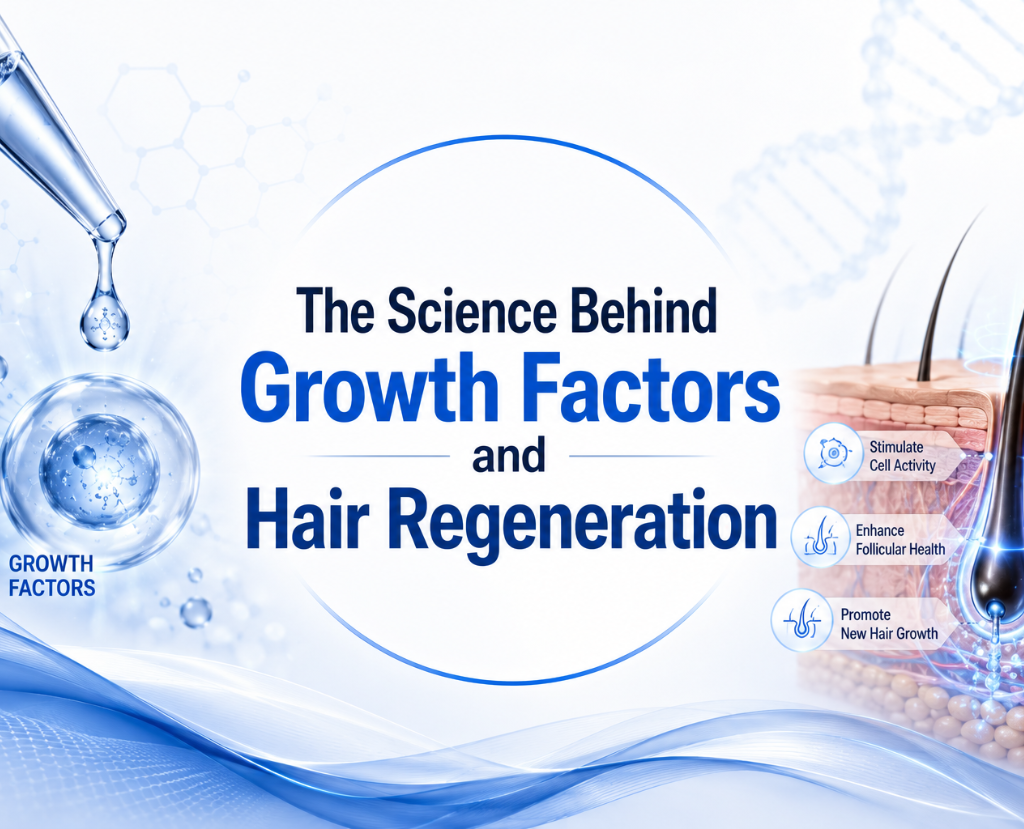
The Science Behind Growth Factors and Hair Regeneration
The term ‘growth factors’ appears frequently in the marketing of PRP and GFC hair treatments — but for many patients, what these proteins actually do at the follicular level remains unclear. Understanding the genuine science behind growth factor therapy is not just academically interesting — it helps you make a more informed treatment decision and set realistic expectations about what is achievable.
At Cosmeticstar in Leeds, we believe that scientific transparency is part of delivering excellent patient care. This blog explains the biology of hair regeneration through growth factors, from the molecular level to the clinical outcomes patients experience.
The Follicle as a Biological Unit
Each hair follicle is a remarkably complex miniature organ. At its base sits the dermal papilla — a cluster of specialised cells that act as the control centre for the hair growth cycle. The dermal papilla receives signals from the surrounding tissue environment and responds by either driving the follicle into active growth (anagen), triggering regression (catagen), or holding it in a resting state (telogen).
In healthy follicles, this cycle is well-regulated and produces consistent, pigmented, full-diameter hair strands. In hair loss conditions — most commonly androgenetic alopecia — DHT sensitivity disrupts this regulation, shortening the anagen phase and gradually shrinking the follicle in a process called miniaturisation. Growth factor therapy targets this disruption directly.
How Growth Factors Interact With the Follicle
Binding and Receptor Activation
Growth factors are signalling proteins that exert their effects by binding to specific receptors on the surface of target cells. In the scalp, dermal papilla cells, keratinocytes, and vascular endothelial cells all carry receptors for the growth factors present in PRP and GFC preparations. When a growth factor binds to its receptor, it triggers a cascade of intracellular signals — activating genes, proteins, and pathways that collectively drive the follicle towards regeneration.
Anagen Induction
One of the primary therapeutic goals of growth factor therapy is to push follicles in the telogen phase back into anagen. PDGF (Platelet-Derived Growth Factor) and IGF-1 (Insulin-Like Growth Factor) have both been demonstrated to stimulate the dermal papilla into producing the molecular signals needed to initiate a new growth cycle. In practical terms, this means follicles that have been in a prolonged resting state begin producing new hair strands — which, over weeks and months, manifests as increased density.
Vascular Remodelling
VEGF (Vascular Endothelial Growth Factor) plays a critical and often underappreciated role in hair regeneration. Follicular health is highly dependent on blood supply — the dermal papilla must receive consistent oxygen and nutrients to sustain an active anagen phase. VEGF stimulates the formation of new blood vessels around the follicle, improving the local vascular environment and giving the follicle greater metabolic resources. This vascular improvement supports not just initial regrowth but the long-term maintenance of healthy hair density.
Reduction of DHT-Driven Miniaturisation
Whilst PRP and GFC do not directly block DHT — as pharmaceutical treatments like finasteride do — the growth factors they deliver create a follicular environment that is more resistant to DHT’s miniaturising effects. By maintaining dermal papilla cell activity and promoting healthy cell signalling, growth factor therapy counteracts some of the downstream damage caused by DHT, slowing the progression of follicular miniaturisation and in many cases reversing it at early stages.
Anti-Inflammatory Effect
Scalp inflammation is an underrecognised contributor to follicular damage in many hair loss patients. TGF-β (Transforming Growth Factor Beta), present in both PRP and GFC preparations, plays a regulatory role in modulating the local immune response around the follicle. By reducing pro-inflammatory signalling, growth factor therapy helps to create a healthier follicular microenvironment — one in which regeneration is more likely to be sustained.
PRP vs GFC: Scientific Differences in Growth Factor Delivery
Standard PRP concentrates platelets from the patient’s blood to approximately three to five times their normal concentration in whole blood. This provides a meaningful increase in growth factor availability at the injection site. GFC takes this further by using a more selective preparation protocol — isolating the growth factor payload with higher specificity whilst removing leukocytes (white blood cells) that can introduce a pro-inflammatory element to the treatment.
Clinical evidence increasingly supports the observation that GFC produces a more consistent and stronger follicular response than standard PRP — with fewer reports of post-treatment scalp sensitivity and a more reliable outcome profile across patient groups.
Treatment Options at Cosmeticstar, Leeds
PRP Hair Treatment
The clinical foundation of growth factor hair therapy, with a well-established evidence base and excellent safety profile. Learn about PRP Hair Treatment in Leeds.
GFC Hair Therapy
The scientifically advanced evolution of PRP, delivering a higher-potency growth factor stimulus with greater precision and a lower inflammatory profile. Explore GFC Hair Therapy in Leeds.
Exosome Therapy
Exosomes represent the next frontier of regenerative hair medicine, carrying molecular signals from stem cells that communicate directly with follicular stem cell populations. Discover Exosome Therapy in Leeds.
IV Drip Therapy & Vitamin Injections
Systemic nutritional support through IV Drip Therapy and Vitamin Injections in Leeds ensures the biological environment supports growth factor activity from the inside out.
Speak to the Team at Cosmeticstar, Leeds
If you would like to understand more about how growth factor therapy could work for your specific hair loss, Cosmeticstar in Leeds offers detailed consultations that translate the science into a clear, personalised treatment plan. Chat now — click the link and you will be redirected straight to WhatsApp.
Conclusion
Growth factor therapy is not simply a wellness trend — it is a scientifically grounded approach to hair regeneration that works at the molecular level to restore follicular function. PRP and GFC hair treatment in Leeds harness these mechanisms with clinical precision. Cosmeticstar in Leeds is committed to delivering this science with transparency, personalised care, and measurable results.
Privacy Notice: Your data is handled in accordance with UK GDPR. Please review our Privacy Policy for full details.
Disclaimer: This blog is for educational purposes only. Always consult a qualified professional before beginning any treatment.
Frequently Asked Questions
Q: How long does it take for growth factors to start working after PRP or GFC?
A: Growth factors begin interacting with follicular cells immediately after injection. Visible clinical changes — reduced shedding and improved density — typically emerge over the following two to five months.
Q: Are the effects of growth factor therapy permanent?
A: The biological improvements triggered by growth factor therapy can be long-lasting, but maintenance sessions every six to twelve months are recommended to sustain results in progressive hair loss conditions.
Q: Why does GFC produce better results than PRP scientifically?
A: GFC isolates a higher concentration of targeted growth factors whilst removing leukocytes that can introduce inflammation — producing a purer, more potent, and more consistent follicular stimulus.
Q: Is growth factor therapy suitable for all types of hair loss?
A: Growth factor therapy is most effective for androgenetic alopecia and telogen effluvium. A clinical assessment at Cosmeticstar will determine whether it is appropriate for your specific hair loss type.