
PRP for Women: Postpartum & Hormonal Hair Thinning
Hair loss in women is both more common and more complex than most public conversations about the topic suggest. While male pattern baldness tends to dominate the hair loss narrative, women experience significant hair thinning at multiple life stages — and the causes are frequently hormonal, nutritional, or a combination of both. PRP hair treatment in Leeds has emerged as one of the most effective and well-evidenced non-surgical responses to these patterns of hair loss, and it is increasingly the first-line option recommended for women who want to address thinning without medication or surgery.
At Cosmeticstar in Leeds, a significant proportion of our PRP hair treatment patients are women dealing with postpartum hair loss, perimenopausal thinning, or the diffuse shedding associated with thyroid dysfunction and other hormonal conditions. This blog explains how PRP works for women, why it is particularly well-suited to hormonally driven hair thinning, and what the treatment experience looks like.
Why Women Lose Hair: The Hormonal Picture
Postpartum Hair Loss
During pregnancy, elevated oestrogen and progesterone levels hold a significantly higher proportion of follicles in the active growth phase — which is why many women notice their hair becoming thicker and more lustrous during the second and third trimesters. After delivery, as hormone levels drop sharply, those follicles are simultaneously released into the resting and shedding phase. The result — postpartum hair loss — typically begins two to four months after delivery and can be dramatic in volume, though it is usually temporary.
PRP hair treatment in Leeds is particularly well-suited to postpartum hair loss because it directly addresses the follicular recovery phase — stimulating dermal papilla cells to re-enter the growth phase more promptly, reducing the duration and severity of the shedding period, and supporting the scalp environment in which new hair is regrowing. For many women, PRP shortens the recovery timeline and produces noticeably better density outcomes than waiting for spontaneous resolution.
Perimenopausal and Menopausal Hair Thinning
As oestrogen declines during perimenopause and menopause, the relative influence of androgens on the hair follicle increases. This produces a gradual, diffuse thinning across the crown and top of the scalp — female androgenetic alopecia — that affects a significant proportion of women over forty. Unlike postpartum loss, menopausal thinning tends not to resolve spontaneously, and it responds well to PRP hair treatment in Leeds when begun at an early to moderate stage.
Thyroid and Other Hormonal Conditions
Thyroid dysfunction — both hypothyroidism and hyperthyroidism — disrupts the rate of cellular activity throughout the body, including within the hair follicle. Diffuse hair shedding is one of the most consistent presenting features of undiagnosed or undertreated thyroid disease. Polycystic ovary syndrome (PCOS), insulin resistance, and adrenal dysfunction can also contribute to elevated androgen levels and subsequent hair thinning in women. PRP hair treatment in Leeds addresses the follicular manifestation of these conditions — but where an underlying hormonal condition is suspected, identifying and managing it medically alongside PRP produces the best outcomes.
How PRP Hair Treatment in Leeds Works for Women
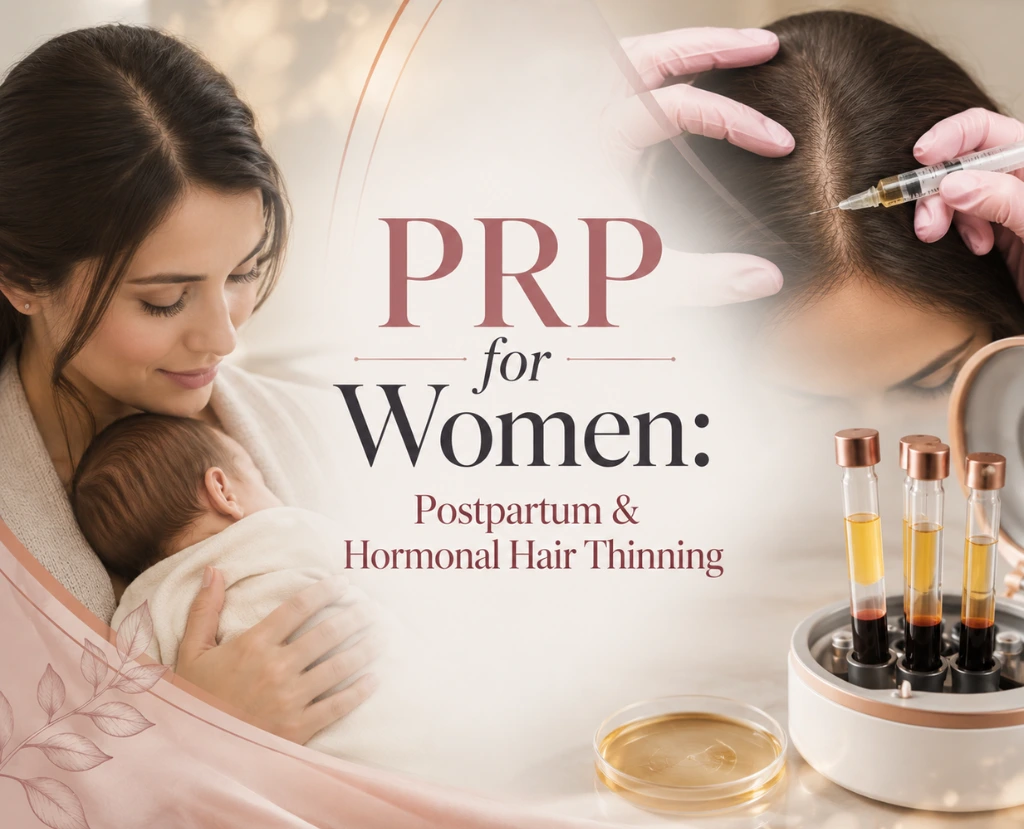
PRP (Platelet-Rich Plasma) hair treatment in Leeds involves drawing a small blood sample, centrifuging it to concentrate the platelet fraction, and injecting the resulting growth-factor-rich plasma into the scalp at the sites of thinning. The concentrated growth factors — PDGF, VEGF, IGF-1, EGF, and others — stimulate the dermal papilla cells that regulate the hair growth cycle, extend the active growth phase, and support the production of stronger, denser strands from follicles that have been miniaturising.
For women with hormonally driven thinning, PRP addresses the follicular side of the equation — increasing the resilience and productivity of the existing follicles regardless of whether the hormonal trigger has been fully resolved. This is clinically significant: even in women whose hormonal balance is difficult to fully restore, PRP can produce meaningful improvement in hair quality and density by working directly at the scalp level.
What PRP Hair Treatment in Leeds Involves for Women
The treatment experience at Cosmeticstar in Leeds is the same for women as for men in terms of the clinical procedure — a blood draw, centrifugation, and a series of scalp injections across the thinning areas. For women with diffuse thinning across the crown and vertex, the injection pattern covers a broader area than the more localised treatment used in some male pattern cases.
A topical anaesthetic cream is applied before the injections, and most women find the procedure manageable — a series of small, brief sensations across the scalp. The appointment takes approximately sixty to ninety minutes, and there is no recovery period — most women return to normal activities the same day.
When to Start PRP Hair Treatment in Leeds
For postpartum hair loss, PRP hair treatment in Leeds is typically most beneficial from around three months post-delivery — when the shedding phase is established and the follicles are ready to respond to growth factor stimulation. Beginning too early, before the shedding phase is underway, may be less effective than waiting for the right point in the follicular cycle.
For perimenopausal and hormonal thinning, earlier is consistently better. The longer a follicle has been miniaturising, the less it is able to respond to treatment. Women who notice their hair changing and act promptly tend to see the strongest PRP results — both in the reduction of shedding and in the recovery of density.
Treatment Options at Cosmeticstar, Leeds
PRP Hair Treatment Leeds
Our PRP Hair Treatment in Leeds uses your own platelet-rich plasma to deliver a targeted growth factor stimulus directly to thinning follicles. Each session is individually planned around your hair loss pattern and current stage of thinning.
GFC Hair Therapy Leeds
For patients who want a more concentrated growth factor preparation or who have had a limited response to standard PRP, GFC Hair Therapy in Leeds delivers a more refined, higher-potency treatment with a lower inflammatory response and consistently stronger outcomes.
Red Light Therapy Leeds
Used alongside PRP or GFC, how red light therapy supports hair restoration by increasing cellular energy in the scalp, reducing perifollicular inflammation, and improving blood flow to thinning areas — creating a significantly more receptive environment for growth factor treatments to work within.
Exosome Therapy Leeds
For patients who want to deepen their treatment response or who have not achieved the density improvement they were hoping for from PRP or GFC alone, Exosome Therapy in Leeds delivers concentrated regenerative signals directly to follicular tissue at the cellular communication level.
IV Drip Therapy & Vitamin Injections
Nutritional deficiencies in ferritin, vitamin D, and B12 are among the most common silent contributors to hair loss — and they limit how well any scalp treatment can perform. Our IV Drip Therapy in Leeds and Vitamin Injections in Leeds correct these deficiencies at the cellular level, giving your PRP treatment the internal environment it needs to produce its best results.
Ready to Take the Next Step?
If you are a woman dealing with postpartum, hormonal, or perimenopausal hair thinning in Leeds and want to understand whether PRP hair treatment is the right approach for your situation, the most useful thing you can do is speak to a clinic that takes the time to assess your specific situation properly before recommending anything. At Cosmeticstar in Leeds, that is exactly what we do. Chat now on WhatsApp — click the link and our team will be with you straight away.
Conclusion
PRP hair treatment in Leeds is one of the most clinically appropriate and well-evidenced options for women whose hair thinning has a hormonal or postpartum component. It works directly at the follicular level, requires no medication, and produces measurable improvements in shedding and density that most women notice within the first few months of treatment. At Cosmeticstar in Leeds, we have specific experience in treating the patterns of hair loss most common in women and design PRP plans around what your follicles and scalp actually need at this point in your journey.
Privacy Notice: Your data is handled in accordance with UK GDPR. Please review our Privacy Policy for full details.
Disclaimer: This blog is for educational purposes only. Always consult a qualified professional before beginning any treatment.
Frequently Asked Questions
Q: Is PRP hair treatment in Leeds safe during breastfeeding?
A: PRP uses your own blood products and does not involve pharmaceutical agents, which makes it generally considered compatible with the postpartum period. However, each case should be discussed individually during your consultation at Cosmeticstar in Leeds, where we take your full health context into account before recommending treatment.
Q: How many PRP sessions will I need for postpartum hair loss?
A: Most women with postpartum hair loss at Cosmeticstar in Leeds undertake an initial course of three to four PRP sessions, spaced four to six weeks apart. Because postpartum loss is typically a recoverable pattern, the response to treatment is often strong and maintenance needs are lower than for women with ongoing hormonal thinning.
Q: Will PRP hair treatment in Leeds help if my thyroid condition is being treated?
A: Yes — PRP hair treatment in Leeds works most effectively when underlying hormonal conditions are being managed medically at the same time. Treating the follicular level with PRP while addressing the hormonal driver through appropriate medical management produces stronger and more sustained results than either approach alone.
Q: How quickly does PRP work for women’s hair loss?
A: Reduced shedding is typically the first sign of response, often noticed within four to six weeks of the first PRP session. Visible improvements in density and strand quality tend to become apparent between months two and four of a consistent treatment course.
Q: Can women use PRP alongside nutritional support for hair loss?
A: Yes — and at Cosmeticstar in Leeds, we frequently combine PRP hair treatment with IV Drip Therapy or Vitamin Injections for women whose assessment reveals nutritional deficiencies contributing to their hair loss. Correcting ferritin, vitamin D, or B12 deficiency alongside PRP produces significantly better outcomes than scalp treatment alone.