
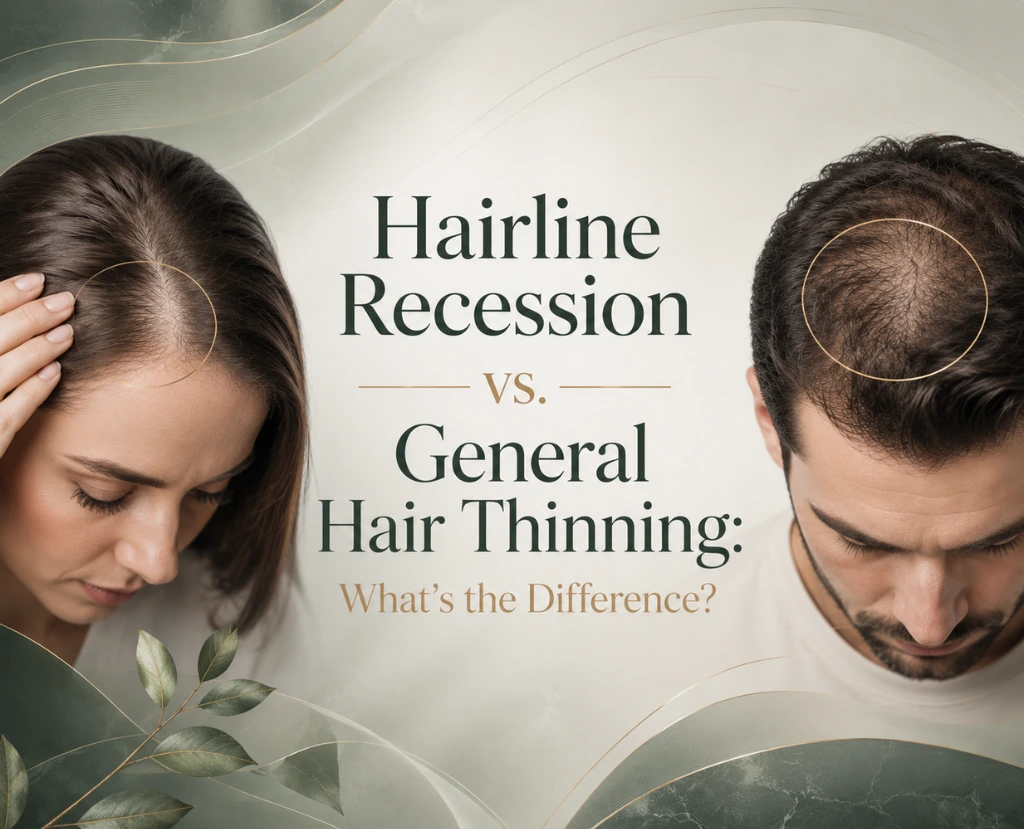
Hairline Recession vs. General Hair Thinning: What’s the Difference?
Not all hair loss is the same — and the distinction between hairline recession and general hair thinning matters practically, because the two patterns have different causes, follow different progressions, and respond to treatment in different ways. Confusing the two can lead to mismatched treatment expectations and, in some cases, the wrong treatment approach.
At Cosmeticstar in Leeds, the assessment of which pattern or combination of patterns a patient is experiencing is the essential first step in any hair loss treatment plan. This blog explains how hairline recession and general hair thinning differ — and what that difference means for treatment in Leeds.
What Is Hairline Recession?
Hairline recession refers specifically to the backward movement of the frontal hairline — the loss of hair at the temples, the forehead border, and the front of the scalp. It is the defining visual feature of the classic Norwood progression in male androgenetic alopecia, beginning with temple recession producing an M-shaped hairline and progressing to a higher, more receded frontal line over time.
Hairline recession is driven primarily by DHT (dihydrotestosterone) acting on genetically susceptible follicles at the frontal border of the scalp. These follicles carry a higher density of androgen receptors than those at the sides and back of the scalp, making them the first and most significantly affected in male pattern baldness. Women can also experience a degree of frontal recession — though the hairline is typically preserved to a greater degree than in men, even in advanced female androgenetic alopecia.
What Is General Hair Thinning?
General hair thinning — diffuse thinning — refers to a reduction in overall hair density across a broader area of the scalp, without a specific recession pattern. The hair becomes progressively finer and sparser across the affected zone, but the hairline itself may remain largely intact. This is the primary pattern seen in female androgenetic alopecia (the Ludwig pattern), in telogen effluvium, and in thinning driven by nutritional deficiency, thyroid dysfunction, or hormonal imbalance.
Diffuse thinning is characterised by miniaturisation — follicles producing progressively shorter, finer strands — distributed across the crown and top of the scalp. Because the hairline is largely preserved, the change is most visible when the hair is parted (a wider parting) or viewed from above (increased scalp visibility across the crown).
Key Differences Between the Two Patterns
Location
Hairline recession is concentrated at the frontal and temporal borders of the scalp. General thinning is distributed across the crown and top of the scalp, with the hairline typically preserved.
Primary Cause
Hairline recession in men is almost always driven by androgenetic alopecia — DHT-driven follicular miniaturisation at the most androgen-sensitive frontal follicles. Diffuse thinning has a wider range of causes including female androgenetic alopecia, telogen effluvium, nutritional deficiency, and hormonal imbalance.
Progression Pattern
Hairline recession tends to progress along the Norwood trajectory — predictable in direction if not in rate. Diffuse thinning progresses across the vertex, typically following the Ludwig scale in women, and can stabilise or fluctuate in response to the underlying driver.
Response to Treatment
Both patterns respond to PRP hair treatment in Leeds — but the response characteristics differ. Diffuse thinning across the crown often produces a stronger and more visually dramatic response to PRP than advanced frontal recession, because the follicles in the crown zone are typically less miniaturised and more capable of responding to growth factor stimulation. Frontal hairline follicles, under the heaviest androgen influence, may respond more slowly and require a more intensive approach — GFC rather than standard PRP, combined with red light therapy.
Can You Have Both Patterns at Once?
Yes — and this is more common than either in isolation. Many men with androgenetic alopecia present with both frontal recession and crown thinning simultaneously. Women with a combination of female androgenetic alopecia and telogen effluvium (triggered by a hormonal event such as perimenopause) can show diffuse thinning with a degree of frontal density reduction. At Cosmeticstar in Leeds, the assessment identifies which pattern or combination is present and tailors the treatment accordingly.
Does the Pattern Affect Which Treatment in Leeds Is Right?
Yes — meaningfully. For diffuse thinning across the crown or vertex, PRP delivered across the broader treatment zone, combined with Red light therapy In leeds and nutritional correction where relevant, typically produces an excellent response. For frontal hairline recession — particularly at more advanced stages — GFC Hair Therapy in Leeds provides a more concentrated growth factor stimulus, and the honest conversation about whether a hair transplant may ultimately be appropriate for the frontal zone is sometimes part of the assessment.
Treatment Options at Cosmeticstar, Leeds
PRP Hair Treatment Leeds
Our PRP Hair Treatment in Leeds uses your own platelet-rich plasma to deliver a concentrated growth factor stimulus directly to thinning follicles — stimulating the dermal papilla cells that regulate the hair growth cycle and supporting the production of stronger, denser strands from follicles that are still biologically active.
GFC Hair Therapy Leeds
For patients who want a more powerful growth factor intervention or who have seen a limited response to standard PRP, GFC Hair Therapy in Leeds provides a more refined, higher-concentration preparation — with a lower inflammatory response at the injection site and consistently stronger outcomes for patients with more significant or faster-progressing thinning.
Red Light Therapy Leeds
Used alongside PRP or GFC, Red light therapy In leeds by increasing cellular energy in the scalp, reducing perifollicular inflammation, and improving blood flow to thinning areas — creating a significantly more receptive environment for growth factor treatments to work within, and maintaining that environment between sessions.
Exosome Therapy Leeds
For patients who want to deepen their treatment response, Exosome Therapy in Leeds delivers concentrated regenerative signals directly to follicular tissue at the cellular communication level — working synergistically with both PRP and red light therapy to produce a more comprehensive biological stimulus.
Ready to Take the Next Step?
If you are unsure whether your hair loss is primarily a recession pattern or a general thinning pattern and want a proper clinical assessment to identify what is happening and what the right treatment approach is, the most useful thing you can do is speak to a clinic that takes the time to assess your specific situation properly before recommending anything. At Cosmeticstar in Leeds, that is exactly what we do. Chat now on WhatsApp — click the link and our team will be with you straight away.
Conclusion
Hairline recession and general hair thinning are different patterns with different causes and different treatment implications. Identifying which pattern you have — or whether you have a combination of both — is the essential first step in designing an effective hair loss treatment plan in Leeds. At Cosmeticstar in Leeds, that assessment is where every conversation starts.
Privacy Notice: Your data is handled in accordance with UK GDPR. Please review our Privacy Policy for full details.
Disclaimer: This blog is for educational purposes only. Always consult a qualified professional before beginning any treatment.
Frequently Asked Questions
Q: Can women have hairline recession?
A: Yes — though hairline recession in women is less common and typically less pronounced than in men. Women with androgenetic alopecia usually experience the Ludwig diffuse thinning pattern with a preserved hairline, but some degree of frontal thinning can occur, particularly in women with higher androgen activity (such as those with PCOS).
Q: Is diffuse thinning harder to treat than hairline recession?
A: Not necessarily — diffuse thinning across the crown often responds very well to PRP hair treatment in Leeds because the follicles in this zone tend to be less advanced in miniaturisation than those in the frontal zone. The best predictor of treatment response is the density of biologically active follicles remaining in the thinning area, regardless of which pattern is present.
Q: Can PRP stop hairline recession?
A: PRP can slow the rate of further recession at the frontal hairline by stimulating the follicles that are still active in this zone. It cannot recover follicles that have already been permanently lost. For early-stage recession, this makes PRP a genuinely useful intervention; for more advanced recession, a hair transplant may be the more appropriate option for the frontal zone.
Q: What causes diffuse hair thinning in women?
A: The most common causes of diffuse thinning in women are female androgenetic alopecia (hormonally driven follicular miniaturisation), telogen effluvium (triggered by postpartum hormone shifts, stress, or nutritional deficiency), thyroid dysfunction, and iron or ferritin deficiency. Identifying the specific driver is essential to designing the right treatment plan.
Q: How is the type of hair loss pattern identified?
A: A clinical assessment at Cosmeticstar in Leeds — combining a visual examination of the hair loss pattern, a discussion of your hair history and family background, and where relevant a nutritional and hormonal blood panel — is the most reliable way to identify the pattern and its underlying causes.