
How Long Does It Take for PRP to Work for Hair Loss?
When you first notice your hair becoming thinner or shedding more than usual, it is natural to look for a solution that delivers quick results. Many women experiencing changes in hair density consider PRP (platelet-rich plasma) as a treatment option because it is non-surgical and uses the body’s own regenerative ability.
However, PRP is not designed to deliver instant results.
It works gradually by improving the condition of hair follicles over time. Understanding how this process works and how long it typically takes can help set realistic expectations and avoid unnecessary frustration.
What happens in the scalp after PRP?
PRP treatment focuses on improving the environment around hair follicles rather than forcing immediate growth.
When platelet-rich plasma is introduced into the scalp, it releases natural growth signals that:
- Support repair at a cellular level
- Improve blood supply to the follicles
- Encourage weak follicles to become more active
- Help extend the natural growth phase of hair
This means the treatment works with your body rather than against it, which is why results develop gradually.
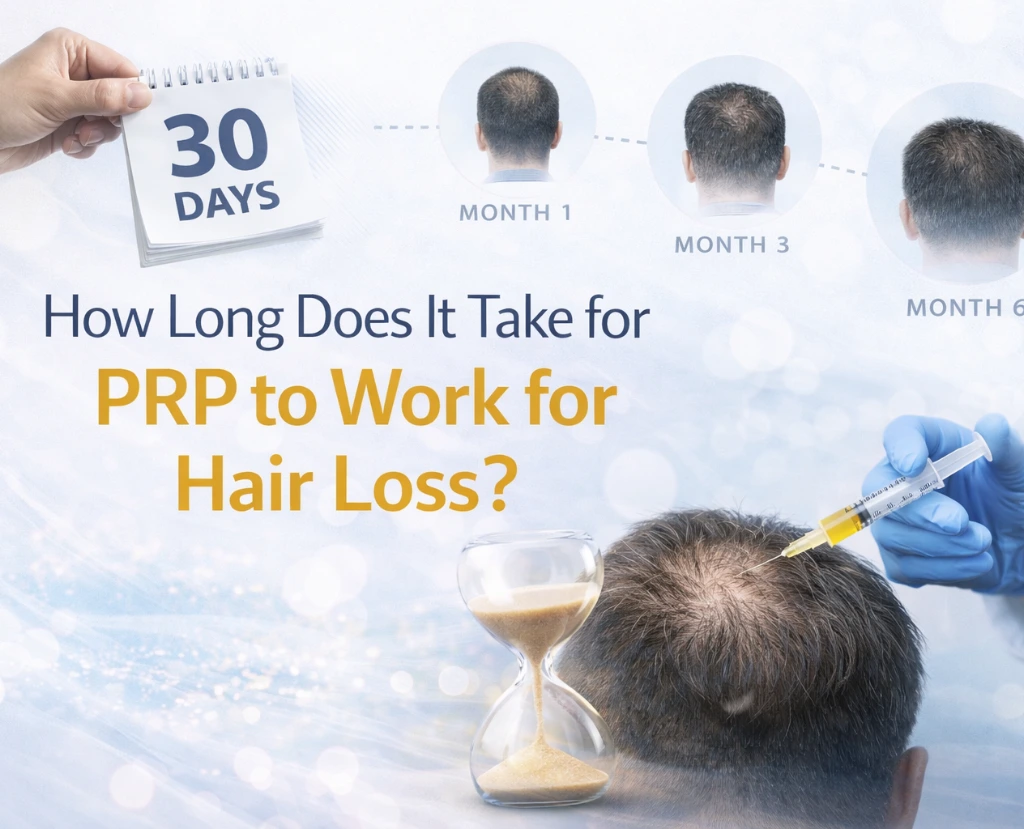
Typical PRP timeline for hair improvement
Initial phase: first few weeks
In the early stage after treatment:
- Visible changes are usually minimal
- Some individuals notice less shedding
- Internal repair begins within the scalp
At this point, the process is happening beneath the surface rather than being visible externally.
Early progress: 1 to 3 months
As treatment continues:
- Hair loss may begin to stabilise
- Existing hair can feel slightly stronger
- Early signs of improvement may appear in thinner areas
This stage often brings subtle but encouraging changes.
Noticeable improvement: 3 to 6 months
This is when progress becomes more visible:
- Hair may appear fuller
- Texture and strength improve
- Areas of thinning can look denser
For many individuals, this is when PRP starts to show clear benefits.
Long-term maintenance: beyond 6 months
With continued care:
- Hair condition becomes more stable
- Improvements are easier to maintain
- Further hair loss can be managed more effectively
Maintenance sessions are often recommended to preserve results.
Why results do not appear at the same speed for everyone
PRP does not follow a fixed timeline because each individual responds differently. Several factors influence how quickly results develop.
Condition of the follicles
If follicles are still active, improvement tends to appear sooner. In more advanced cases, progress may be slower.
Hormonal influence
Hormonal changes can continue to affect the hair cycle, which may delay visible improvement.
Nutritional health
Hair growth depends on internal health. If the body lacks essential nutrients, progress may be slower.
In such situations, supporting the body with vitamin injections and IV drip therapy can help improve overall response to treatment.
Treatment consistency
PRP works best when sessions are carried out as recommended. Gaps in treatment can slow down results.
How to support better and faster results
Although PRP takes time, certain steps can help improve the outcome:
- Begin treatment as early as possible
- Maintain a balanced and nutrient-rich diet
- Follow the recommended treatment schedule
- Address any underlying hormonal concerns
- Avoid habits that weaken hair
These factors help create a better environment for hair to recover and grow.
Is PRP a permanent solution?
PRP is not a one-time permanent fix. It is a treatment that requires maintenance.
Without follow-up sessions:
- Hair may gradually return to its previous condition
- Results may reduce over time
With proper maintenance, however, it can provide long-term improvement in hair quality.
When should you expect visible change?
Most individuals begin to notice visible improvement after a few months, although this varies depending on personal factors.
For some, reduced shedding appears early. For others, visible growth may take longer. The key is consistency and patience throughout the process.
Conclusion
PRP is designed to support natural hair recovery rather than deliver instant results. It works gradually by improving the condition of hair follicles and creating a healthier scalp environment.
The time it takes to see results depends on several factors, including overall health, hormonal balance, and how consistently the treatment is followed. Supporting PRP with internal care, such as vitamin injections and IV drip therapy, can help improve outcomes by addressing underlying deficiencies.
If you are considering non-surgical options for hair loss in Leeds, Cosmeticstar offers personalised treatments focused on long-term, natural-looking results.
Not sure how long PRP might take in your specific case or what to expect from the process? 👉 chat now to get clear, professional guidance tailored to your situation.
GDPR Notice: All treatment-related information is handled in a GDPR-compliant manner. Your personal data is securely protected. Clicking the WhatsApp link will redirect you to an external platform. Please review our Privacy Policy for more details.
Disclaimer: This blog is for educational purposes only. Always consult a qualified professional before starting any treatment.
FAQs
Q: How quickly can PRP reduce hair shedding?
A: Some people notice reduced shedding within a few weeks, although visible growth takes longer.
Q: Why am I not seeing results yet?
A: Hair recovery takes time, and factors such as hormones, nutrition, and consistency can influence progress.
Q: Can PRP help with sudden hair shedding?
A: It can help stabilise shedding if hair follicles are still active.
Q: Do I need more than one session?
A: Yes, PRP works best as a course of treatments rather than a single session.
Q: Does internal health affect PRP results?
A: Yes, overall health plays a significant role in how well the treatment works.