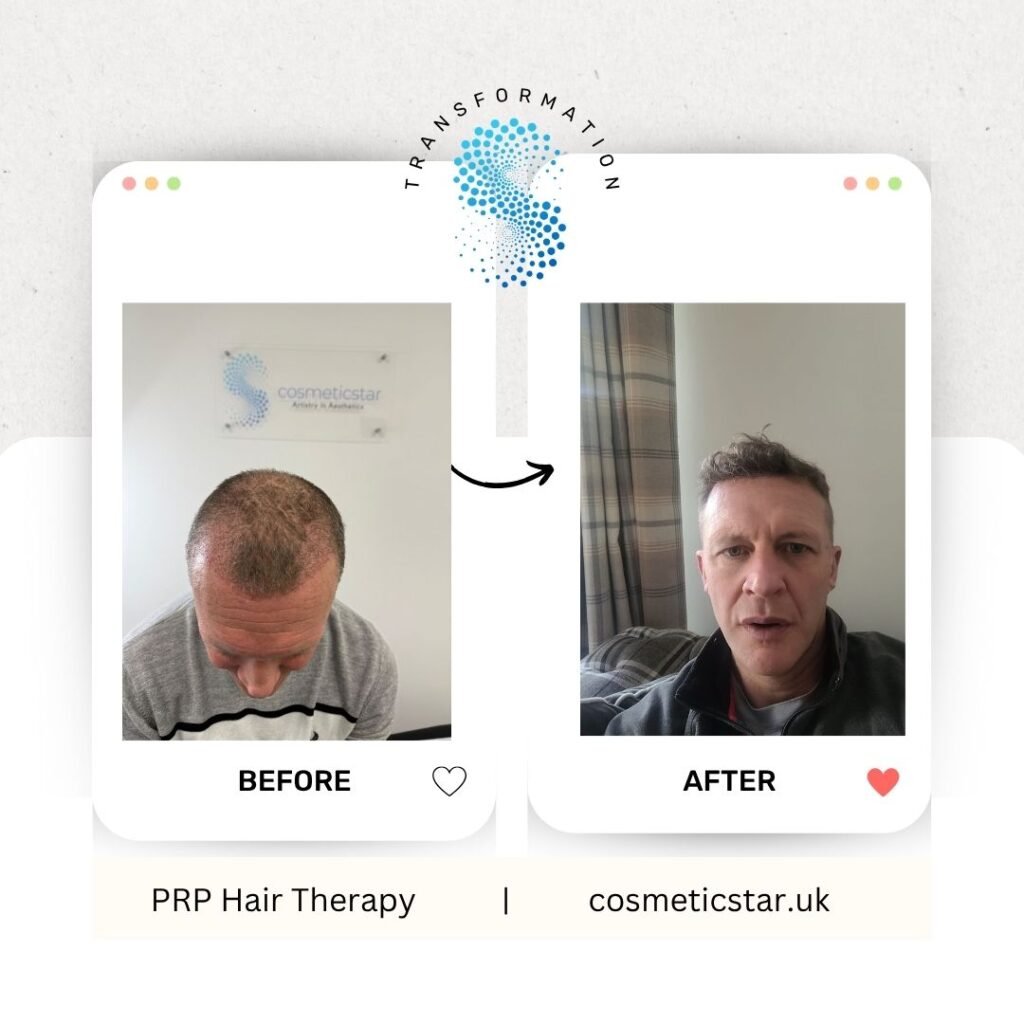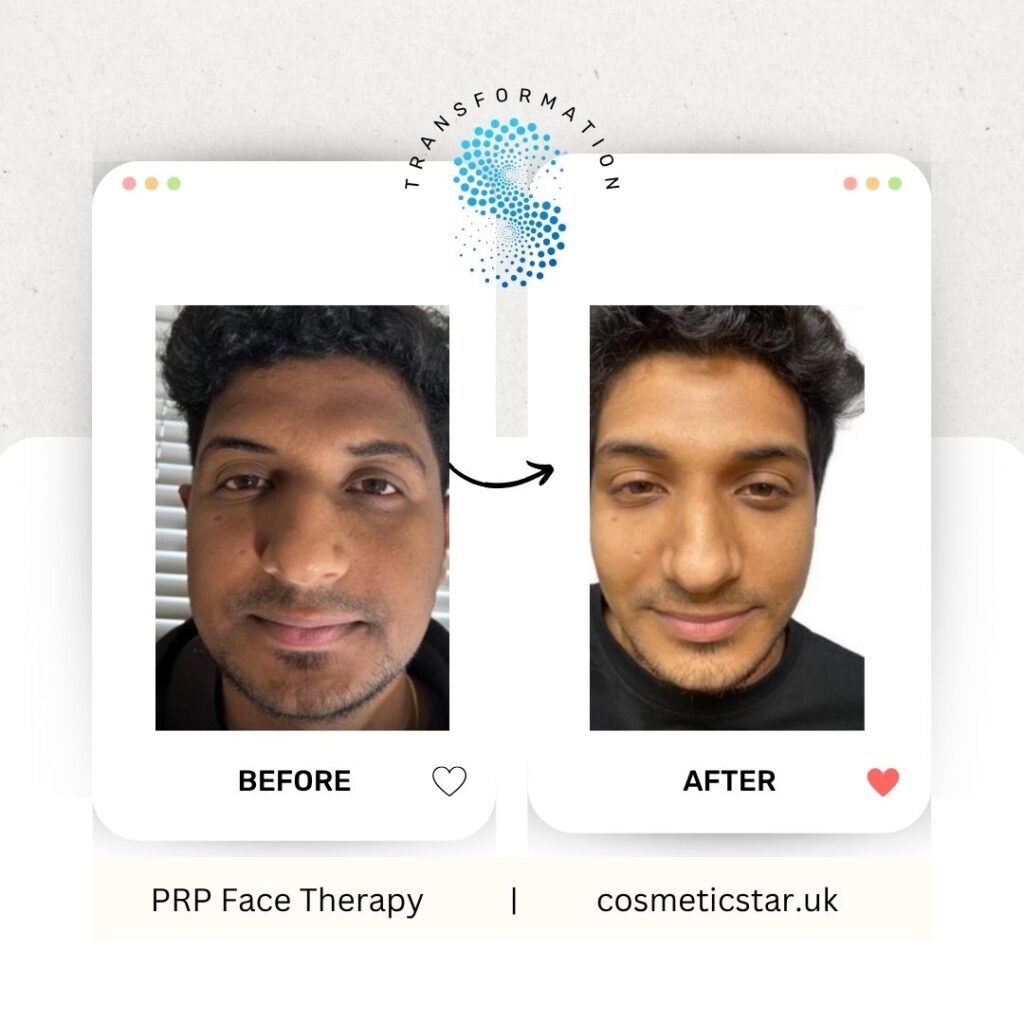

PRP Therapy in Leeds: Hair Restoration & Skin Rejuvenation
Thinning hair and tired-looking skin share the same underlying problem: your cells have stopped regenerating as efficiently as they used to. PRP therapy works by putting your body’s own healing system back to work, using concentrated platelets from your own blood to stimulate repair from within.
At Cosmeticstar in Leeds, we use PRP (Platelet-Rich Plasma) for two purposes: to restore density and thickness to thinning hair, and to rejuvenate tired, dull or ageing skin. Because PRP is derived from your own blood, it is naturally biocompatible, requires no synthetic chemicals, and carries a very low risk of allergic reaction.
What Is PRP Therapy?
PRP (Platelet-Rich Plasma) is a concentrated portion of your own blood that contains 4-8 times the normal concentration of platelets. Platelets are best known for helping blood clot, but they also release growth factors — signalling proteins that instruct surrounding cells to repair, regenerate and multiply. When PRP is reintroduced into the scalp or skin, it triggers this natural repair response exactly where it’s needed.
The Science Behind PRP
When platelets are activated during the PRP process, they release a cocktail of growth factors, including PDGF (Platelet-Derived Growth Factor), VEGF (Vascular Endothelial Growth Factor), and TGF-beta (Transforming Growth Factor). Each plays a distinct role: PDGF stimulates cell division and tissue repair, VEGF encourages new blood vessel formation (improving blood supply to hair follicles), and TGF-beta regulates collagen production in the skin. Together, these signals shift tissue from a resting state into an active repair and regeneration state — which is why PRP is used for both hair follicles and skin cells, despite them being very different tissue types.
On the scalp specifically, research has focused on PRP’s ability to extend the anagen (growth) phase of the hair cycle and shorten the telogen (resting) phase, which is one of the proposed mechanisms behind reduced shedding and improved density after a course of treatment.
Signs You May Benefit From PRP
- Noticeable thinning at the crown, parting, or temples
- More hair than usual left on your pillow, in the shower drain, or on your brush
- A visibly widening parting line
- Skin that looks dull, tired, or has lost some of its bounce and firmness
- Fine lines starting to appear, or skin texture that feels rougher than it used to
- You’ve tried topical products with limited or no visible change
How PRP Therapy Works
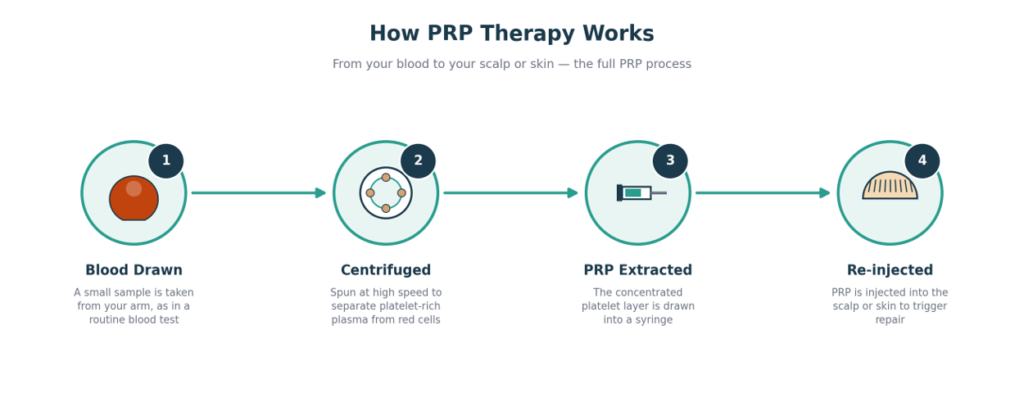
The entire process happens in a single clinic visit, from blood draw to treatment:
A small blood sample — roughly the same amount taken for a standard blood test — is drawn from your arm. It’s placed into a centrifuge, a machine that spins the sample at high speed. This separates the blood into its component layers: red blood cells sink to the bottom, platelet-poor plasma rises to the top, and the platelet-rich plasma forms a concentrated layer in between. Our practitioner extracts this PRP layer and prepares it for injection into the treatment area — either the scalp or the skin, depending on your goals.
PRP for Hair Restoration
Injected into the scalp, PRP targets the hair follicle directly, waking up follicles that have shrunk or gone dormant due to genetic hair loss, stress, or hormonal changes.
01
Stimulates Dormant Follicles
Growth factors signal miniaturised or inactive follicles to re-enter the active growth phase.
02
Increases Hair Density
Regular sessions visibly thicken existing hair and reduce the appearance of thinning patches.
03
Improves Scalp Circulation
PRP encourages blood flow to the scalp, delivering more oxygen and nutrients to each follicle.
04
Slows Further Hair Loss
Strengthening existing follicles helps reduce the rate of ongoing shedding.
05
Works for Men and Women
Suitable for androgenetic alopecia (pattern hair loss), early-stage thinning, and diffuse hair loss.
PRP for Skin Rejuvenation
Applied to the face — often alongside microneedling — PRP is sometimes called the “vampire facial.” It rebuilds skin from the inside out rather than simply resurfacing it.
01
Boosts Collagen & Elastin
Growth factors stimulate fibroblasts, the cells responsible for producing collagen.
02
Improves Skin Texture
Regular treatment smooths roughness and refines enlarged pores over time.
03
Reduces Fine Lines
Increased collagen production gradually softens early signs of ageing.
04
Restores Radiance
Improved cell turnover leaves skin looking brighter and more even-toned.
05
Speeds Healing
PRP is often combined with other skin clinic treatments to accelerate post-procedure recovery.
Who Is PRP Therapy Suitable For?
PRP hair therapy is best suited to patients in the early-to-moderate stages of hair thinning, where follicles are miniaturised but not yet completely inactive. PRP skin therapy suits most skin types and is commonly used for early ageing, dullness, uneven texture, and as an add-on to microneedling. A full medical history is reviewed at consultation, as PRP is not suitable for anyone with certain blood disorders or who is on blood-thinning medication.
The Cosmeticstar PRP Treatment Journey
Your safety, comfort, and satisfaction drive our clinical practice. We maintain a strictly regulated environment, ensuring you receive the highest standard of care.
Every PRP journey starts with an in-depth assessment of your hair or skin concerns, medical history, and expectations. This consultation ensures PRP is the right treatment — and helps us decide whether hair, skin, or a combined treatment plan is best for you.
A small blood sample is taken and processed in the centrifuge, as shown above, to isolate your concentrated platelet-rich plasma.
Using fine needles, PRP is injected at calculated depths and spacing across the treatment area — the scalp for hair, or targeted zones of the face for skin. A topical numbing cream is available for comfort.
Ready to restore density to your hair or radiance to your skin? Contact our Leeds team today to book your PRP consultation.
Treatment Plan & Results Timeline
Most patients begin with a course of 3-4 sessions, spaced around 4-6 weeks apart, followed by maintenance sessions every 4-6 months. Because PRP works with your body’s natural repair cycle, results build gradually rather than overnight:
- Weeks 1-2: Any redness or tenderness settles; no visible change yet — the growth factors are signalling cells at this stage.
- Weeks 3-6: Hair patients often notice reduced shedding; skin patients may notice slightly improved texture.
- Months 2-3: New, finer hairs may become visible at the scalp; skin tone and firmness continue to improve as new collagen forms.
- Months 3-6: Most patients see their fullest results after completing the initial course, with hair density and skin quality both continuing to improve.
- Beyond 6 months: Maintenance sessions every 4-6 months help sustain results long-term.
Safety & Who Should Avoid PRP
PRP is generally very well tolerated because it uses your own blood, but it isn’t suitable for everyone. You may need to avoid or delay PRP if you:
- Have a diagnosed blood or platelet disorder (e.g. thrombocytopenia, clotting disorders)
- Are currently on blood-thinning medication, unless cleared by your GP
- Have an active scalp or skin infection in the treatment area
- Are pregnant or breastfeeding
- Have a history of skin cancer in the treatment area
A full medical history is always reviewed at your consultation before any treatment is agreed.
Pre & Post-Treatment Care
- Stay well hydrated in the 24 hours before your appointment.
- Avoid alcohol and blood-thinning medication (e.g. ibuprofen, aspirin) for 24-48 hours prior, unless medically necessary.
- Avoid washing your hair or applying skincare products for 24 hours after treatment.
- Mild redness, tenderness or swelling at the injection site is normal and typically settles within 24-48 hours.
- Avoid strenuous exercise, saunas and direct sun exposure for 48 hours post-treatment.
PRP Cost in Leeds
Treatment costs depend on whether PRP is used for hair or skin, the number of sessions required, and whether it’s combined with complementary treatments such as GFC or microneedling. During your consultation, we provide a fully transparent cost breakdown tailored to your goals. Please review our full price list on our website for standard procedure rates.
Written & reviewed by Kavya, Lead Aesthetician & Owner, Cosmeticstar Leeds
Frequently Asked Questions
Most patients describe PRP injections as mildly uncomfortable rather than painful. A topical numbing cream is applied beforehand to keep the treatment as comfortable as possible.
Yes. PRP is frequently combined with microneedling for skin, or with GFC and exosome therapy for hair, to enhance overall results.
Most patients begin PRP in their late 20s through to their 50s or beyond, once thinning or ageing signs become noticeable. There's no strict upper age limit — suitability is assessed on your health and scalp/skin condition, not age alone.
Yes. Because PRP works with your body's own healing process rather than adding volume or altering structure, results appear as gradual, natural-looking improvement in density and skin quality rather than a sudden change.
PRP doesn't create permanent new follicles or reverse the underlying cause of hair loss, so results are maintained with ongoing sessions. If you stop entirely, hair and skin gradually return toward their pre-treatment state over time, which is why we recommend periodic maintenance sessions.
Unveil Your Most Beautiful Self.
Before after
Real results