
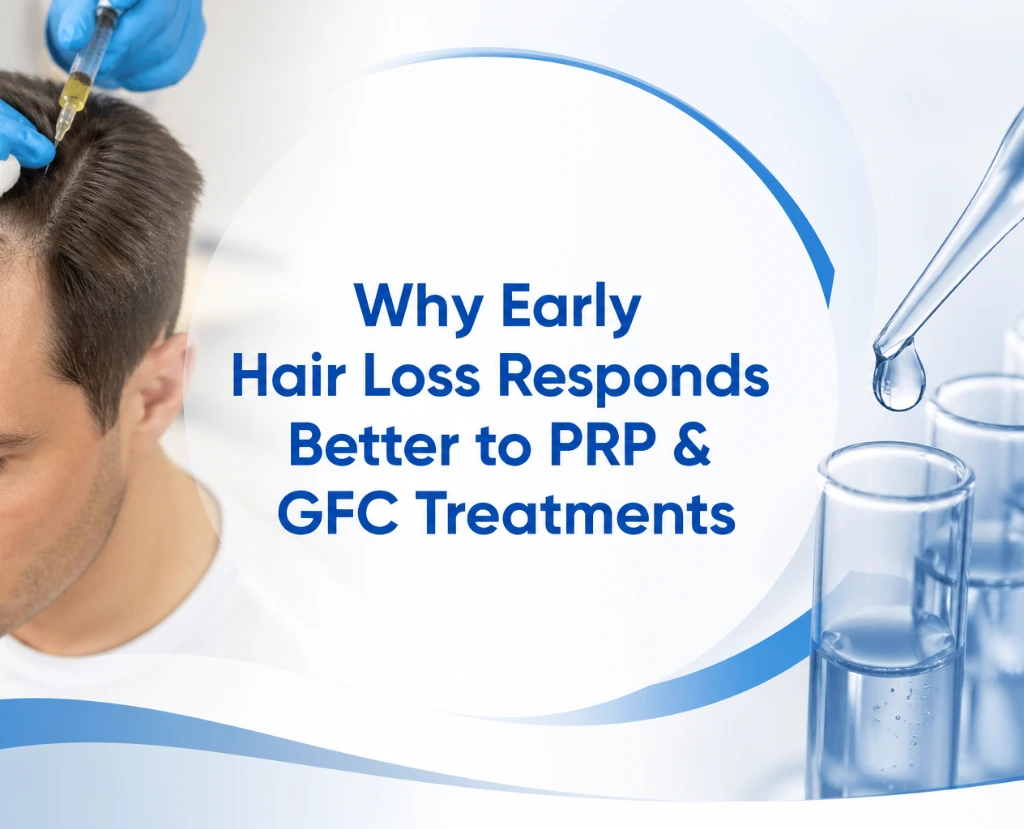
Why Early Hair Loss Responds Better to PRP & GFC Treatments
The most consistent finding across clinical research into PRP and GFC therapy is not which preparation method delivers the highest growth factor concentration — it is when the treatment is applied. Patients who begin treatment at the earliest signs of hair loss achieve significantly better outcomes than those who wait. This blog explains the biological reasons behind that pattern and why early intervention is the single most important decision you can make for your hair.
The Biology of Early vs Late-Stage Hair Loss
Hair follicles do not disappear overnight. The process of hair loss — particularly androgenetic alopecia — unfolds gradually over years. Follicles exposed to dihydrotestosterone (DHT) undergo progressive miniaturisation: each growth cycle produces thinner, shorter, and less pigmented hair, until eventually the follicle ceases activity altogether.
At the early stages of this process, the follicle is not damaged beyond recovery. It is miniaturised — its growth cycle shortened — but it retains its biological machinery and the stem cells required to regenerate. This is the window during which PRP and GFC therapy are most impactful. At later stages, when the follicular structure itself has undergone fibrosis, the capacity for regeneration is severely diminished.
Why PRP in Leeds Is Most Effective Early
PRP therapy works by delivering a concentrated dose of autologous growth factors — derived from the patient’s own blood — directly to the scalp. These growth factors, including PDGF, VEGF, and EGF, bind to receptors on follicular stem cells and trigger a cascade of regenerative activity: increased cellular proliferation, extended anagen phase, improved localised blood supply, and reduced follicular inflammation.
In early-stage hair loss, these signals fall on biologically receptive ground. The follicle’s stem cell population is largely intact, the dermal papilla remains active, and the signalling pathways governing hair growth are functional. PRP in Leeds at this stage can meaningfully reverse miniaturisation, extend the growth cycle, and restore visible hair density.
As hair loss advances, the receptive surface for these growth factor signals diminishes. Fewer active follicular stem cells means a weaker response, regardless of the quality of the PRP preparation. The treatment is not failing — the biological infrastructure it needs to work with has already been lost.
Why GFC Therapy in Leeds Amplifies Early Results
GFC therapy takes the principle of PRP and refines it significantly. By using a more sophisticated centrifugation and preparation process, GFC isolates a higher concentration of specific growth factors — without the red blood cells, white blood cells, and inflammatory mediators present in standard PRP. The result is a cleaner, more potent biological signal delivered directly to the follicle.
For patients in the early stages of hair loss, GFC in Leeds offers the opportunity to achieve more substantial results in fewer sessions. Because the follicles are still biologically active and receptive, the amplified growth factor signal from GFC can produce faster and more pronounced improvements in density, scalp health, and hair calibre compared to standard PRP alone.
Patients who begin GFC treatment at Norwood Stage II or Ludwig Grade I often report visible differences within six to eight weeks of their first session — a timeline that reflects both the potency of the treatment and the receptivity of follicles that have not yet undergone significant structural damage.
The Clinical Cost of Waiting
Delaying treatment is one of the most common and costly decisions patients make in the context of hair loss. Many individuals notice early changes — a widening parting, more hair on the brush, a receding temple — and attribute them to stress, seasonal shedding, or a temporary phase. By the time they seek professional assessment, months or years may have passed and the hair loss may have progressed to a stage where the range of effective non-surgical options has narrowed.
At Cosmeticstar in Leeds, we regularly see patients who wish they had acted sooner. The biological reality is straightforward: every month of untreated hair loss is a month during which follicles are continuing to miniaturise. Reversing that trajectory becomes progressively more challenging as time passes.
Non-surgical Treatment Options at Cosmeticstar, Leeds
PRP Hair Treatment
Clinically supported growth factor therapy using your own blood — most effective when started early. Learn about PRP Hair Treatment in Leeds.
GFC Hair Therapy
A more concentrated, refined alternative to PRP — ideal for patients seeking stronger early-stage results. Explore GFC Hair Therapy in Leeds.
Exosome Therapy
Cutting-edge regenerative therapy delivering stem-cell-derived signals to reactivate and support follicular activity. Discover Exosome Therapy in Leeds.
IV Drip Therapy
Intravenous nutrient delivery to optimise the internal environment supporting healthy hair growth. View our IV Drip Therapy in Leeds.
Vitamin Injections
Targeted correction of nutritional deficiencies that may be compounding early hair loss. Learn about our Vitamin Injections in Leeds.
Prevention and Maintenance
- Seek a professional hair assessment at the first sign of thinning — do not wait for visible scalp.
- Photograph your hair monthly to track changes — early progression is easy to miss without comparison.
- Address nutritional and hormonal contributing factors alongside scalp treatment from the outset.
- Maintain results with periodic sessions once primary treatment goals are achieved.
Act Early — Speak to Cosmeticstar in Leeds
If you have noticed changes in your hair density, parting width, or hairline — even subtle ones — the most valuable step you can take is a professional clinical assessment. At Cosmeticstar, we assess your hair loss thoroughly and recommend a treatment plan tailored to your current stage and goals. Chat now — click the link and you will be redirected straight to WhatsApp.
Conclusion
The evidence is clear: PRP and GFC therapy in Leeds work best when applied early. The biology of hair loss means that every stage of progression narrows the window of optimal responsiveness. If you are in the early stages of hair loss, now is the most effective time to seek treatment. Cosmeticstar in Leeds is ready to help you act at the right time — with the right treatment.
Privacy Notice: Your data is handled in accordance with UK GDPR. Please review our Privacy Policy for full details.
Disclaimer: This blog is for educational purposes only. Always consult a qualified professional before beginning any treatment.
Frequently Asked Questions
Q: What counts as ‘early’ hair loss for PRP or GFC treatment?
A: Early-stage hair loss generally refers to Norwood Stage I–III in men or Ludwig Grade I in women, where follicles are miniaturised but still biologically active.
Q: Can GFC reverse hair loss that has been progressing for two or three years?
A: It depends on the degree of follicular miniaturisation — a clinical assessment will determine how much regenerative potential remains and what outcomes are realistic.
Q: How quickly does PRP work at the early stages?
A: Many patients at early stages notice reduced shedding within four to six weeks and visible density improvements within three to four months.
Q: Is it safe to start PRP or GFC treatment in my twenties?
A: Yes — both treatments are safe and well-tolerated at any adult age, and starting early often produces the most impressive long-term outcomes.