
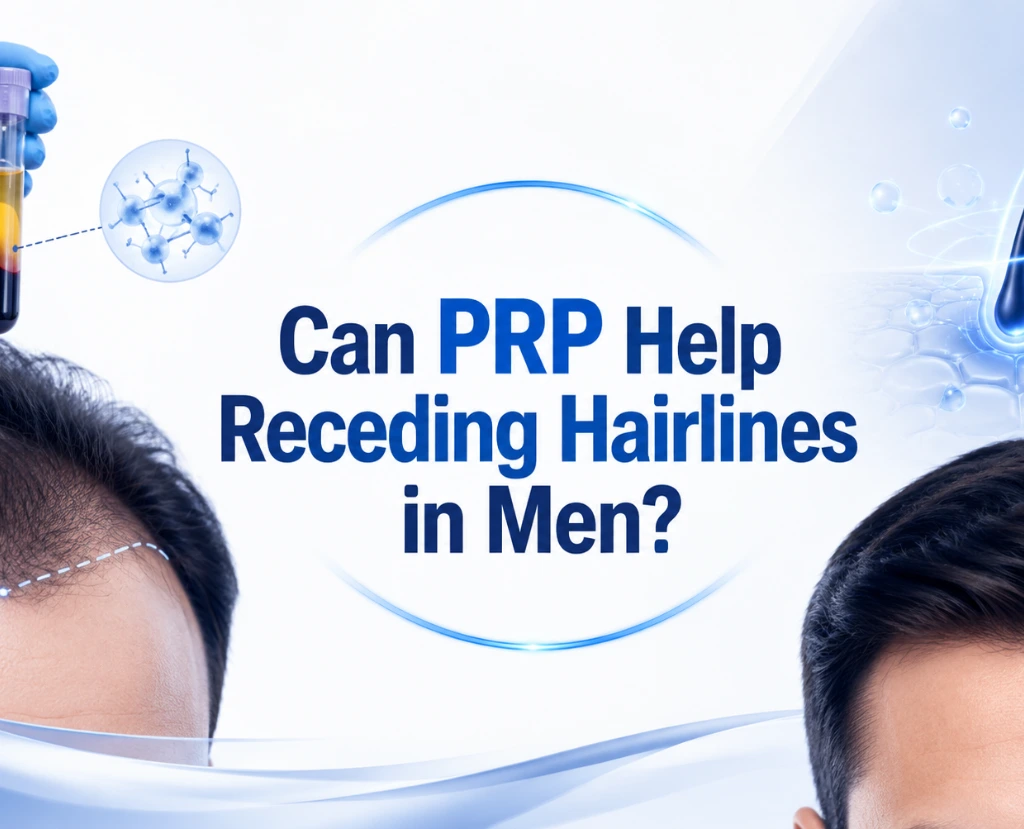
Can PRP Help Receding Hairlines in Men?
A receding hairline is one of the earliest and most visible signs of male pattern hair loss — and for many men, it is the point at which hair loss shifts from a background concern to something that genuinely affects confidence and self-perception. The question most men ask at this stage is a straightforward one: is there anything that can actually help?
The answer, in many cases, is yes. PRP hair treatment in Leeds has emerged as one of the most clinically credible non-surgical options for men experiencing hairline recession — and at Cosmeticstar in Leeds, it is one of the most requested treatments we provide. This blog explains how PRP works for receding hairlines, what realistic expectations look like, and when it is most likely to succeed.
Why Do Hairlines Recede in Men?
The majority of male hairline recession is driven by androgenetic alopecia — a hereditary condition involving sensitivity to dihydrotestosterone (DHT), a hormone derived from testosterone. When DHT binds to susceptible follicles at the temples and frontal hairline, it progressively miniaturises them: each successive hair growth cycle produces a finer, shorter strand until the follicle eventually stops producing visible hair altogether.
The temples and hairline are typically the first areas to be affected because follicles in these regions tend to carry the greatest DHT sensitivity. Progression follows the Norwood Scale, with Stages 1 to 3 representing the period during which non-surgical intervention is most effective — and most clinically justified.
How PRP Works on a Receding Hairline
PRP (Platelet-Rich Plasma) therapy works by delivering a concentrated volume of growth factors — derived from the patient’s own blood — directly into the follicular layer of the scalp at the hairline. The key growth factors involved, including PDGF, VEGF, IGF-1, and EGF, interact with follicular tissue in several clinically meaningful ways:
- They stimulate dermal papilla cells — the cells responsible for regulating the hair growth cycle — to become more active
- They improve vascularisation of the follicle, ensuring a richer nutrient and oxygen supply to the hairline area
- They extend the anagen (growth) phase, meaning each follicle spends more time actively producing hair
- They counteract some of the miniaturising effects of DHT at the follicular level
The result, in suitable candidates, is a gradual improvement in hairline density, a reduction in shedding at the temples, and in some cases a measurable recovery of the hairline over a course of treatment sessions.
What Results Can Men Realistically Expect?
PRP for receding hairlines is most effective when treatment begins at Norwood Stages 1 to 3 — before extensive follicular miniaturisation has occurred. At these stages, follicles at the hairline are still biologically active and capable of responding to growth factor stimulation. Patients in this range typically report reduced shedding within the first two to three months, followed by visible improvements in density and hairline definition between months three and six.
At Stages 4 and beyond, PRP can still deliver meaningful benefits — particularly in slowing the rate of recession and improving the quality of remaining hair — but the expectation of full hairline restoration is less realistic. A thorough clinical assessment at Cosmeticstar in Leeds will establish where you sit on the scale and what level of improvement is achievable in your specific case.
Treatment Options at Cosmeticstar, Leeds
PRP Hair Treatment
PRP is the established first-line non-surgical treatment for hairline recession in men — delivering autologous growth factors directly to miniaturised follicles at the temples and frontal scalp. Learn about PRP Hair Treatment in Leeds.
GFC Hair Therapy
For men whose hairline recession is progressing at a faster rate, or who want stronger results from fewer sessions, GFC therapy delivers a more concentrated growth factor stimulus than standard PRP. Explore GFC Hair Therapy in Leeds.
Exosome Therapy
Exosome Therapy can be combined with PRP or GFC to amplify the regenerative signal at the hairline — particularly valuable for men at moderate stages of recession. Discover Exosome Therapy in Leeds.
IV Drip Therapy & Vitamin Injections
Optimal internal nutrition supports follicular responsiveness. Our IV Drip Therapy and Vitamin Injections in Leeds are regularly combined with PRP and GFC to maximise treatment outcomes for male patients.
Key Considerations Before Starting PRP for Hairline Recession
- Earlier intervention consistently delivers better results — do not delay once recession becomes noticeable
- A minimum course of three to four sessions is typically required to assess full responsiveness
- PRP slows and reverses early recession — it does not regenerate follicles that have been permanently inactive for many years
- Maintenance sessions every six to twelve months are recommended to sustain results
Book a Consultation at Cosmeticstar, Leeds
If you are concerned about a receding hairline and want to understand your options honestly, Cosmeticstar in Leeds offers thorough clinical assessments that identify exactly what is treatable and the most effective approach for your hair loss pattern. Chat now — click the link and you will be redirected straight to WhatsApp.
Conclusion
For men in the early-to-moderate stages of hairline recession, PRP hair treatment in Leeds is a clinically credible, non-surgical option that can deliver measurable results. Acting before significant miniaturisation has occurred significantly improves the outcome. Cosmeticstar in Leeds combines thorough clinical assessment with advanced regenerative treatments to give men the best possible chance of retaining and restoring their hairline.
Privacy Notice: Your data is handled in accordance with UK GDPR. Please review our Privacy Policy for full details.
Disclaimer: This blog is for educational purposes only. Always consult a qualified professional before beginning any treatment.
Frequently Asked Questions
Q: Can PRP fully restore a receded hairline?
A: In early stages, PRP can produce meaningful hairline recovery. In advanced cases, it is more effective at slowing progression and improving existing density rather than full restoration.
Q: How many PRP sessions are needed for a receding hairline?
A: Most men complete an initial course of three to four sessions, spaced four to six weeks apart, before assessing results and planning maintenance.
Q: Is GFC more effective than PRP for hairline recession?
A: GFC delivers a more concentrated growth factor dose and tends to produce stronger results — particularly for men with faster-progressing recession or a limited response to standard PRP.
Q: At what age is PRP most effective for receding hairlines?
A: PRP can work at any adult age — but younger men with early-stage recession typically experience the strongest results due to higher follicular activity levels.