
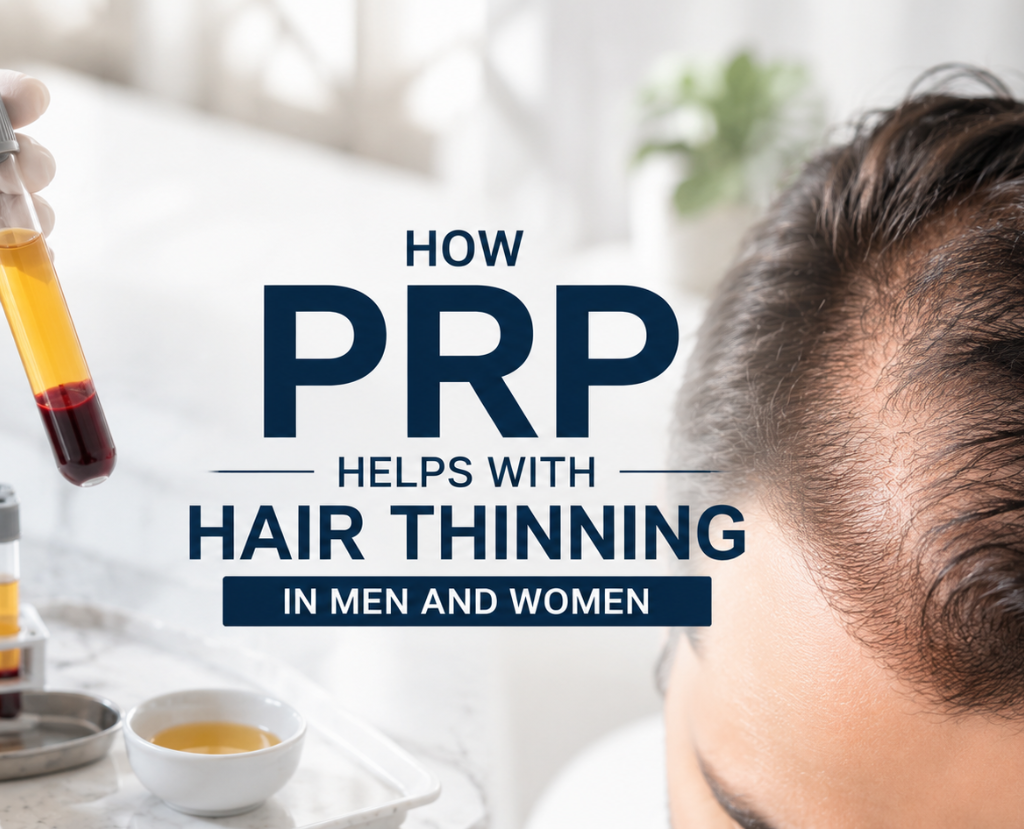
How PRP Helps With Hair Thinning in Men and Women
If you have started noticing more hair on your pillow in the morning, a slightly wider parting, or temples that do not look quite the same as they used to — you are not alone. Hair thinning is something millions of people across the UK deal with quietly, often for months or even years before they feel ready to do something about it. And when they do start looking into their options, PRP hair treatment in Leeds tends to come up fairly quickly.
At Cosmeticstar in Leeds, we see both men and women for PRP treatment every week. Some arrive having already done a lot of research; others are not entirely sure what PRP involves but have heard it works. Either way, this blog is designed to give you a straightforward, honest explanation of how PRP actually helps with hair thinning — the biology behind it, what the treatment process looks like, and what you can realistically expect from it.
First — Why Does Hair Thin in the First Place?
Hair thinning does not happen overnight, even if it feels that way. The most common driver in both men and women is androgenetic alopecia — a hereditary sensitivity to a hormone called DHT (dihydrotestosterone), which gradually shrinks hair follicles over successive growth cycles. Each cycle, the hair produced gets a little finer and a little shorter, until eventually the follicle stops producing visible hair altogether.
But genetics is not the only factor. Hormonal fluctuations — particularly around pregnancy, the postnatal period, or the menopause — can trigger significant shedding in women. Nutritional deficiencies, particularly low ferritin (the stored form of iron), vitamin D, and biotin, can slow follicular function considerably. Chronic stress can push large numbers of follicles into a premature resting phase simultaneously, causing sudden and often alarming shedding known as telogen effluvium.
So — What Is PRP Hair Treatment and How Does It Help?
PRP stands for Platelet-Rich Plasma. Despite the clinical-sounding name, the concept is genuinely straightforward: a small amount of your own blood is drawn, processed in a centrifuge to concentrate the platelet fraction, and the resulting plasma — now rich in growth factors — is injected into the scalp in the areas where thinning is occurring.
Why does that help? Because platelets are not just clotting agents — they carry a concentrated payload of proteins called growth factors, which the body uses to signal and drive cellular repair and regeneration. The key ones relevant to hair regrowth include PDGF (Platelet-Derived Growth Factor), which stimulates the specialised cells at the base of each follicle; VEGF (Vascular Endothelial Growth Factor), which improves blood supply to the scalp; IGF-1 (Insulin-Like Growth Factor), which prolongs the active growth phase of the hair cycle; and EGF (Epidermal Growth Factor), which supports the structural health of the follicle and surrounding tissue.
When these proteins are delivered in concentrated form directly to miniaturised follicles, they essentially interrupt the thinning process and create the biological conditions for healthier, fuller hair regrowth. PRP for hair thinning in Leeds at Cosmeticstar is delivered with a precise injection protocol mapped to the specific thinning pattern of each individual patient — not a generic scatter approach.
How PRP Helps Men With Hair Thinning
For men, hair thinning usually follows a fairly recognisable path — temples starting to pull back, a thinning patch at the crown, or a general reduction in the density that was once there. This is androgenetic alopecia progressing through the Norwood Scale, and it affects a significant proportion of men before they reach their forties.
The reason PRP is effective here is that it directly targets the follicles that DHT is working to miniaturise. The growth factors in PRP stimulate the dermal papilla cells — the tiny control centres at the base of each follicle — to become more active, extend the hair’s growth phase, and produce a thicker, stronger strand. The VEGF component improves blood circulation in the scalp, which is often reduced in areas of thinning and is one of the reasons those follicles have become weaker.
PRP hair treatment in Leeds works most effectively for men at Norwood Stages 1 to 4 — before the follicles have been dormant for an extended period. At these stages, most men notice reduced shedding within the first few sessions and visible improvements in density within three to five months of beginning a full treatment course at Cosmeticstar.
How PRP Helps Women With Hair Thinning
Female hair thinning tends to be more diffuse than the male pattern — rather than a receding hairline, women more commonly experience an overall reduction in density across the crown and top of the scalp, with the parting becoming noticeably wider. It is often subtler to start with, which is partly why many women dismiss it for longer than they should.
PRP hair treatment in Leeds is genuinely well-suited to this diffuse pattern because it stimulates follicles across the treated area rather than targeting a single zone. Women who come to Cosmeticstar for PRP are often pleasantly surprised by how quickly they notice a change in their day-to-day shedding rate — most report that the shower drain and the hairbrush are telling a noticeably different story within six to eight weeks of starting treatment.
PRP is also appropriate for women whose thinning is linked to postpartum hormonal shifts, thyroid changes, or the perimenopause — provided a proper clinical assessment is done first to understand the full picture before treatment begins.
What the Treatment Process Actually Looks Like
- A small blood sample — roughly the same amount as a standard blood test — is drawn at the start of each session
- The sample is placed in a centrifuge for around ten minutes, which separates and concentrates the platelet fraction
- The resulting PRP is drawn up and injected into the scalp using a fine needle at the precise depth and spacing needed for the thinning zones
- The full session takes approximately 45 to 60 minutes — most patients read emails or listen to music throughout
- There is no general anaesthetic, no surgical incision, and no recovery time — most patients return to work the same day
- An initial increase in shedding may occur in the first few weeks — this is a recognised part of the follicular reset process and not a cause for concern
Treatment Options at Cosmeticstar, Leeds
PRP Hair Treatment
PRP hair treatment in Leeds at Cosmeticstar is tailored to each patient’s thinning pattern and delivered with a clinical precision that makes a genuine difference to outcomes. Learn more about PRP Hair Treatment in Leeds.
GFC Hair Therapy
For patients whose thinning is more significant or progressing at a quicker rate, GFC hair therapy in Leeds takes the growth factor approach further — delivering a more concentrated, more refined preparation with a lower inflammatory response than standard PRP. It is the stronger option and increasingly the first choice for patients who want to give their hair the best possible chance. Explore GFC Hair Therapy in Leeds.
Exosome Therapy
Exosome Therapy works at the cellular communication level — carrying regenerative signals from stem cells directly to follicular tissue. It can be combined with PRP or GFC to deepen and extend the treatment response. Discover Exosome Therapy in Leeds.
Ready to Do Something About It?
If hair thinning has been on your mind for a while, the best thing you can do is get a proper assessment — not a generic consultation, but one that actually looks at your specific pattern, asks the right questions, and gives you honest guidance. That is exactly what we offer at Cosmeticstar in Leeds. Chat now — click the link and you will be redirected straight to WhatsApp, where our team is ready to help.
Conclusion
PRP hair treatment in Leeds is not a miracle cure — but for the right patient at the right stage, it is a genuinely effective, science-backed, non-surgical way to address hair thinning before it progresses further. The earlier you act, the more you have to work with. Cosmeticstar in Leeds delivers PRP with the clinical precision and personalised care that gives patients the best possible chance of real, lasting improvement.
Privacy Notice: Your data is handled in accordance with UK GDPR. Please review our Privacy Policy for full details.
Disclaimer: This blog is for educational purposes only. Always consult a qualified professional before beginning any treatment.
Frequently Asked Questions
Q: How many PRP sessions are needed for hair thinning?
A: Most patients complete an initial course of three to four PRP sessions in Leeds, spaced four to six weeks apart. Results continue to develop for several months after the final session in the course.
Q: Does PRP hurt?
A: Most patients describe it as mild to moderate discomfort — similar to a series of small pinprick sensations. A topical numbing cream can be applied beforehand if needed. It is a well-tolerated treatment for the vast majority of patients.
Q: How soon will I see results from PRP hair treatment in Leeds?
A: A noticeable reduction in daily shedding is usually the first sign — most patients notice this within six to eight weeks. Visible improvements in density and hair quality tend to become apparent between months three and five.
Q: Is PRP or GFC better for hair thinning?
A: Both are effective, but GFC hair therapy in Leeds delivers a more concentrated growth factor preparation and typically produces stronger results — particularly for patients with more pronounced or faster-progressing thinning.
Q: Can PRP be combined with other hair thinning treatments?
A: Yes — and at Cosmeticstar it frequently is. PRP works well alongside GFC, Exosome Therapy, IV Drip Therapy, and Vitamin Injections as part of a wider, personalised plan.