
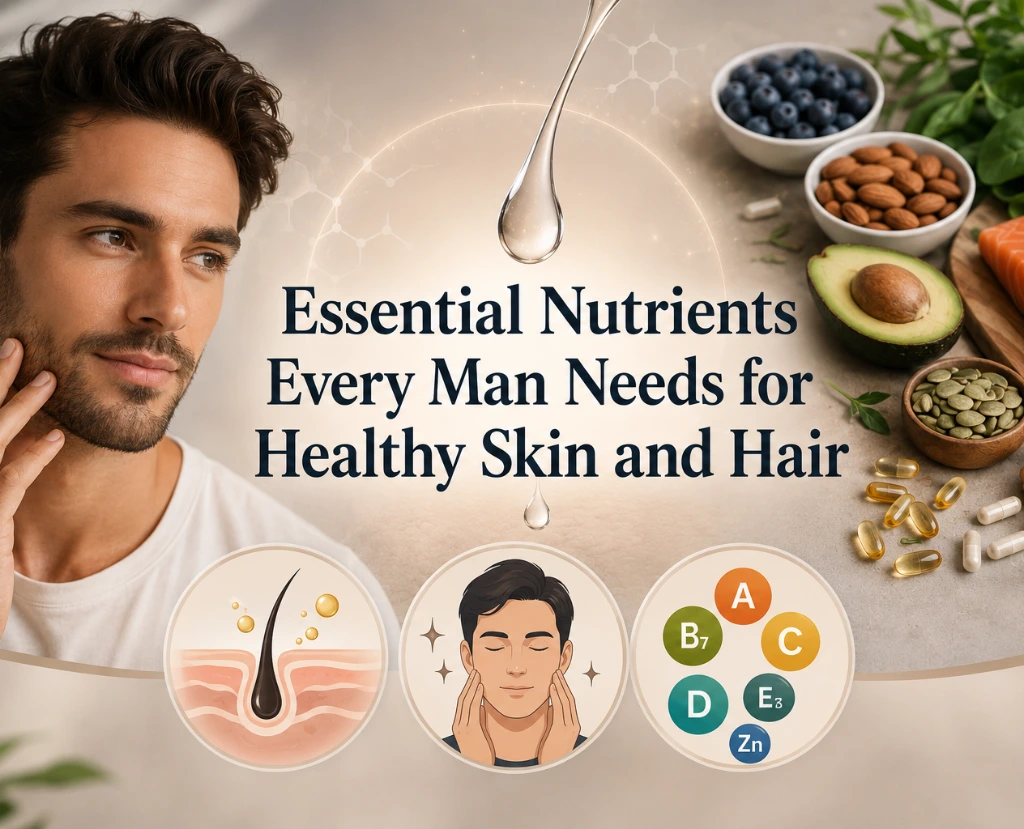
Essential Nutrients Every Man Needs for Healthy Skin and Hair
Men’s skin and hair health tends to be underserved by the wellness conversation — most of the nutritional advice targeted at hair and skin is aimed at women. But the biological requirements are not as different as the marketing suggests. Men’s follicles need the same core nutrients to sustain healthy growth cycles; men’s skin depends on the same vitamins and proteins to maintain its barrier function, resilience, and appearance.
What is different is the specific risks and deficiency patterns that affect men — shaped by diet, training habits, stress, and hormonal profile. This blog covers the essential nutrients that matter for men’s skin and hair, and the most effective ways to ensure adequate levels.
The Nutritional Foundations of Men’s Skin and Hair
The British Association of Dermatologists’ patient information resources reflect the growing clinical recognition that skin health — and by extension hair health — is deeply influenced by the nutritional environment. Men who eat a varied, nutrient-dense diet and maintain good gut health generally have better skin and hair outcomes than those who do not. The challenge is that ‘varied’ diet does not always mean nutritionally sufficient — and modern lifestyles, high training volumes, and chronic stress can create deficiencies even in men who eat reasonably well.
The Essential Nutrients
Protein — The Foundation of Everything
Hair is made almost entirely of keratin, which is a protein. Skin cells also depend on protein for their structural integrity and their ability to renew efficiently. Men who train intensively, follow calorie-restricted diets, or eat predominantly processed food may be consuming insufficient protein for optimal hair and skin function — even if their overall calorie intake seems adequate. A minimum of 1.2 grams of protein per kilogram of body weight per day is a reasonable starting point for men who want to maintain hair and skin health alongside an active lifestyle.
Vitamin D
Vitamin D is essential for both hair follicle cycling and skin cell regulation. For men, low vitamin D is associated with hair shedding, scalp inflammation, impaired skin barrier function, and reduced immune activity in the skin — making it more susceptible to conditions like seborrhoeic dermatitis. The UK’s limited sun exposure for much of the year means supplementation or injection is essentially necessary for maintaining adequate levels through autumn and winter.
Zinc
Zinc is involved in over 300 enzymatic processes in the body and has a particularly prominent role in both hair and skin health. For hair, it supports the growth cycle, modulates DHT activity, and maintains the structural integrity of the follicle. For skin, it is essential for wound healing, sebum regulation, and reducing inflammation — which is why zinc deficiency is frequently associated with acne, slow healing, and a dull, uneven complexion in men. Intensive exercise, alcohol, and stress are among the most common causes of zinc depletion.
Vitamin B Complex
The B vitamins collectively support the metabolic processes that underpin healthy cell production — including the rapidly dividing cells of the hair follicle and skin. Biotin (B7) supports keratin synthesis and is the most directly relevant for hair shaft strength. Niacin (B3) improves skin barrier function and supports even skin tone. B12 drives red blood cell production and nutrient delivery to follicular tissue. Pantothenic acid (B5) supports moisture retention in the skin. Together, the B vitamins form an important nutritional layer for men’s hair and skin quality.
Vitamin C
Collagen — the structural protein that keeps skin firm and resilient — cannot be produced without vitamin C as a co-factor. For men, vitamin C is also important as an antioxidant that neutralises the oxidative stress generated by exercise, environmental exposure, and high cortisol levels. It also significantly enhances iron absorption — making it a useful companion to any iron supplementation protocol. A consistently low vitamin C intake is one of the most overlooked contributors to slow skin ageing in men.
Omega-3 Fatty Acids
Omega-3s reduce systemic inflammation — which has downstream benefits for both hair follicles (where inflammation contributes to miniaturisation) and skin (where chronic inflammation drives ageing, redness, and barrier disruption). Men who do not eat oily fish at least twice a week and do not supplement omega-3s are frequently deficient. The effects are subtle but cumulative — and tend to become more apparent as men age.
Iron and Ferritin
In men who train intensively, follow plant-based diets, or have gut conditions affecting absorption, ferritin can fall to levels that impair hair follicle function. Adequate ferritin ensures that follicles have the stored iron they need to sustain the active growth phase. Without it, hair becomes thinner and more fragile over successive cycles.
Treatment Options at Cosmeticstar, Leeds
Vitamin Injections
For men with identified deficiencies, our Vitamin Injections in Leeds deliver B12, vitamin D, zinc, and biotin directly into the muscle for complete, rapid absorption.
IV Drip Therapy
Our IV Drip Therapy in Leeds provides a comprehensive intravenous nutritional delivery tailored to each patient — the most effective approach when multiple deficiencies are present simultaneously.
PRP Hair Treatment
Nutritional support from within, combined with direct follicular stimulation through PRP Hair Treatment in Leeds, produces significantly better hair outcomes than either approach alone.
GFC Hair Therapy
For men with more pronounced or progressing hair thinning, GFC Hair Therapy in Leeds delivers the most advanced growth factor treatment available — working alongside nutritional correction to restore healthy hair growth.
Simple Habits That Make a Real Difference
- Eat enough protein — at least 1.2g per kilogram of body weight daily if you are active
- Test your vitamin D, B12, zinc, and ferritin levels at least once a year
- Supplement vitamin D consistently through autumn and winter
- Reduce alcohol intake — it depletes zinc and B vitamins faster than most men realise
- Manage stress with structure — chronic cortisol elevation depletes zinc, damages skin collagen, and impairs follicular function
Book at Cosmeticstar, Leeds
For men who want a comprehensive assessment of their hair and skin health — and a treatment plan that addresses both the internal and clinical picture — Cosmeticstar in Leeds is the place to start. Chat now — click the link and you will be redirected straight to WhatsApp.
Conclusion
The nutrients essential for men’s hair and skin health are well understood — the challenge is making sure your body actually has them in sufficient quantities. Cosmeticstar in Leeds helps men get the full picture, correct what is missing, and combine nutritional support with clinical treatments that produce real, lasting results.
Privacy Notice: Your data is handled in accordance with UK GDPR. Please review our Privacy Policy for full details.
Disclaimer: This blog is for educational purposes only. Always consult a qualified professional before beginning any treatment.
Frequently Asked Questions
Q: What is the most important nutrient for men’s hair health?
A: Zinc and vitamin D are the most clinically significant nutritional factors for men’s hair growth and scalp health — but protein adequacy is the often-overlooked foundation that supports everything else.
Q: Can poor skin and hair be caused by the same nutritional gaps?
A: Yes — deficiencies in zinc, vitamin D, B vitamins, and vitamin C commonly affect both skin and hair simultaneously, since both structures depend on the same underlying nutritional processes.
Q: Are IV vitamins suitable for men?
A: Yes — IV drip therapy at Cosmeticstar in Leeds is equally appropriate for men and women. It is particularly valuable for men with multiple deficiencies or those who have not responded adequately to oral supplementation.
Q: Can I combine vitamin therapy with PRP for better hair results?
A: Yes — and at Cosmeticstar in Leeds we actively recommend this combination. Nutritional optimisation enhances the follicular environment in which PRP and GFC treatment deliver their results.