
GFC vs PRP: What’s the Actual Difference
This is probably the question we get asked most at Cosmeticstar in Leeds — and it is completely understandable. Both GFC and PRP use your own blood. Both involve scalp injections. Both stimulate hair growth through growth factors. So what actually separates them, and does the difference matter enough to be clinically relevant?
The honest answer is yes — and the difference is more meaningful than most clinics explain. This blog breaks it down properly, without the marketing language.
Starting Point: What They Have in Common
PRP (Platelet-Rich Plasma) and GFC (Growth Factor Concentrate) both begin with the same starting material: the patient’s own blood. Both treatments use centrifugation to process that blood and concentrate the platelet fraction. Both deliver growth factors to the scalp via injection with the aim of stimulating follicular activity, extending the hair growth phase, and improving scalp circulation. And both are non-surgical, minimally invasive, and have an excellent safety profile because they use the patient’s own biological material.
Up to this point, the two treatments are essentially the same. The difference lies entirely in what happens during the preparation process — and the downstream clinical consequences of that difference.
Where PRP and GFC Diverge: The Preparation
Standard PRP preparation concentrates the platelet-rich plasma from whole blood — which means the final product contains not just platelets and their associated growth factors, but also a proportion of leukocytes (white blood cells). These leukocytes are part of the body’s natural healing response and have their own role in tissue repair. But when injected into the scalp, they also introduce an inflammatory component that can reduce the precision of the treatment and cause post-injection scalp sensitivity, redness, and swelling in some patients.
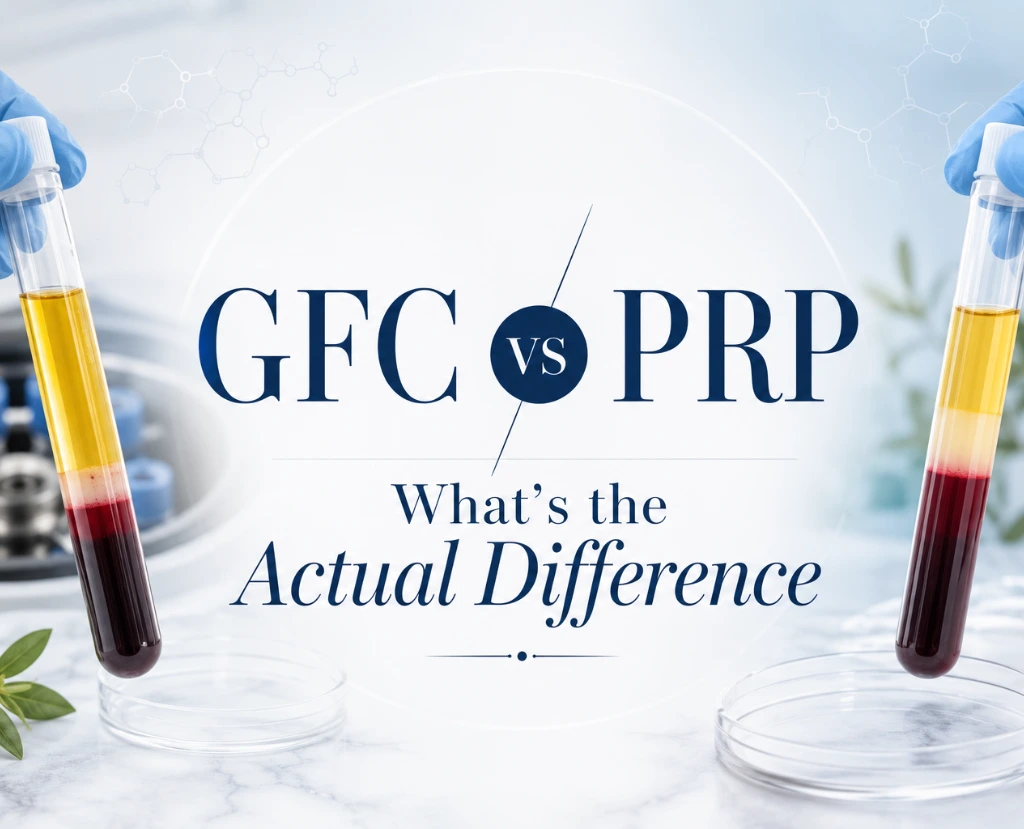
GFC uses a more selective preparation protocol that isolates specifically the growth factor payload — PDGF, VEGF, IGF-1, EGF, and TGF-β — at concentrations significantly higher than standard PRP can achieve, whilst removing the leukocyte component.
The Three Practical Differences That Matter to Patients
1. Potency
GFC delivers growth factors at a measurably higher concentration than standard PRP. This means each session of GFC hair therapy in Leeds provides a stronger regenerative signal to follicular cells — encouraging a more pronounced and more consistent response. For patients who have tried PRP elsewhere without achieving the results they were looking for, this increased potency is often the missing variable.
2. Tolerability
Because GFC removes the inflammatory leukocyte component, it produces a significantly lower post-treatment inflammatory response than standard PRP. In practice, this means less scalp redness, less post-treatment sensitivity, and in the days following treatment, a more comfortable experience. For patients who have had a difficult time tolerating PRP sessions, GFC is almost always better tolerated.
3. Consistency of Results
The cleaner, more targeted preparation of GFC produces more consistent and predictable results across patient groups — including those with scalp sensitivity, those at moderate stages of hair loss, and those with skin types that tend to be more reactive to inflammatory stimuli. Standard PRP results can be more variable between patients, partly because the inflammatory component introduces an element of unpredictability in the follicular response.
So Which Should You Choose?
If you are deciding between GFC and PRP hair treatment in Leeds at Cosmeticstar, the honest clinical recommendation is:
- GFC is the stronger option for most patients — particularly those at moderate stages of hair loss, those who have had limited PRP results, and those with scalp sensitivity
- PRP remains an excellent, well-evidenced first-line treatment — particularly for patients at the earliest stages of hair loss or those combining both treatments for a comprehensive approach
- Some patients benefit most from a combined approach — using both across an extended treatment course for a compounding effect
The right choice depends on your specific hair loss pattern, scalp condition, and what you have tried before — which is exactly what a proper clinical consultation at Cosmeticstar in Leeds is designed to establish.
Treatment Options at Cosmeticstar, Leeds
GFC Hair Therapy
The more potent, more targeted, and more consistently effective evolution of PRP — our most advanced growth factor hair treatment in Leeds. Explore GFC Hair Therapy in Leeds.
PRP Hair Treatment
A well-evidenced, trusted foundation treatment and excellent complement to GFC in a combined hair restoration approach. Learn about PRP Hair Treatment in Leeds.
Exosome Therapy
The most advanced regenerative option available — Exosome Therapy in Leeds works at the cellular signalling level and can be combined with GFC for the deepest and most sustained follicular response.
Find Out Which Is Right for You
A proper clinical assessment at Cosmeticstar in Leeds gives you a definitive answer based on your hair loss stage, scalp condition, and what you have tried before. Chat now — click the link and you will be redirected straight to WhatsApp.
Conclusion
GFC and PRP are not interchangeable. They share the same starting material and the same fundamental mechanism, but GFC’s more advanced preparation produces a more potent, better-tolerated, and more consistently effective treatment. Cosmeticstar in Leeds offers both — and will help you choose the one that gives your hair the best possible chance.
Privacy Notice: Your data is handled in accordance with UK GDPR. Please review our Privacy Policy for full details.
Disclaimer: This blog is for educational purposes only. Always consult a qualified professional before beginning any treatment.
Frequently Asked Questions
Q: Is GFC more expensive than PRP in Leeds?
A: GFC typically carries a slightly higher cost than standard PRP due to the more advanced preparation process — but stronger results often mean fewer sessions are needed overall, making it cost-effective in practice.
Q: Can I switch from PRP to GFC mid-treatment?
A: Yes — patients who have completed some PRP sessions and want to switch to GFC can do so. At Cosmeticstar in Leeds, we assess the current state of treatment and advise on the best way to transition.
Q: Does GFC work faster than PRP?
A: GFC typically produces a faster and more pronounced initial response due to its higher growth factor concentration — though the biological timeline follows a broadly similar pattern for both treatments.
Q: Is GFC suitable if I have a sensitive scalp?
A: Yes — GFC’s lower inflammatory profile makes it particularly appropriate for patients with scalp sensitivity who have found standard PRP uncomfortable or less consistent in its results.