

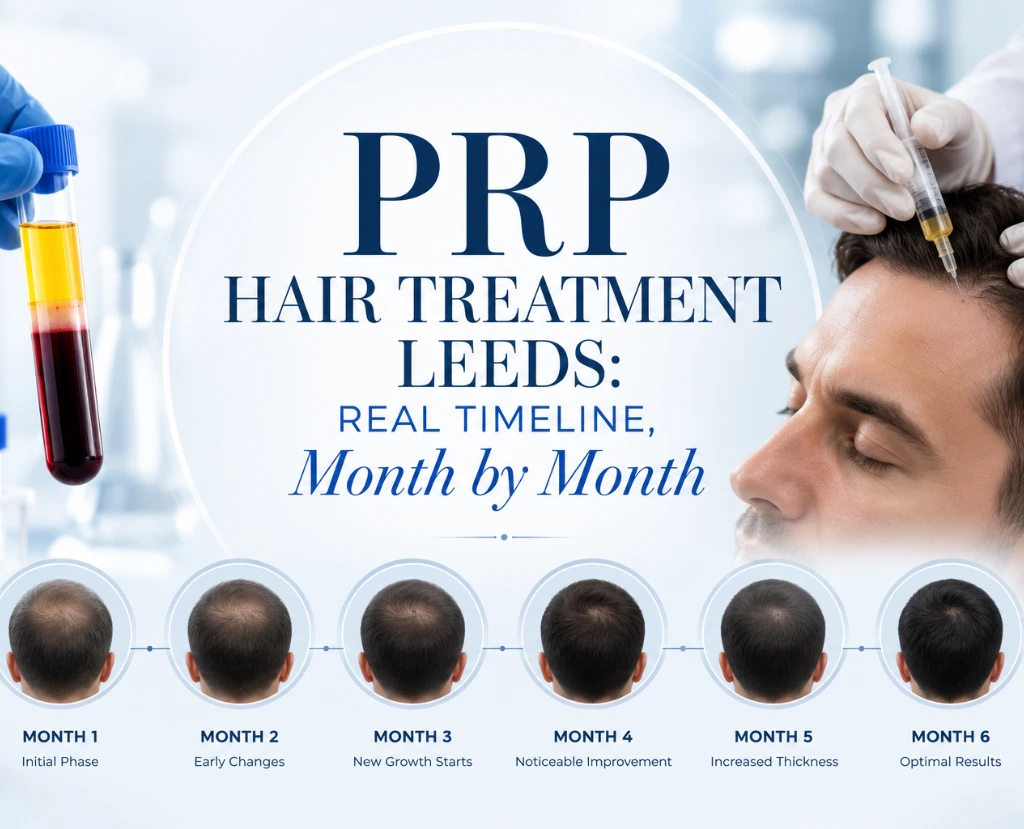
PRP Hair Treatment Leeds: Real Timeline, Month by Month
One of the most common reasons people give up on PRP too early is that they did not know what to expect — and when the first two months did not deliver dramatic results, they assumed the treatment had not worked. The reality is that PRP for hair loss in Leeds follows a biological timeline that cannot be rushed. Understanding it in advance makes the whole process easier to commit to.
At Cosmeticstar in Leeds, we walk every patient through this timeline before their first session. This blog is the extended version of that conversation — covering every stage from the day of your first treatment through to the twelve-month mark.
Before We Start: Why Hair Treatments Take the Time They Do
Hair regrowth is governed by the biology of the hair growth cycle — anagen (active growth), catagen (transition), and telogen (rest). PRP works by changing the signalling environment within this cycle — encouraging more follicles to enter and sustain the anagen phase. But follicles do not respond overnight. They transition through biological stages at their own pace, which is why results from PRP hair treatment in Leeds develop over months rather than weeks.
Month by Month: The Real PRP Timeline
Week 1 to 2: Nothing Dramatic — and That Is Normal
In the first one to two weeks after your initial PRP session at Cosmeticstar in Leeds, most patients notice nothing visibly different about their hair. This is expected and completely normal. Beneath the surface, the growth factors delivered during treatment are beginning to interact with follicular cells and initiate the biological cascade that will produce visible results over the coming months. The work is happening — it is just not yet visible.
Some patients notice a mild improvement in scalp health — less oiliness, a subtle reduction in daily shedding, or a slightly different texture. These are early signs the treatment is working, but they are subtle.
Weeks 3 to 6: The Shedding Phase — Stay the Course
This is the stage that trips most people up. Between three and six weeks after the first PRP session, many patients notice an increase in hair shedding. The reaction is understandable — you have just had a treatment meant to help your hair, and now more of it is falling out. But this is not a sign that PRP has failed. It is a sign that it is working.
When PRP growth factors push dormant follicles back towards the active growth phase, those follicles must first shed the old, miniaturised strand they are currently holding before a new cycle can begin. That increase in shedding is the old hair clearing the way. It typically resolves within four to six weeks, and what follows is a cleaner, more active scalp environment.
Months 2 to 3: Things Start to Shift
By months two and three — particularly after patients have completed their second PRP session at Cosmeticstar in Leeds — the daily shed rate begins to noticeably decrease. The scalp often feels healthier. Some patients notice new, fine growth beginning to emerge at the hairline or in areas of thinning. The hair that is coming out tends to be finer than before — the miniaturised strands being replaced by healthier ones growing behind them.
Months 3 to 5: Visible Improvement
This is the window most patients at Cosmeticstar point to as when they first noticed a real difference. Hair density begins to improve measurably — not dramatically, but tangibly. Strand calibre increases. The overall appearance of the scalp changes in a way that feels meaningful, not just a slight variation in day-to-day styling. Clinical photographs taken at this stage typically show a clear and objective improvement over the baseline.
Months 5 to 8: The Results Compound
Results continue to develop through months five to eight as the compounding effect of a full PRP treatment course at Cosmeticstar in Leeds accumulates. Follicles that were stimulated in earlier sessions are now cycling through fuller anagen phases. Strand thickness continues to improve. Patients who have maintained their treatment schedule consistently at this point consistently report the best outcomes.
Months 8 to 12: Maintenance and Longevity
At around the eight-to-twelve-month mark, most patients at Cosmeticstar in Leeds begin their first maintenance session. Without ongoing maintenance, results from PRP gradually diminish as the progressive hair loss condition continues — so periodic top-up sessions are the key to sustaining what has been built. Most patients find that one maintenance session every six to twelve months keeps their results stable and often continuing to improve.
What Affects Your Personal Timeline
- Stage of hair loss when treatment begins — earlier stages respond faster and more completely
- How consistently you attend sessions — irregular treatment breaks reduce the compounding effect
- Your nutritional status — low ferritin, vitamin D, or zinc can significantly slow follicular responsiveness
- Whether GFC is used instead of or alongside PRP — GFC tends to produce a faster initial response
- Stress levels and sleep quality — both influence cortisol, which affects the hair growth cycle
Treatment Options at Cosmeticstar, Leeds
PRP Hair Treatment
PRP hair treatment in Leeds at Cosmeticstar — delivered with a personalised protocol and clinical photography to track your progress month by month. Learn about PRP Hair Treatment in Leeds.
GFC Hair Therapy
For patients who want a faster and stronger response across the treatment timeline, GFC Hair Therapy in Leeds delivers a more potent growth factor preparation that typically accelerates the visible stages of improvement.
Exosome Therapy
Combined with PRP or GFC, Exosome Therapy in Leeds can accelerate the early stages of the timeline and deepen the overall follicular response for patients wanting the most comprehensive approach.
Start Your Timeline at Cosmeticstar, Leeds
The best month of your PRP timeline is the one you actually begin. At Cosmeticstar in Leeds, we track progress with clinical photography at every key stage so you can see your results developing objectively — no guesswork, no uncertainty. Chat now — click the link and you will be redirected straight to WhatsApp.
Conclusion
PRP hair treatment in Leeds follows a biological timeline that rewards patience and consistency. Knowing what to expect at each stage — from the initial shedding phase through to visible density improvements and long-term maintenance — makes the whole journey significantly easier to commit to and see through. Cosmeticstar in Leeds is with you at every stage of that timeline.
Privacy Notice: Your data is handled in accordance with UK GDPR. Please review our Privacy Policy for full details.
Disclaimer: This blog is for educational purposes only. Always consult a qualified professional before beginning any treatment.
Frequently Asked Questions
Q: When will I see results from PRP hair treatment in Leeds?
A: Most patients notice a visible improvement in density and hair quality between months three and five. Reduced shedding is usually the first sign, noticeable within six to eight weeks.
Q: Why is my hair shedding more after PRP?
A: An initial shedding phase between weeks three and six is a normal and expected part of the follicular reset process triggered by PRP. It means the treatment is working and should not be a reason to stop.
Q: How many PRP sessions do I need at Cosmeticstar in Leeds?
A: Most patients complete an initial course of three to four sessions, followed by maintenance every six to twelve months to sustain and build on results.
Q: Does GFC have a faster timeline than PRP?
A: Yes — GFC typically produces a faster initial response due to its higher growth factor concentration. The same biological stages apply, but patients often move through the early phases more quickly with GFC.