
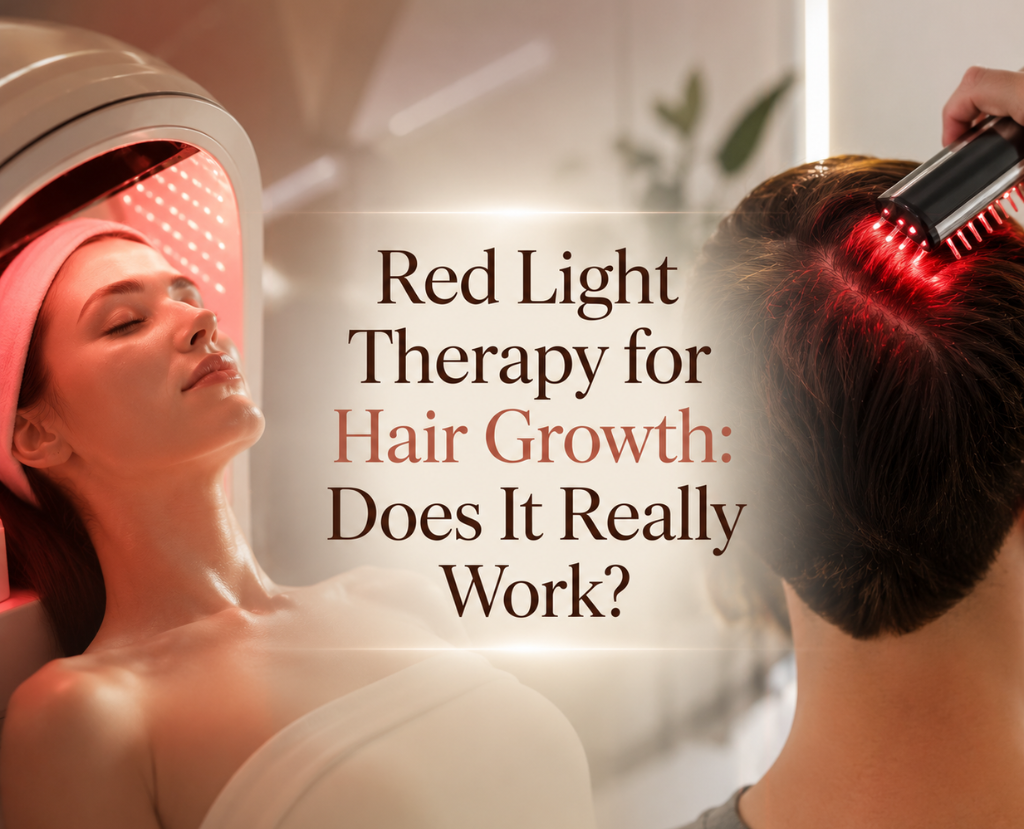
Red Light Therapy for Hair Growth: Does It Really Work?
When something becomes popular in the wellness space, scepticism is a reasonable starting position. Red light therapy has had its share of overclaiming — particularly from consumer device manufacturers who extrapolate heavily from clinical studies conducted under very different conditions. So when someone asks whether red light therapy genuinely works for hair growth, the honest answer requires separating what the evidence actually shows from what the marketing suggests.
At Cosmeticstar in Leeds, we use clinical-grade red light therapy as part of our hair restoration offering. This blog gives you a straight answer based on the research — including where the evidence is strong, where it is more limited, and what it realistically means for someone considering treatment.
The Science Behind Red Light Therapy and Hair Follicles
The biological mechanism by which red and near-infrared light affects hair follicles is reasonably well understood. When light at specific wavelengths — typically 630 to 670 nm (red) and 810 to 850 nm (near-infrared) — is absorbed by cells in the scalp, it is taken up by cytochrome c oxidase, a photoreceptive enzyme within the mitochondria. This absorption triggers an increase in adenosine triphosphate (ATP) production — the cell’s primary energy currency.
For hair follicle cells, this increase in cellular energy has several downstream effects. Dermal papilla cells — the specialised cells at the base of each follicle that regulate the hair growth cycle — become more active. The duration of the anagen (growth) phase extends. Follicles that have been in the resting phase are stimulated to re-enter active growth more promptly. And the micro-environment within the follicle becomes more conducive to the production of thicker, stronger hair strands.
What the Clinical Research Shows
The evidence base for low-level laser therapy (LLLT) and photobiomodulation for hair growth has grown substantially over the past fifteen years. Multiple randomised controlled trials have demonstrated statistically significant improvements in hair count and hair density compared to sham device controls in participants with androgenetic alopecia.
The key nuance in interpreting this research is that results depend on the device parameters — wavelength, power density, treatment duration, and frequency — and on the stage of hair loss in the individual patient. Consumer-grade products frequently operate below the parameters used in clinical trials.
Who Is Most Likely to Benefit?
Red light therapy for hair growth produces the most reliable results in people at early to moderate stages of hair loss — where follicles are still present and biologically active, but functioning below their potential due to DHT-driven miniaturisation, poor scalp circulation, nutritional deficiency, or chronic low-grade scalp inflammation. At this stage, the follicle is not gone — it is underperforming. Red light therapy addresses that underperformance at the cellular level.
What It Cannot Do
Red light therapy does not eliminate DHT or block its effect on genetically susceptible follicles. It does not permanently stop androgenetic alopecia. It does not produce results in follicles that have been dormant for many years. And it does not work identically across all individuals — response varies based on skin type, the stage of hair loss, the device used, and treatment adherence.
Treatment Options at Cosmeticstar, Leeds
Red Light Therapy
Our red light therapy sessions in Leeds are delivered using clinical-grade devices calibrated to the wavelengths with the strongest evidence for hair follicle stimulation and skin rejuvenation. Learn more about Red Light Therapy in Leeds.
PRP Hair Treatment
For targeted follicular stimulation through your body’s own growth factors, PRP Hair Treatment in Leeds at Cosmeticstar is tailored to your specific thinning pattern and delivered with clinical precision.
GFC Hair Therapy
For patients with more significant thinning or faster progression, GFC Hair Therapy in Leeds delivers a more concentrated, more refined growth factor preparation than standard PRP — with a lower inflammatory response and stronger outcomes.
Exosome Therapy
Working at the cellular communication level, Exosome Therapy in Leeds carries regenerative signals directly to follicular tissue — and combines powerfully with both red light therapy and growth factor treatments.
IV Drip Therapy & Vitamin Injections
Scalp health depends on what the body is working with internally. Our IV Drip Therapy in Leeds and Vitamin Injections in Leeds correct nutritional deficiencies that can otherwise limit how well any hair treatment performs.
Ready to Take the Next Step?
If you are considering red light therapy for hair growth and want an honest picture of what it can do for your specific situation, the most useful thing you can do is get a proper assessment from a clinic that takes the time to understand your specific situation. That is exactly what we offer at Cosmeticstar in Leeds. Chat now — click the link, and you will be redirected straight to WhatsApp where our team is ready to help.
Conclusion
Red light therapy for hair growth does work — within a clearly defined context. The evidence is real, the mechanism is understood, and the clinical parameters matter enormously. At Cosmeticstar in Leeds, we deliver red light therapy at clinical grade, combined with a proper assessment of your hair loss stage and pattern.
Privacy Notice: Your data is handled in accordance with UK GDPR. Please review our Privacy Policy for full details.
Disclaimer: This blog is for educational purposes only. Always consult a qualified professional before beginning any treatment.
Frequently Asked Questions
Q: How long does it take to see results from red light therapy for hair?
A: A reduction in shedding is typically the earliest sign of response, often noticed after four to eight sessions. Visible improvements in density take longer — most patients see meaningful changes between months two and four of a consistent treatment course.
Q: Is red light therapy permanent for hair growth?
A: Red light therapy is not a permanent solution in the way that a hair transplant is. Maintenance sessions are needed to sustain the follicular stimulation and improvements achieved. Periodic treatment every four to eight weeks following an initial course is a common maintenance schedule.
Q: Does red light therapy work for both men and women with hair loss?
A: Yes — the clinical evidence includes both male and female participants. The mechanism is the same regardless of the pattern of hair loss, and results at equivalent stages of thinning are broadly comparable between men and women.
Q: Can red light therapy be combined with GFC hair therapy?
A: Combining red light therapy with GFC Hair Therapy in Leeds is one of the more powerful non-surgical combinations available. GFC delivers concentrated growth factors directly to the follicle; red light therapy enhances the cellular environment in which those growth factors are received.