
How Red Light Therapy Supports Hair Restoration
Hair restoration is not a single treatment — it is a process. For most people dealing with hair thinning, the most effective outcomes come not from a single magic solution but from a combination of approaches that address the problem from different angles simultaneously. Red light therapy has emerged as one of the most clinically valuable additions to that combination — not as a replacement for established treatments like PRP or GFC, but as a tool that amplifies their effects and addresses aspects of hair loss that injectable treatments cannot reach on their own.
At Cosmeticstar in Leeds, red light therapy is part of a wider hair restoration offering. This blog explains precisely how it contributes to the restoration process — the biology, the timing, and the patient profiles for whom it makes the most meaningful difference.
The Restoration Problem: What Thinning Hair Actually Needs
Hair restoration is about persuading follicles that have reduced their output to increase it again. In androgenetic alopecia, follicles are progressively miniaturised by DHT. Each successive hair growth cycle produces a finer, shorter strand. The follicle is not destroyed — it is suppressed. The challenge of restoration is creating conditions in which suppressed follicles can recover their activity and begin producing thicker, longer-lasting strands once more.
That requires three things working together: a reduction in the factors suppressing follicular activity (primarily DHT, inflammation, and poor scalp circulation), an increase in the biological signals that promote follicular growth (growth factors, increased cellular energy, extended anagen duration), and the nutritional and circulatory support that keeps follicular cells functioning optimally. Red light therapy addresses all three — though it is most powerful when combined with treatments that deliver the growth factor component directly.
How Red Light Therapy Addresses the Root Causes of Hair Thinning
Cellular Energy at the Follicle
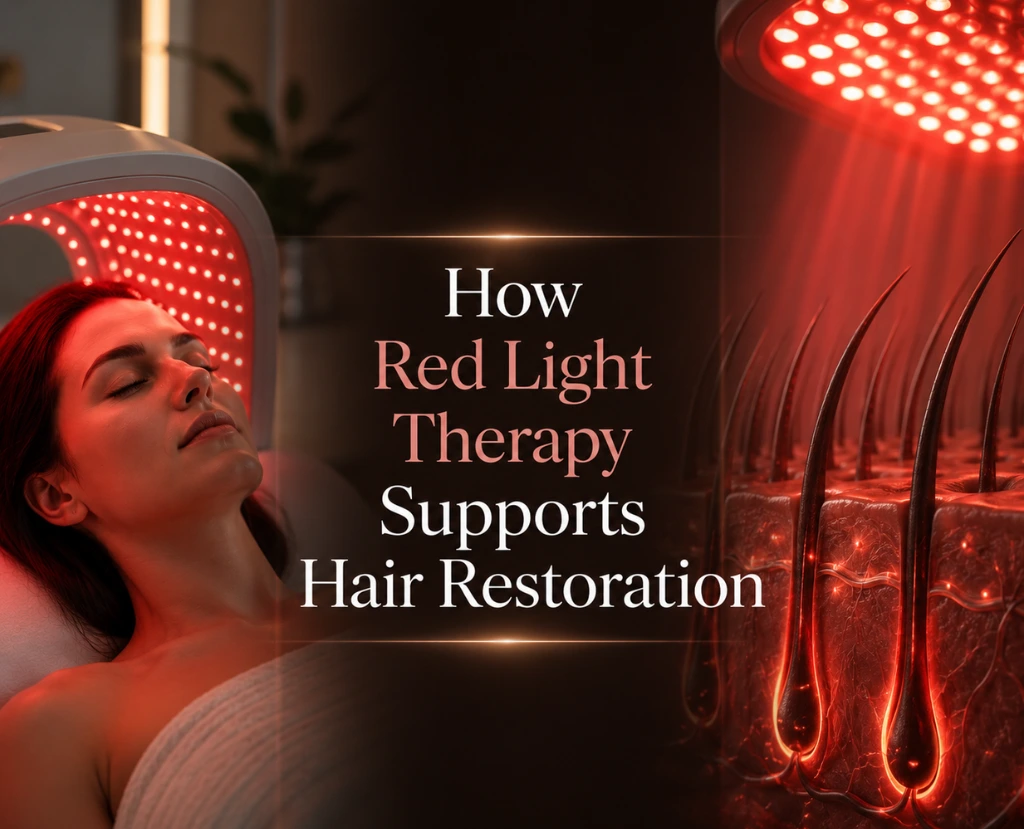
Hair follicle cells are among the most metabolically active in the body and have a correspondingly high demand for cellular energy. Red and near-infrared light at 630 to 850 nm is absorbed by cytochrome c oxidase in the mitochondria of follicular cells, increasing ATP production. This enhanced energy availability extends the anagen (growth) phase, reduces the number of follicles prematurely entering the telogen (resting) phase, and supports the production of more substantial hair strands.
Scalp Inflammation
Perifollicular inflammation — low-grade inflammation in the tissue immediately surrounding the hair follicle — is increasingly recognised as a contributor to the miniaturisation process in androgenetic alopecia. Red light therapy consistently reduces the production of pro-inflammatory cytokines in the scalp, creating a less hostile environment for follicular function. This is one of the reasons red light therapy complements PRP and GFC so well — growth factors find a more receptive environment when scalp inflammation has been reduced.
Scalp Circulation
Adequate blood flow to the scalp is essential for follicular health — it delivers the oxygen, nutrients, and hormonal signals that follicle cells depend on. Red light therapy promotes vasodilation and stimulates the formation of new capillaries in the treated tissue, improving overall scalp perfusion. Improving circulation in thinning zones is a meaningful part of restoring the environment in which follicles can function.
Dermal Papilla Cell Activation
The dermal papilla cells at the base of each follicle are the master regulators of the hair growth cycle. Red light therapy stimulates these cells directly, enhancing their responsiveness to growth signals and prolonging their activity during the growth phase. This is particularly relevant for follicles that have been in a reduced-activity state due to DHT exposure.
Combining Red Light Therapy With Other Treatments
Red light therapy’s greatest value in hair restoration is arguably as a complement to growth factor treatments. When PRP Hair Treatment in Leeds or GFC Hair Therapy in Leeds is delivered into the scalp, it floods the follicular tissue with concentrated biological signals that promote regrowth. Red light therapy, applied before or after, creates an improved cellular environment in which those signals are received and acted upon more effectively.
Treatment Options at Cosmeticstar, Leeds
Red Light Therapy
Our red light therapy sessions in Leeds are delivered using clinical-grade devices calibrated to the wavelengths with the strongest evidence for hair follicle stimulation and skin rejuvenation. Learn more about Red Light Therapy in Leeds.
PRP Hair Treatment
For targeted follicular stimulation through your body’s own growth factors, PRP Hair Treatment in Leeds at Cosmeticstar is tailored to your specific thinning pattern and delivered with clinical precision.
GFC Hair Therapy
For patients with more significant thinning or faster progression, GFC Hair Therapy in Leeds delivers a more concentrated, more refined growth factor preparation than standard PRP — with a lower inflammatory response and stronger outcomes.
Exosome Therapy
Working at the cellular communication level, Exosome Therapy in Leeds carries regenerative signals directly to follicular tissue — and combines powerfully with both red light therapy and growth factor treatments.
IV Drip Therapy & Vitamin Injections
Scalp health depends on what the body is working with internally. Our IV Drip Therapy in Leeds and Vitamin Injections in Leeds correct nutritional deficiencies that can otherwise limit how well any hair treatment performs.
Ready to Take the Next Step?
If hair restoration is something you have been seriously considering and you want to understand which approaches are right for your situation, the most useful thing you can do is get a proper assessment from a clinic that takes the time to understand your specific situation. That is exactly what we offer at Cosmeticstar in Leeds. Chat now — click the link and you will be redirected straight to WhatsApp where our team is ready to help.
Conclusion
Red light therapy earns its place in hair restoration not as a standalone miracle but as a clinically grounded tool that addresses the underlying biological factors driving follicular decline — and amplifies the effects of the growth factor treatments it sits alongside. At Cosmeticstar in Leeds, it forms part of a properly considered, personalised restoration plan built around what your scalp and follicles actually need.
Privacy Notice: Your data is handled in accordance with UK GDPR. Please review our Privacy Policy for full details.
Disclaimer: This blog is for educational purposes only. Always consult a qualified professional before beginning any treatment.
Frequently Asked Questions
Q: Is red light therapy enough on its own for hair restoration?
A: For mild hair thinning, red light therapy alone can produce meaningful improvements. For moderate to significant thinning, it is most effective as part of a combined plan that also includes growth factor treatment such as PRP or GFC.
Q: How often should red light therapy be done for hair restoration?
A: An initial course of two to three sessions per week for several weeks is typical, followed by a maintenance schedule of one session every one to two weeks. Exact frequency is personalised to each patient at Cosmeticstar.
Q: Can red light therapy help with alopecia areata?
A: There is emerging evidence that photobiomodulation may support follicular recovery in alopecia areata, primarily through its anti-inflammatory effects. However, alopecia areata has an autoimmune component that requires specific clinical management, and red light therapy is considered a supportive rather than primary treatment in these cases.
Q: Does red light therapy work on previously transplanted hair?
A: Yes — red light therapy is used post-transplant to support graft survival, reduce scalp inflammation, and accelerate the regrowth timeline. It is also effective in maintaining the density of non-transplanted areas surrounding the transplant zones.
Q: How does red light therapy compare to minoxidil for hair growth?
A: Both promote follicular activity through different mechanisms. Minoxidil is a topical vasodilator; red light therapy operates through photobiomodulation at the mitochondrial level. They can be used simultaneously without conflict as part of a broader maintenance strategy.