
PRP vs Red Light Therapy: Which Is Better for Hair Loss?
When people start researching non-surgical options for hair loss, two treatments tend to come up consistently: PRP (Platelet-Rich Plasma) and red light therapy. Both are evidence-backed, both are non-invasive in the sense that neither requires surgery, and both are used at Cosmeticstar in Leeds. But they work through entirely different mechanisms — which means the question of which is better is not straightforward, and the honest answer depends on your specific situation.
What PRP Does
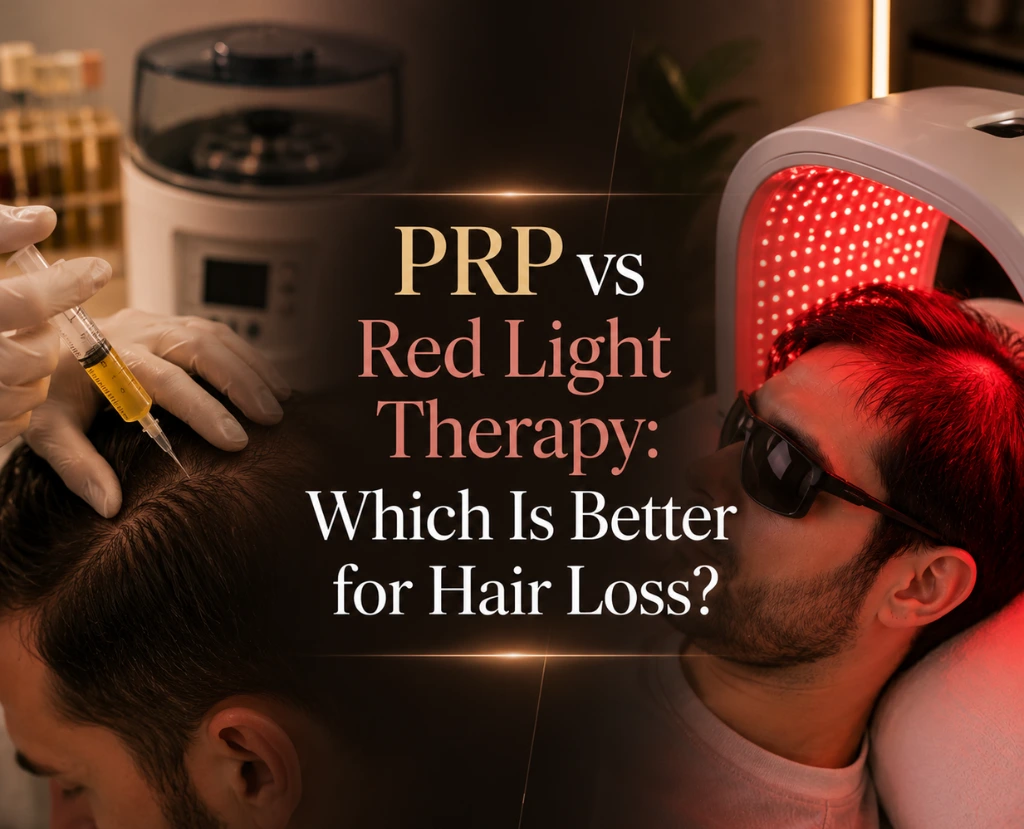
PRP treatment involves drawing a small amount of your own blood, processing it in a centrifuge to concentrate the platelet fraction, and injecting the resulting plasma into the scalp at the sites of thinning. The concentrated platelets carry a payload of growth factors — PDGF, VEGF, IGF-1, EGF, and others — delivered directly into the follicular tissue. These proteins stimulate dermal papilla cells, improve blood supply to the scalp, extend the active growth phase, and signal follicles to produce thicker, stronger strands.
What Red Light Therapy Does
Red light therapy delivers specific wavelengths of red and near-infrared light to the scalp, absorbed by mitochondria in follicular cells. This increases cellular energy production (ATP), reduces oxidative stress and inflammation, promotes vasodilation and scalp circulation, and stimulates dermal papilla cell activity. The treatment is entirely non-invasive — nothing is injected, there is no recovery period, and the experience is comfortable for virtually all patients.
Comparing the Two Honestly
Depth of Effect
PRP delivers its active agents directly to the follicular level — the growth factors act precisely where hair production occurs.
Red light therapy penetrates to the follicle depth through tissue, but the primary effect is on cellular energy and inflammation rather than direct growth factor delivery.
Side Effects and Comfort
Red light therapy is entirely comfortable, produces no downtime, and carries essentially no risk of adverse effects at clinical parameters.
PRP involves injections into the scalp, which most patients describe as mild to moderate discomfort, and occasional temporary redness or swelling. For patients who are needle-averse, red light therapy is the more accessible starting point.
Evidence Base
Both treatments have published clinical evidence supporting their use for hair loss. PRP has a larger volume of randomised controlled trial data specific to androgenetic alopecia.
Red light therapy also has RCT data and has received regulatory clearance for hair growth in several markets.
The Case for Combining Both
The most clinically compelling argument in the PRP versus red light therapy debate is that the comparison itself is somewhat misleading — because the treatments are complementary rather than competing. PRP delivers concentrated growth factors; red light therapy creates a more receptive cellular environment for those growth factors to act within. At Cosmeticstar in Leeds, the combination consistently produces stronger outcomes than either treatment alone.
Treatment Options at Cosmeticstar, Leeds
Red Light Therapy
Our red light therapy sessions in Leeds are delivered using clinical-grade devices calibrated to the wavelengths with the strongest evidence for hair follicle stimulation and skin rejuvenation. Learn more about Red Light Therapy in Leeds.
PRP Hair Treatment
For targeted follicular stimulation through your body’s own growth factors, PRP Hair Treatment in Leeds at Cosmeticstar is tailored to your specific thinning pattern and delivered with clinical precision.
GFC Hair Therapy
For patients with more significant thinning or faster progression, GFC Hair Therapy in Leeds delivers a more concentrated, more refined growth factor preparation than standard PRP — with a lower inflammatory response and stronger outcomes.
Exosome Therapy
Working at the cellular communication level, Exosome Therapy in Leeds carries regenerative signals directly to follicular tissue — and combines powerfully with both red light therapy and growth factor treatments.
IV Drip Therapy & Vitamin Injections
Scalp health depends on what the body is working with internally. Our IV Drip Therapy in Leeds and Vitamin Injections in Leeds correct nutritional deficiencies that can otherwise limit how well any hair treatment performs.
Ready to Take the Next Step?
If you are weighing up your options for hair loss treatment and want honest, personalised guidance on the right approach, the most useful thing you can do is get a proper assessment from a clinic that takes the time to understand your specific situation. That is exactly what we offer at Cosmeticstar in Leeds. Chat now — click the link, and you will be redirected straight to WhatsApp, where our team is ready to help.
Conclusion
PRP and red light therapy are not rivals — they address different aspects of the same problem and work best together. PRP provides the growth factor stimulus that drives follicular recovery; red light therapy provides the cellular and vascular environment in which that stimulus has the greatest effect. At Cosmeticstar in Leeds, we design treatment plans that use both where appropriate.
Privacy Notice: Your data is handled in accordance with UK GDPR. Please review our Privacy Policy for full details.
Disclaimer: This blog is for educational purposes only. Always consult a qualified professional before beginning any treatment.
Frequently Asked Questions
Q: Can I start with red light therapy and add PRP later?
A: Yes — many patients begin with red light therapy as an accessible, comfortable introduction to hair loss treatment and add PRP or GFC once they have assessed their initial response.
Q: How many PRP sessions are needed for hair loss?
A: An initial course of three to four PRP sessions, spaced four to six weeks apart, is standard at Cosmeticstar. Maintenance every six to twelve months is typically recommended.
Q: Is red light therapy safe to use after a PRP injection?
A: Yes — and at Cosmeticstar we frequently sequence red light therapy alongside PRP appointments. The anti-inflammatory and vasodilatory effects of red light complement the growth factor delivery of PRP without any adverse interaction.
Q: Which treatment is better for early-stage hair loss?
A: For very early thinning, red light therapy alone can produce meaningful improvements. As thinning progresses, adding PRP is strongly advised. The earlier any treatment begins, the more follicular activity there is to work with.