
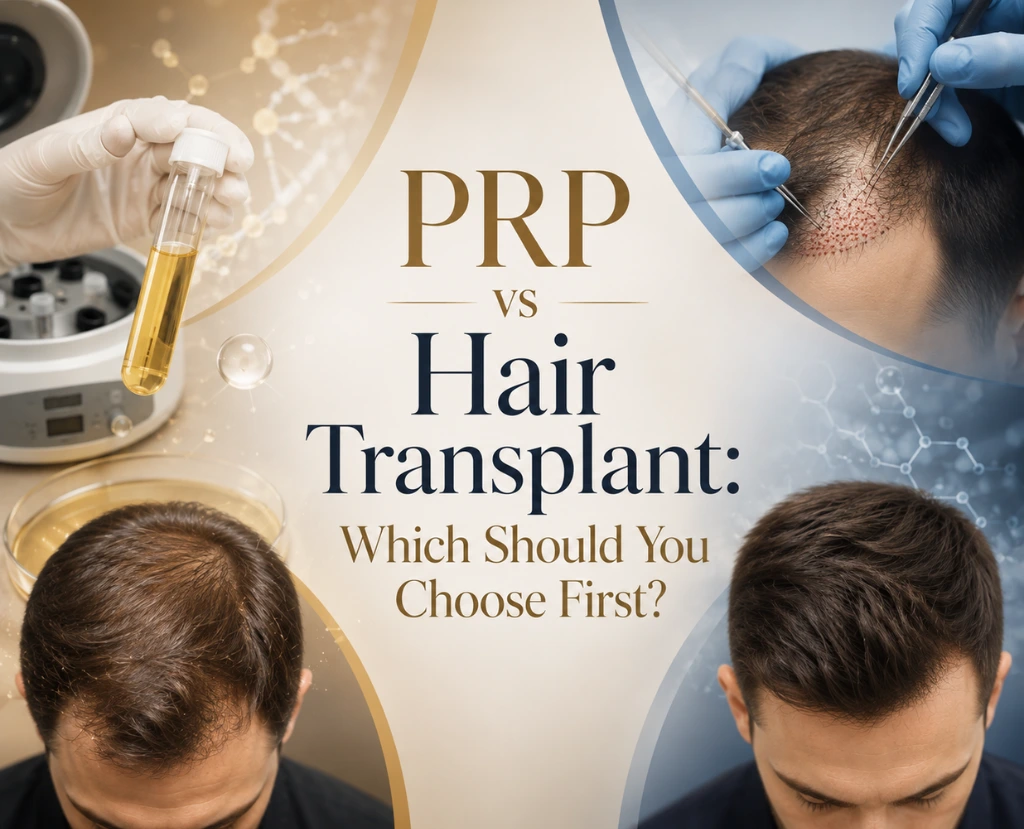
PRP vs Hair Transplant: Which Should You Choose First?
This is one of the most common questions asked by people who have noticed their hair thinning and started researching options. And it is a genuinely important question — because choosing the wrong approach for your current stage of hair loss either wastes money or delays meaningful treatment. The answer is not one-size-fits-all, and anyone who tells you it is — in either direction — is not giving you a complete picture.
At Cosmeticstar in Leeds, we offer both PRP hair treatment and the full supporting infrastructure for hair transplant aftercare — but we do not recommend either without a proper assessment first. This blog gives you the framework to understand which approach makes sense at which stage, and why the two are not actually in competition with each other.
Understanding What Each Treatment Does
What PRP Hair Treatment in Leeds Does
PRP (Platelet-Rich Plasma) hair treatment in Leeds involves extracting a small sample of your blood, concentrating the platelet fraction using a centrifuge, and injecting the resulting growth-factor-rich plasma into the scalp at the sites of thinning. The growth factors — PDGF, VEGF, IGF-1, EGF, TGF-β — stimulate the dermal papilla cells that regulate the hair growth cycle, extend the active growth phase, and promote the production of thicker, stronger strands from existing follicles.
PRP hair treatment in Leeds works with the follicles you already have. It does not create new follicles — it rescues underperforming ones and helps them produce better hair. This is why it is most effective at early to moderate stages of hair loss, where a meaningful population of follicles is still present and biologically active.
What a Hair Transplant Does
A hair transplant involves surgically extracting follicular units from a donor area (typically the sides and back of the scalp, which are genetically resistant to DHT) and implanting them into thinning or bald areas. The transplanted follicles are genetically protected and will produce hair permanently in their new location. A hair transplant creates results that PRP cannot — it fills areas where follicles have been lost or become permanently inactive.
A hair transplant is a surgical procedure with real recovery demands, significant cost, and a result that continues to develop over twelve to eighteen months. It is the most permanent non-medical solution for advanced hair loss — but it is not appropriate at every stage, and it does not stop the natural hair loss process in the non-transplanted areas.
The Stage Question: This Is What Actually Decides It
Choose PRP Hair Treatment in Leeds First If:
- You are at an early to moderate stage of hair loss — Norwood 1 to 4 for men, Ludwig 1 to 2 for women.
- Your follicles are thinning and miniaturising but still present and biologically capable of responding to stimulation.
- You want to slow the progression of hair loss and improve density without surgery.
- You are not yet ready for, or not a candidate for, surgical intervention.
- You want to use PRP as a maintenance tool alongside or after a hair transplant to protect non-transplanted areas.
Consider a Hair Transplant First If:
- You are at a more advanced stage of hair loss — Norwood 5 to 7 for men — where large areas of follicles have been permanently lost.
- Non-surgical treatment has been unable to produce adequate coverage in the areas most important to you aesthetically.
- You have stable hair loss (not rapidly progressing) and sufficient donor density for a successful result.
- You understand that a transplant addresses the areas treated but does not stop loss in surrounding, non-transplanted zones.
Why PRP and Hair Transplants Are Not Either/Or
The most important thing to understand about PRP hair treatment in Leeds vs hair transplant is that for most patients, the question is not which one to choose — it is which one to start with, and when to introduce the other.
PRP hair treatment in Leeds is used before a hair transplant to improve the overall scalp environment and maximise the health of follicles that are not being transplanted. It is used after a hair transplant — typically from four to six weeks post-surgery — to improve graft survival, reduce scalp inflammation, accelerate the regrowth timeline, and support the areas surrounding the transplant zones that are still subject to natural hair loss.
At Cosmeticstar in Leeds, we frequently design treatment plans that sequence PRP alongside GFC Hair Therapy in Leeds and how red light therapy supports hair restoration as part of a comprehensive approach that maximises results at every stage.
The Timing Decision
Starting PRP hair treatment in Leeds at an early stage has a compounding advantage: every month that thinning continues unchecked, follicles miniaturise further and eventually reach the point where they can no longer respond to stimulation. The follicular window — the period during which non-surgical treatment can produce meaningful results — is finite. Acting earlier keeps more options open and produces stronger outcomes from both PRP and, if ever needed, a subsequent transplant.
Treatment Options at Cosmeticstar, Leeds
PRP Hair Treatment Leeds
Our PRP Hair Treatment in Leeds uses your own platelet-rich plasma to deliver a targeted growth factor stimulus directly to thinning follicles. Each session is individually planned around your hair loss pattern and current stage of thinning.
GFC Hair Therapy Leeds
For patients who want a more concentrated growth factor preparation or who have had a limited response to standard PRP, GFC Hair Therapy in Leeds delivers a more refined, higher-potency treatment with a lower inflammatory response and consistently stronger outcomes.
Red Light Therapy Leeds
Used alongside PRP or GFC, how red light therapy supports hair restoration by increasing cellular energy in the scalp, reducing perifollicular inflammation, and improving blood flow to thinning areas — creating a significantly more receptive environment for growth factor treatments to work within.
Exosome Therapy Leeds
For patients who want to deepen their treatment response or who have not achieved the density improvement they were hoping for from PRP or GFC alone, Exosome Therapy in Leeds delivers concentrated regenerative signals directly to follicular tissue at the cellular communication level.
IV Drip Therapy & Vitamin Injections
Nutritional deficiencies in ferritin, vitamin D, and B12 are among the most common silent contributors to hair loss — and they limit how well any scalp treatment can perform. Our IV Drip Therapy in Leeds and Vitamin Injections in Leeds correct these deficiencies at the cellular level, giving your PRP treatment the internal environment it needs to produce its best results.
Ready to Take the Next Step?
If you are trying to decide between PRP hair treatment in Leeds and a hair transplant and want a clinical perspective on what makes sense for your specific stage of hair loss, the most useful thing you can do is speak to a clinic that takes the time to assess your specific situation properly before recommending anything. At Cosmeticstar in Leeds, that is exactly what we do. Chat now on WhatsApp — click the link and our team will be with you straight away.
Conclusion
PRP hair treatment in Leeds and hair transplant surgery serve different stages of the same problem. PRP comes first when follicles are still active and responsive. Transplant comes when permanent replacement is needed. And PRP comes back into the picture after transplant to protect what surrounds the transplanted zones. At Cosmeticstar in Leeds, we help you understand exactly where you are in that picture and what the right next step is.
Privacy Notice: Your data is handled in accordance with UK GDPR. Please review our Privacy Policy for full details.
Disclaimer: This blog is for educational purposes only. Always consult a qualified professional before beginning any treatment.
Frequently Asked Questions
Q: Can PRP prevent the need for a hair transplant altogether?
A: For patients who start PRP hair treatment in Leeds early enough, it is possible to maintain satisfactory density without ever needing surgical intervention. PRP cannot guarantee this outcome — androgenetic alopecia is a progressive condition — but early treatment significantly slows that progression and keeps more options available for longer.
Q: How long should I try PRP before considering a hair transplant?
A: An initial course of three to four PRP sessions followed by an assessment of response is the standard approach at Cosmeticstar in Leeds. Meaningful improvement in shedding and density is typically visible within three to six months of starting treatment. If response is limited, the treatment plan is reviewed and adjusted rather than immediately escalating to surgical options.
Q: Is PRP useful after a hair transplant?
A: Yes — and at Cosmeticstar in Leeds, post-transplant PRP is one of our most recommended protocols. It improves graft survival, reduces scalp inflammation, accelerates the regrowth timeline, and supports the non-transplanted areas of the scalp that continue to be subject to natural hair loss.
Q: Does hair transplant stop hair loss permanently?
A: The transplanted follicles are genetically resistant to DHT and will produce hair permanently in their new location. However, hair loss continues in the non-transplanted areas of the scalp. This is why ongoing PRP hair treatment in Leeds is recommended after a transplant — to protect and maintain the surrounding areas.
Q: Can I have PRP at the same time as planning a hair transplant?
A: Yes — in fact, starting PRP hair treatment in Leeds while preparing for a hair transplant is a sensible approach. PRP improves the scalp environment ahead of surgery and can be continued in the post-operative period to support recovery and optimise the result.