

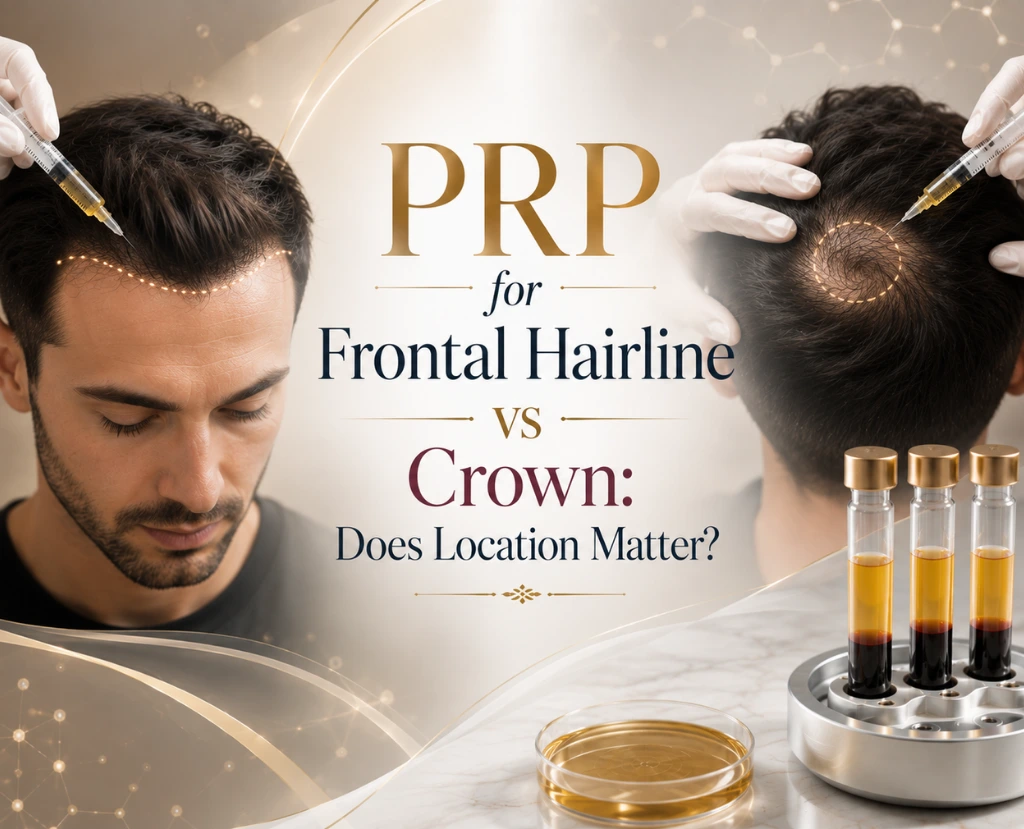
PRP for Frontal Hairline vs Crown: Does Location Matter?
A question that comes up regularly during PRP hair treatment consultations in Leeds is whether the location of the thinning on the scalp affects how well PRP works. Specifically — does PRP produce the same results at the frontal hairline as it does at the crown, and are there areas where PRP is consistently more or less effective?
The short answer is yes — location does matter, and it matters in ways that are important to understand before starting PRP hair treatment in Leeds. This blog explains the biological reasons why different scalp zones respond differently to PRP, what realistic outcomes look like for each area, and how the treatment approach at Cosmeticstar in Leeds is adapted based on where your hair loss is concentrated.
Why Location Matters: The Biological Context
Hair follicles across the scalp are not biologically identical. The follicles in different zones carry different levels of androgen sensitivity — meaning their susceptibility to DHT-driven miniaturisation varies significantly by location. This variation in androgen sensitivity is the primary reason that androgenetic alopecia follows predictable patterns — the Norwood progression in men, the Ludwig distribution in women — rather than affecting the scalp randomly.
This same variation in androgen sensitivity affects how follicles respond to the growth factor stimulus of PRP hair treatment in Leeds. Follicles that are less sensitised to DHT and at an earlier stage of miniaturisation are more capable of responding fully to PRP. Follicles that have been under heavy DHT influence for longer, and have miniaturised further, have a more limited capacity to respond — regardless of how potent the growth factor delivery is.
PRP for the Crown (Vertex)
The crown — or vertex — is typically one of the most responsive areas for PRP hair treatment in Leeds in men. This may seem counterintuitive given that the crown is often the first area where thinning becomes visible, but the reason lies in the follicular characteristics of this zone. Crown follicles, while DHT-sensitive, tend to miniaturise more gradually than frontal hairline follicles, and there is typically a broader population of still-active, still-responsive follicles present even at moderate stages of thinning.
PRP hair treatment in Leeds targeting the crown typically produces improvements in hair density and shedding reduction that become visible within the standard three to six month timeframe. The improvement tends to be in the calibre and density of existing strands — making the coverage of the crown visibly better — rather than producing dramatic new growth in areas where follicles have already been fully lost.
For women with Ludwig-pattern thinning — diffuse loss across the crown and vertex — the crown zone is the primary treatment area, and PRP hair treatment in Leeds consistently produces meaningful density improvements in this distribution when combined with appropriate nutritional support and, ideally, red light therapy.
PRP for the Frontal Hairline and Temples
The frontal hairline and temples are the zones most sensitive to DHT in men with androgenetic alopecia — which is why hairline recession typically begins here. This elevated androgen sensitivity means that the follicles in this zone have often been under the greatest DHT pressure for the longest time, and may have miniaturised further than those in the crown by the time treatment begins.
PRP hair treatment in Leeds can produce meaningful improvements at the frontal hairline — particularly when treatment begins at an early stage, before significant recession has occurred. The key clinical question is how many biologically active follicles remain in the hairline zone. Where active follicles are still present, PRP stimulates them to produce stronger, denser strands and reduces the rate of further recession. Where follicles have already been permanently lost, PRP cannot restore them — and in advanced cases of frontal recession, a hair transplant is the more appropriate option for this zone.
PRP for the Mid-Scalp
The mid-scalp — the zone between the frontal hairline and the crown — is often the last area to be affected in the standard Norwood progression, and is frequently a strong responder to PRP hair treatment in Leeds. Follicular activity in the mid-scalp is typically well-maintained at early to moderate stages, and the growth factor stimulus of PRP is received by tissue that still has considerable productive capacity.
Maintaining mid-scalp density through PRP and red light therapy is one of the most clinically important goals of non-surgical hair treatment — because mid-scalp coverage is critical to an overall appearance of adequate hair density.
Combining PRP With Red Light Therapy by Zone
One of the advantages of red light therapy is that it can be applied across the entire scalp simultaneously, improving the cellular energy environment and reducing perifollicular inflammation in all zones — including the frontal hairline, where DHT-driven inflammation is most concentrated. When PRP injections are delivered into a scalp that has been prepared with red light therapy, the growth factors find a more receptive environment in all zones, including the more challenging frontal area.
What This Means for Your PRP Treatment Plan in Leeds
At Cosmeticstar in Leeds, the injection pattern for every PRP hair treatment session is mapped specifically to the individual patient’s thinning distribution — covering the zones where active follicles are present and treatment is most likely to produce a meaningful response. We are honest about where PRP is likely to be most effective and where additional approaches — such as GFC Hair Therapy in Leeds for more resistant zones or a hair transplant for areas of complete follicle loss — are more appropriate.
Treatment Options at Cosmeticstar, Leeds
PRP Hair Treatment Leeds
Our PRP Hair Treatment in Leeds uses your own platelet-rich plasma to deliver a targeted growth factor stimulus directly to thinning follicles. Each session is individually planned around your hair loss pattern and current stage of thinning.
GFC Hair Therapy Leeds
For patients who want a more concentrated growth factor preparation or who have had a limited response to standard PRP, GFC Hair Therapy in Leeds delivers a more refined, higher-potency treatment with a lower inflammatory response and consistently stronger outcomes.
Red Light Therapy Leeds
Used alongside PRP or GFC, red light therapy by increasing cellular energy in the scalp, reducing perifollicular inflammation, and improving blood flow to thinning areas — creating a significantly more receptive environment for growth factor treatments to work within.
Exosome Therapy Leeds
For patients who want to deepen their treatment response or who have not achieved the density improvement they were hoping for from PRP or GFC alone, Exosome Therapy in Leeds delivers concentrated regenerative signals directly to follicular tissue at the cellular communication level.
Ready to Take the Next Step?
If you want to understand whether PRP hair treatment in Leeds is likely to produce results in the specific areas where your hair is thinning and what the right approach is for your particular pattern, the most useful thing you can do is speak to a clinic that takes the time to assess your specific situation properly before recommending anything. At Cosmeticstar in Leeds, that is exactly what we do. Chat now on WhatsApp — click the link and our team will be with you straight away.
Conclusion
Location does matter in PRP hair treatment in Leeds — not as a barrier to treatment, but as a factor that shapes realistic expectations and helps determine the right approach for each zone. The crown and mid-scalp tend to be strong responders; the frontal hairline responds well at early stages and requires honest assessment as thinning progresses. At Cosmeticstar in Leeds, we map every PRP treatment plan to your specific distribution of hair loss — so the treatment is targeted where it can actually make a difference.
Privacy Notice: Your data is handled in accordance with UK GDPR. Please review our Privacy Policy for full details.
Disclaimer: This blog is for educational purposes only. Always consult a qualified professional before beginning any treatment.
Frequently Asked Questions
Q: Can PRP restore a receded frontal hairline?
A: PRP hair treatment in Leeds can slow further recession at the frontal hairline and improve the quality of strands in the zone where follicles are still active. In areas where significant recession has already occurred and follicles have been permanently inactive, PRP cannot restore what is already gone — and in these cases, a hair transplant is the more appropriate option for the frontal zone.
Q: Is the crown easier to treat with PRP than the hairline?
A: In most cases, yes — the crown tends to have more biologically active follicles at comparable stages of hair loss than the frontal hairline, which is under heavier androgen pressure. This generally translates to a stronger PRP response in the crown zone. However, individual variation is significant, and proper assessment at Cosmeticstar in Leeds is the only reliable way to determine your specific responsiveness across zones.
Q: How many PRP sessions does it take to see results at the crown?
A: At Cosmeticstar in Leeds, meaningful improvements in crown density are typically visible within three to six months of beginning a PRP hair treatment course of three to four sessions. The full benefit of the initial course continues to develop for several months after the final session.
Q: Can PRP prevent further hairline recession?
A: PRP hair treatment in Leeds at an early stage of hairline recession can meaningfully slow the rate of further recession by stimulating the follicles that are still active in and around the hairline zone. It works best as a proactive intervention rather than a reactive one — the earlier treatment begins, the more follicular activity there is to protect.
Q: Does location on the scalp affect the number of PRP sessions needed?
A: The number of sessions in an initial PRP course at Cosmeticstar in Leeds is three to four regardless of the primary thinning zone. However, maintenance frequency may be adjusted based on response — and in zones where androgenetic pressure is highest, such as the frontal hairline, more frequent maintenance may be beneficial to sustain the results achieved.