
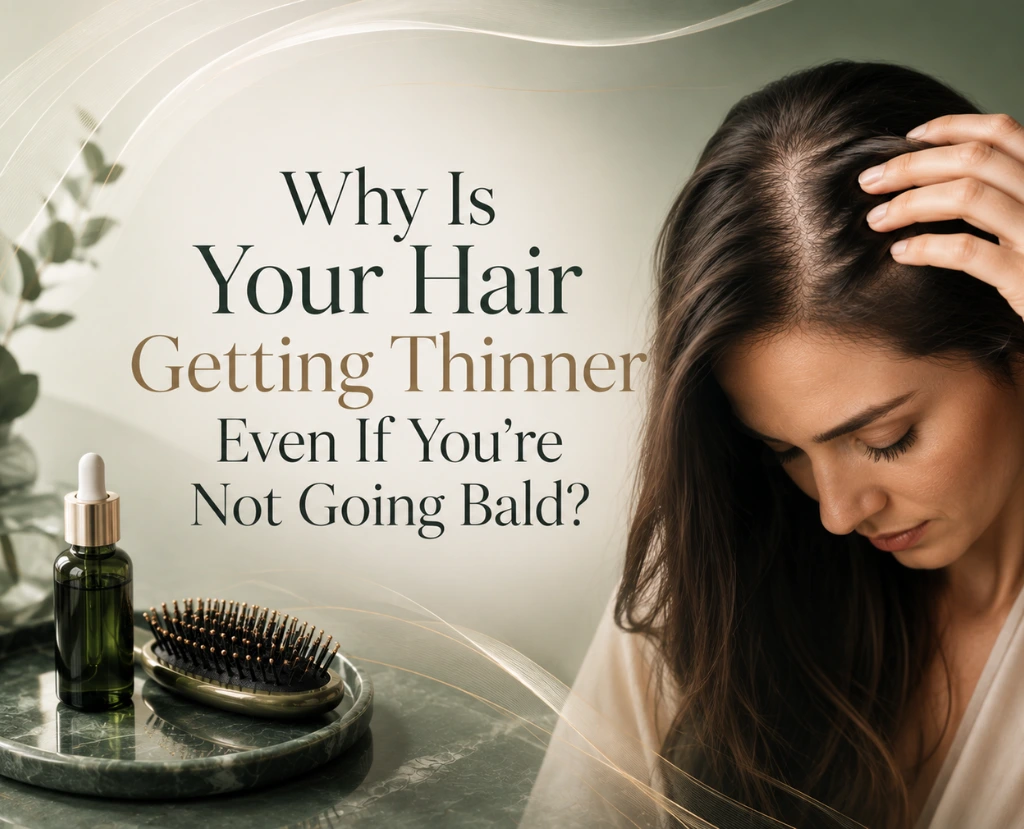
Why Is Your Hair Getting Thinner Even If You’re Not Going Bald?
Hair thinning and baldness are not the same thing — and confusing them leads a lot of people to delay seeking hair loss treatment in Leeds until significant, visible progress has been made. Your hair can become progressively finer, lighter, and less dense without any obvious bald patches appearing. And by the time the thinning becomes undeniable, the follicular window for the most effective treatment response has often narrowed considerably.
At Cosmeticstar in Leeds, diffuse hair thinning without overt baldness is one of the most common presentations we assess. This blog explains the most frequent causes, why the hair becomes thinner without falling out in concentrated patches, and what effective hair loss treatment in Leeds looks like for this pattern.
Understanding Miniaturisation: The Root of Gradual Thinning
The process underlying most gradual hair thinning — without dramatic visible hair loss — is follicular miniaturisation. Under the influence of DHT (in androgenetic alopecia) or other triggers (nutritional deficiency, hormonal imbalance, chronic stress), hair follicles do not suddenly stop producing hair. Instead, they produce progressively shorter, finer, less pigmented strands over successive growth cycles. Each growth cycle, the strand produced is a little thinner and a little shorter than the one before.
This process can continue for years before individual hairs become so fine that they are barely visible. The result is hair that looks and feels less full — less volume, less body, a ponytail that has shrunk — without obvious patches or a dramatically receded hairline. It is a gradual erosion rather than a sudden loss, which is why it is easy to dismiss and difficult to date precisely.
Common Causes of Gradual Hair Thinning
Early Androgenetic Alopecia
Both male and female androgenetic alopecia can present as diffuse thinning in the early stages before the characteristic pattern becomes fully apparent. In men, this is often first noticed at the crown; in women, it typically presents as reduced fullness across the top of the scalp. The earlier this is identified and treated with PRP or GFC hair treatment in Leeds, the stronger the response and the more density can be preserved.
Nutritional Deficiency
Low ferritin, vitamin D deficiency, and B12 insufficiency are among the most commonly identified causes of diffuse hair thinning in adults. These deficiencies affect the quality and calibre of hair produced — follicles operating in a nutritionally depleted environment produce thinner, more fragile strands even when the follicles themselves are not being miniaturised by hormonal factors. This is a genuinely common and genuinely correctable cause of hair that is getting progressively thinner.
Thyroid Dysfunction
Both hypothyroidism and hyperthyroidism affect the rate of cellular activity throughout the body, including in the hair follicle. Thyroid-related hair thinning is diffuse, typically affecting the whole scalp rather than following a pattern, and often accompanied by other signs of thyroid dysfunction — fatigue, weight changes, temperature sensitivity. It may not resolve fully until thyroid function is adequately managed medically.
Chronic Stress and Cortisol
Chronic stress produces sustained cortisol elevation that disrupts the hair growth cycle and depletes the nutritional reserves that follicular function depends on. The result is often diffuse thinning that develops gradually over months to years of sustained stress, without the dramatic acute shed of an acute telogen effluvium event. This pattern can be difficult to recognise precisely because it develops so slowly.
Post-Hormonal Events in Women
Postpartum, perimenopause, and changes to hormonal contraception are all common triggers for diffuse hair thinning in women. These events disrupt the hormonal balance that regulates the hair growth cycle, leading to a gradual reduction in density that can persist for months to years if the hormonal environment does not fully restabilise.
What You Can Do About Gradual Hair Thinning
The most important first step is identifying the cause — or combination of causes — driving the thinning. A proper clinical assessment at Cosmeticstar in Leeds, including a nutritional blood panel and a review of your hormonal history and hair loss pattern, is the foundation of an effective treatment plan.
Where androgenetic alopecia or hormonal factors are the primary driver, PRP or GFC hair treatment in Leeds stimulates follicular activity directly — and combined with Red light therapy In leeds, produces consistently stronger density improvements than either modality alone.
Treatment Options at Cosmeticstar, Leeds
PRP Hair Treatment Leeds
Our PRP Hair Treatment in Leeds uses your own platelet-rich plasma to deliver a concentrated growth factor stimulus directly to thinning follicles — stimulating the dermal papilla cells that regulate the hair growth cycle and supporting the production of stronger, denser strands from follicles that are still biologically active.
GFC Hair Therapy Leeds
For patients who want a more powerful growth factor intervention or who have seen a limited response to standard PRP, GFC Hair Therapy in Leeds provides a more refined, higher-concentration preparation — with a lower inflammatory response at the injection site and consistently stronger outcomes for patients with more significant or faster-progressing thinning.
Red Light Therapy Leeds
Used alongside PRP or GFC, Red light therapy In leeds by increasing cellular energy in the scalp, reducing perifollicular inflammation, and improving blood flow to thinning areas — creating a significantly more receptive environment for growth factor treatments to work within, and maintaining that environment between sessions.
Exosome Therapy Leeds
For patients who want to deepen their treatment response, Exosome Therapy in Leeds delivers concentrated regenerative signals directly to follicular tissue at the cellular communication level — working synergistically with both PRP and red light therapy to produce a more comprehensive biological stimulus.
Ready to Take the Next Step?
If your hair has been getting gradually thinner and you want to understand why and what can be done about it before the progression continues further, the most useful thing you can do is speak to a clinic that takes the time to assess your specific situation properly before recommending anything. At Cosmeticstar in Leeds, that is exactly what we do. Chat now on WhatsApp — click the link and our team will be with you straight away.
Conclusion
Gradual hair thinning without obvious baldness is common, has identifiable causes, and responds well to the right hair loss treatment in Leeds when identified and addressed appropriately. The earlier you act, the more follicular activity there is to work with and the stronger your treatment response will be. At Cosmeticstar in Leeds, we start with an honest assessment of what is driving your thinning and build a treatment plan around that — not a generic protocol applied to every presentation.
Privacy Notice: Your data is handled in accordance with UK GDPR. Please review our Privacy Policy for full details.
Disclaimer: This blog is for educational purposes only. Always consult a qualified professional before beginning any treatment.
Frequently Asked Questions
Q: Can thin hair become thick again with treatment?
A: Where the thinning is driven by nutritional deficiency or a correctable hormonal factor, hair quality and calibre can improve significantly with treatment. Where miniaturisation has been ongoing for years, PRP and GFC can stimulate follicles to produce thicker strands than they have been — but the degree of improvement depends on how far miniaturisation has progressed.
Q: Is hair getting thinner always a sign of hair loss?
A: Not always — some degree of change in hair texture and calibre with age is normal. But progressive thinning over months to years, particularly if accompanied by increased shedding or visible scalp, is worth assessing. The distinction between normal age-related change and pathological thinning is exactly what a proper clinical assessment at Cosmeticstar in Leeds is designed to determine.
Q: What blood tests are needed for hair thinning?
A: At Cosmeticstar in Leeds, the key markers for diffuse hair thinning are ferritin (stored iron), vitamin D, full blood count, thyroid function (TSH, T4), and B12. In women, a hormonal panel including oestrogen, progesterone, and androgens may also be relevant depending on the clinical picture.
Q: Does diet affect hair thickness?
A: Significantly — the quality of hair produced by follicles reflects the nutritional environment they are working within. Diets low in protein, iron, zinc, and B vitamins are directly associated with reduced hair calibre and increased shedding.
Q: How long does it take to see hair get thicker after treatment?
A: Improvements in hair calibre and strand quality — the hair feeling fuller and stronger — are typically noticeable within two to four months of starting treatment at Cosmeticstar in Leeds. Visible improvements in overall density take three to six months from the start of a treatment course.