

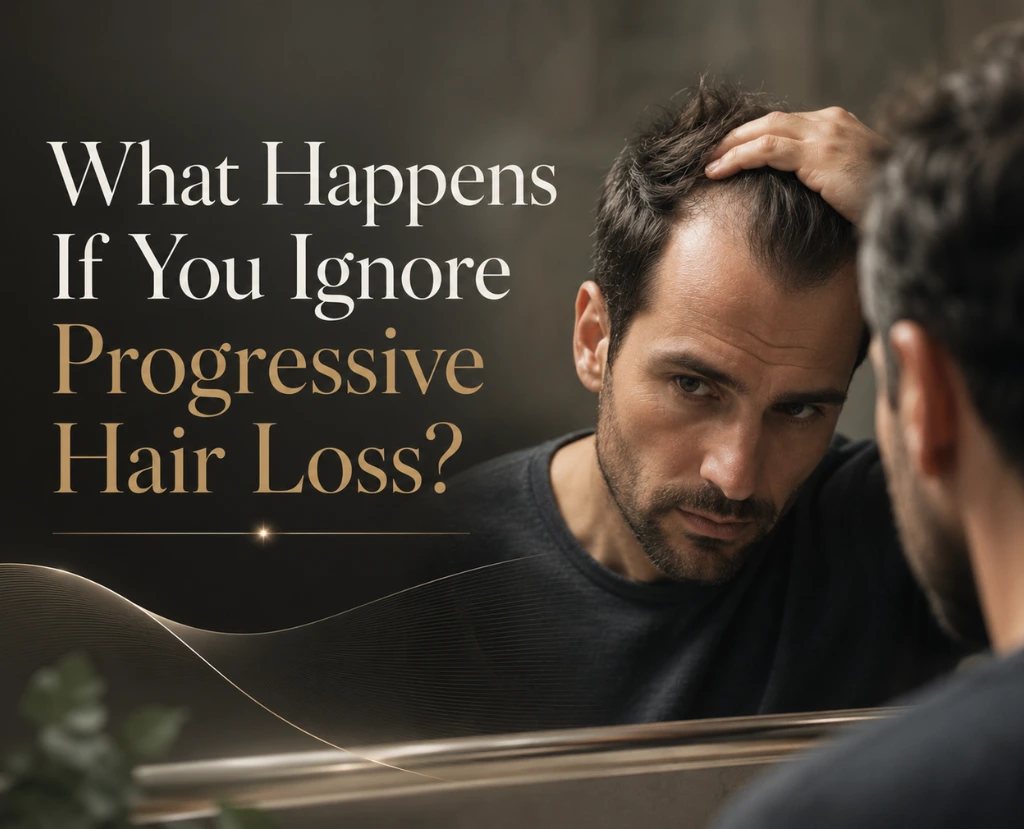
What Happens If You Ignore Progressive Hair Loss?
The most common reason people give for delaying hair loss treatment in Leeds is some version of waiting to see what happens. It is a completely understandable response — hair loss is often gradual, the significance of early changes is easy to minimise, and the decision to seek treatment carries its own psychological weight. But from a clinical perspective, ignoring progressive hair loss has real consequences — consequences that accumulate quietly over months and years and that directly affect what treatment can achieve when the decision to act is eventually made.
This blog is not designed to create alarm. It is designed to give you an accurate picture of what is actually happening to your follicles during a period of untreated progressive hair loss — so that the decision about when to seek hair loss treatment in Leeds is made with full clinical understanding rather than optimism about what time will bring.
What Is Happening to Your Follicles While You Wait
Androgenetic alopecia does not pause while you decide what to do. DHT (dihydrotestosterone) continues to bind to androgen receptors in genetically susceptible follicles, progressively shortening each successive growth cycle. Each hair produced is a little finer, a little shorter, and a little less pigmented than the one before. This process — follicular miniaturisation — continues cycle by cycle, month by month, until the follicle produces hair that is barely visible and eventually reaches a state of dormancy.
The clinical significance of this timeline is that there is a follicular window — a period during which a given follicle is still biologically active enough to respond to PRP, GFC, or other hair loss treatment in Leeds. Once a follicle has crossed from miniaturisation into prolonged dormancy, the capacity to restimulate it through non-surgical treatment is significantly reduced. And once permanently dormant, no non-surgical treatment can restore it.
The Narrowing Treatment Window: Why Timing Matters
When patients come to Cosmeticstar in Leeds having ignored progressive hair loss for several years, the clinical conversation is different from those who come at the first sign of change. At an earlier stage, the discussion is about which combination of hair loss treatments will produce the strongest recovery of density. At a later stage, the discussion is about what is still achievable non-surgically, what might require surgical intervention, and what expectations are realistic.
This is not a counsel of despair — meaningful improvement is achievable at many stages, and we make clear to every patient exactly what is realistic for their specific situation. But the treatment options available at Norwood Stage 2 are genuinely different from those available at Norwood Stage 5, and the outcomes achievable are genuinely different too. Waiting costs follicular activity that cannot be recovered.
The Psychological Dimension: Why This Matters Beyond the Physical
Progressive hair loss that is ignored does not stop having psychological impact — it accumulates it. The gradual erosion of hair density, the daily awareness of change, the increasing effort required to style and manage thinner hair, and the self-consciousness that develops in social and professional contexts are real costs that compound over time. Patients who come to us having delayed treatment for five years frequently describe how much of that time was spent being aware of and troubled by their hair — without any productive response to that awareness.
The decision to seek hair loss treatment in Leeds does not eliminate these feelings immediately. But it redirects the energy from passive worry to active management — and for most patients, that shift in itself has a meaningful impact on how they relate to their hair and their confidence.
What Becomes Progressively Harder With Time
- Non-surgical treatment in Leeds becomes less able to produce visible density recovery as miniaturisation advances — the target follicles are fewer and less responsive.
- Scalp coverage from remaining hair becomes harder to achieve as hair becomes finer and sparser — styling and management become progressively more effortful.
- The surgical option — hair transplant — becomes more constrained as the available donor supply must cover a larger denuded area.
- The psychological burden of visible, advanced hair loss is typically greater than that of mild to moderate thinning, and the timeline to reaching that point is shortened by delay.
The Honest Case for Acting Now
Hair loss treatment in Leeds at Cosmeticstar does not ask you to commit to anything before you have had an honest assessment of where you stand and what treatment can realistically achieve. The consultation is the starting point — not the treatment. Coming in to understand your situation, your options, and your realistic outcomes is a very low-cost step that gives you the information needed to make a genuinely informed decision.
What we know from years of clinical experience at Cosmeticstar in Leeds is that patients who act at the first sign of meaningful change consistently achieve better outcomes — more density preserved, more follicular activity to work with, and more treatment options available — than those who wait. The case for acting sooner is not emotional. It is clinical. And it is real.
Treatment Options at Cosmeticstar, Leeds
PRP Hair Treatment Leeds
Our PRP Hair Treatment in Leeds uses your own platelet-rich plasma to deliver a concentrated growth factor stimulus directly to thinning follicles — stimulating the dermal papilla cells that regulate the hair growth cycle and supporting the production of stronger, denser strands from follicles that are still biologically active.
GFC Hair Therapy Leeds
For patients who want a more powerful growth factor intervention or who have seen a limited response to standard PRP, GFC Hair Therapy in Leeds provides a more refined, higher-concentration preparation — with a lower inflammatory response at the injection site and consistently stronger outcomes for patients with more significant or faster-progressing thinning.
Red Light Therapy Leeds
Used alongside PRP or GFC, Red light therapy In leeds by increasing cellular energy in the scalp, reducing perifollicular inflammation, and improving blood flow to thinning areas — creating a significantly more receptive environment for growth factor treatments to work within, and maintaining that environment between sessions.
Exosome Therapy Leeds
For patients who want to deepen their treatment response, Exosome Therapy in Leeds delivers concentrated regenerative signals directly to follicular tissue at the cellular communication level — working synergistically with both PRP and red light therapy to produce a more comprehensive biological stimulus.
IV Drip Therapy & Vitamin Injections
Nutritional deficiencies in ferritin, vitamin D, and B12 are among the most common silent contributors to hair loss and limit how well any scalp treatment can perform. Our IV Drip Therapy in Leeds and Vitamin Injections in Leeds correct these deficiencies at the cellular level, giving every hair treatment the internal environment it needs to produce its best results.
Ready to Take the Next Step?
If you have been aware of progressive hair loss for a while and want to understand honestly what your current options are and what acting now versus waiting further actually means for your treatment outcomes, the most useful thing you can do is speak to a clinic that takes the time to assess your specific situation properly before recommending anything. At Cosmeticstar in Leeds, that is exactly what we do. Chat now on WhatsApp — click the link and our team will be with you straight away.
Conclusion
Ignoring progressive hair loss does not make it stop — it makes the consequences progressively harder to address. Every month of untreated androgenetic alopecia narrows the follicular window, reduces the number of biologically active follicles that hair loss treatment in Leeds can work with, and limits what non-surgical treatment can achieve. At Cosmeticstar in Leeds, we give you an honest picture of where you stand and what is actually achievable — and we do that from the first conversation, with no commitment required from your side until you decide it is the right step.
Privacy Notice: Your data is handled in accordance with UK GDPR. Please review our Privacy Policy for full details.
Disclaimer: This blog is for educational purposes only. Always consult a qualified professional before beginning any treatment.
Frequently Asked Questions
Q: Is it too late to treat my hair loss if it has been progressing for years?
A: It depends on the stage your hair loss has reached and how much biologically active follicular activity remains. Hair loss that has been progressing for years is not automatically untreatable — many patients who come to Cosmeticstar in Leeds after a long period of ignoring hair loss still have a meaningful population of responsive follicles and achieve real improvement from treatment. A proper clinical assessment is the only way to know what is still achievable for your specific situation.
Q: Does ignoring hair loss make it progress faster?
A: Not directly — the rate of androgenetic alopecia progression is primarily genetic. But ignoring it means not addressing contributing factors — nutritional deficiency, scalp inflammation, poor circulation — that can meaningfully accelerate the rate of miniaturisation when left unmanaged. Treatment does not stop genetic progression, but it significantly slows it and counteracts the contributing factors that would otherwise compound it.
Q: What is the best hair loss treatment in Leeds for someone who has waited a long time?
A: The right treatment for someone with more advanced hair loss depends on the specific pattern and density of remaining follicular activity. For patients at moderate stages, GFC hair treatment in Leeds combined with red light therapy and nutritional support is typically the strongest non-surgical option. For more advanced presentations, an honest discussion about whether hair transplant surgery is appropriate as part of the overall plan is part of the assessment at Cosmeticstar in Leeds.
Q: Can red light therapy help if I have been losing hair for a long time?
A: Yes — Red light therapy In leeds by reducing perifollicular inflammation and improving cellular energy in follicular tissue, which is relevant at any stage of hair loss where biologically active follicles are still present. It is most effective as part of a combined approach alongside PRP or GFC rather than as a standalone treatment for advanced loss.
Q: Will my hair grow back if I start treatment now after years of loss?
A: Whether hair regrows after a long period of progressive loss depends on how much follicular activity remains in the thinning areas. Where follicles are still present and still producing some hair — however fine — PRP and GFC hair treatment in Leeds can stimulate them back to more productive function. Where areas are completely smooth and follicles have been inactive for many years, regrowth through non-surgical treatment is unlikely. A clinical assessment at Cosmeticstar in Leeds will tell you honestly which situation you are in.