
PRP for Female Pattern Hair Loss in Leeds: What Women Need to Know
Female pattern hair loss is significantly more common than most public conversations suggest. It affects approximately 40 percent of women to some degree by the age of fifty, with prevalence increasing substantially after the menopause. Despite being widespread, it is consistently underdiagnosed and undertreated — partly because the pattern is different from male baldness and less visually obvious, and partly because many women attribute gradual thinning to other causes and delay seeking proper assessment.
PRP hair treatment in Leeds has emerged as one of the most clinically appropriate and well-evidenced non-surgical options for women with female pattern hair loss — and at Cosmeticstar in Leeds, it is one of the most common presentations we treat with PRP hair treatment in Leeds. This blog explains everything women in Leeds need to know: the causes, the treatment approach, the expected results, and the factors that make PRP particularly effective for female hair loss.
Understanding Female Pattern Hair Loss
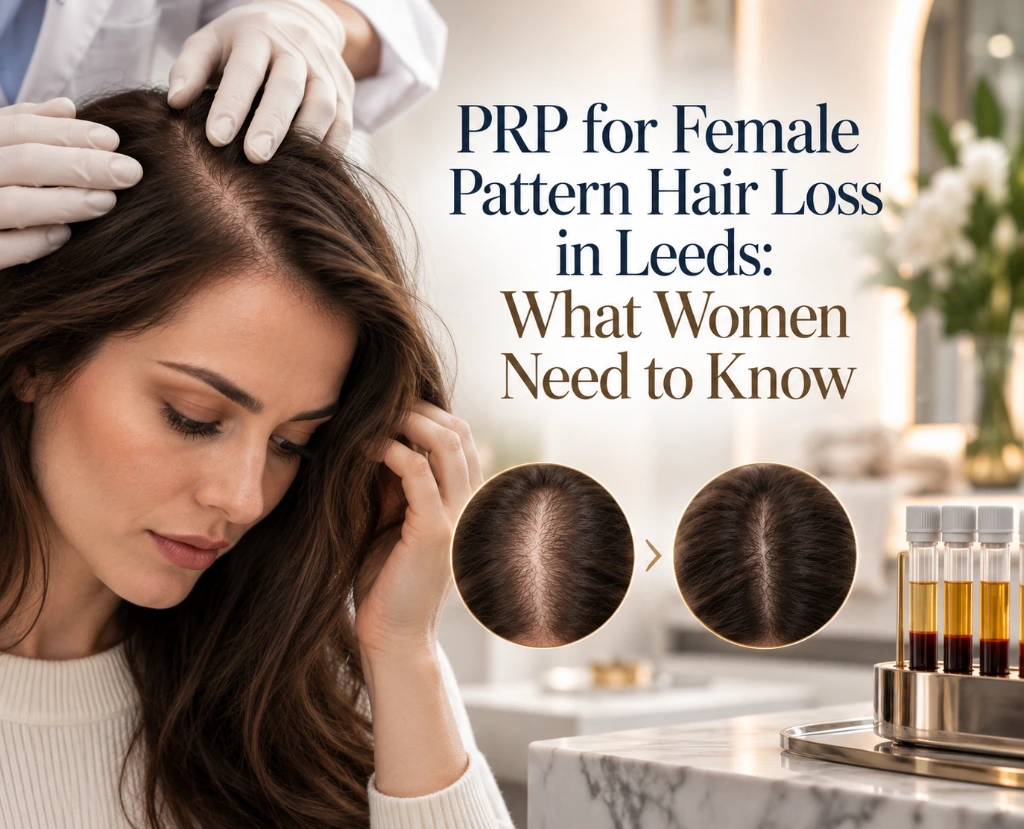
Female pattern hair loss — also known as female androgenetic alopecia — is characterised by diffuse thinning across the crown and top of the scalp, following the Ludwig pattern rather than the Norwood recession seen in men. The frontal hairline is typically preserved, making the thinning most visible from above or when the hair is parted. The parting widens, the crown becomes progressively more visible, and the overall density and weight of the hair reduces.
The underlying mechanism is the same as in male pattern baldness: DHT (dihydrotestosterone) acts on genetically susceptible follicles to progressively miniaturise them. But in women, the hormonal picture is more complex. Oestrogen provides some protective effect on the hair follicle — when oestrogen declines during perimenopause and menopause, the relative influence of androgens increases, and female pattern hair loss can begin or accelerate significantly. Other hormonal factors — PCOS, thyroid dysfunction, changes in contraception — also contribute to androgenetic hair loss in women.
Why PRP Hair Treatment in Leeds Works Particularly Well for Women
The reason PRP hair treatment in Leeds is particularly well-suited to female pattern hair loss relates to the follicular biology of the Ludwig thinning pattern. In female androgenetic alopecia, the follicles across the crown and vertex are miniaturising but rarely permanently lost in the way that follicles can be in advanced male pattern baldness. This means the follicular window — the period during which platelet-rich plasma treatment can produce a meaningful response — is often broader and more enduring for women than for men.
Platelet-rich plasma growth factors delivered directly to these miniaturising follicles stimulate the dermal papilla cells, extend the active growth phase, and support the production of thicker, more substantial strands from follicles that have been reducing their output. The result — improved crown density, reduced shedding, stronger hair across the vertex — is one of the most visible and impactful improvements PRP produces in any patient group.
The PRP Hair Treatment Approach for Female Hair Loss in Leeds
Assessment First
For women presenting with hair loss in Leeds, assessment is particularly important before any platelet-rich plasma treatment begins. Female hair loss has a wider range of potential causes than male pattern baldness — including nutritional deficiencies, thyroid dysfunction, PCOS, and postpartum hormonal shifts — that can either drive hair loss independently or compound underlying androgenetic alopecia. Identifying these factors through a targeted blood panel (ferritin, vitamin D, B12, thyroid function, hormonal profile where relevant) before starting PRP ensures that treatment is directed at the complete clinical picture.
The Injection Pattern for Female Hair Loss
The PRP injection pattern for female pattern hair loss at Cosmeticstar in Leeds covers a broader area than for male androgenetic alopecia — mapping the diffuse thinning across the crown and vertex rather than targeting a more concentrated recession zone. This broader coverage requires more injection points per session and a different mapping approach that our practitioners are specifically experienced in for female hair loss presentations.
Combining PRP With Nutritional Support
Women with female pattern hair loss frequently have nutritional deficiencies — particularly low ferritin — that compound the androgenetic process. At Cosmeticstar in Leeds, addressing these through IV Drip Therapy in Leeds or Vitamin Injections in Leeds alongside the PRP hair treatment course consistently produces stronger and more sustained improvements in hair density and quality than scalp treatment alone. In some women, particularly those with predominantly nutritional hair loss, addressing deficiencies alone produces significant improvement without requiring scalp-level treatment.
Specific Female Hair Loss Patterns and PRP in Leeds
Postpartum Hair Loss
Postpartum hair loss typically begins two to four months after delivery as elevated pregnancy hormones normalise and the follicles held in the growth phase during pregnancy are simultaneously released to shed. PRP hair treatment in Leeds for postpartum hair loss accelerates follicular reactivation, reduces the duration and severity of the shedding phase, and supports a more complete and rapid recovery of density. Most women with postpartum hair loss at Cosmeticstar see excellent results from a standard three-session PRP course beginning at around three months post-delivery.
Perimenopausal and Menopausal Hair Thinning
As oestrogen declines during perimenopause, female androgenetic alopecia can begin or accelerate significantly. PRP hair treatment in Leeds is an effective and appropriate non-surgical option for perimenopausal and menopausal women, working directly at the follicular level regardless of the hormonal environment. Combined with Red light therapy and nutritional support, PRP produces meaningful density improvements in this group that are particularly valuable given that the thinning pattern at this stage tends to be progressive without treatment.
PCOS-Related Hair Loss in Women
Women with polycystic ovary syndrome (PCOS) frequently experience hair thinning driven by elevated androgens. PRP hair treatment in Leeds addresses the follicular manifestation of this androgen excess — stimulating dormant and miniaturising follicles directly — while medical management of the PCOS itself is best co-ordinated with the patient’s GP or specialist. The combination of appropriate medical management and PRP at Cosmeticstar produces significantly better outcomes than scalp treatment alone.
Hair Loss Treatments at Cosmeticstar Leeds
PRP Hair Treatment Leeds
Our PRP hair treatment in Leeds uses your own platelet-rich plasma — concentrated via centrifuge and injected precisely into thinning scalp zones — to deliver a targeted growth factor stimulus directly to dormant and miniaturising hair follicles. Every session is individually mapped to your hair loss pattern.
GFC Hair Therapy Leeds
For patients who want a more powerful growth factor intervention than standard platelet-rich plasma therapy, GFC Hair Therapy in Leeds provides a more refined, higher-concentration preparation with a lower inflammatory response and consistently stronger outcomes — particularly for moderate to advanced androgenetic alopecia.
Red Light Therapy Leeds
Used alongside PRP or GFC, Red light therapy by increasing cellular energy in the scalp at the mitochondrial level, reducing perifollicular inflammation, and improving blood flow to thinning follicles — creating a significantly more receptive environment for platelet-rich plasma growth factors to work within.
Exosome Therapy Leeds
For patients who want to deepen their hair restoration response beyond what PRP or GFC alone can achieve, Exosome Therapy in Leeds delivers concentrated regenerative signals directly to follicular tissue — working synergistically with platelet-rich plasma to produce a more comprehensive biological stimulus.
IV Drip Therapy & Vitamin Injections Leeds
Nutritional deficiencies in ferritin, vitamin D, and B12 are among the most common silent contributors to hair loss in Leeds patients — and they limit how well platelet-rich plasma treatment can perform. Our IV Drip Therapy in Leeds and Vitamin Injections in Leeds correct these deficiencies at the cellular level, giving every PRP session the internal environment it needs to produce its strongest results.
Book a PRP Hair Consultation in Leeds
If you are a woman in Leeds experiencing hair thinning — whether from female pattern hair loss, postpartum shedding, perimenopausal change, or another cause — and you want an honest clinical assessment of your options and what PRP can realistically achieve, the most useful next step is a proper clinical assessment — not a generic online quiz or a sales call. At Cosmeticstar in Leeds, we assess your specific hair loss pattern, stage, and contributing factors before making any recommendation. Chat with us now on WhatsApp and our team will get back to you straight away.
Conclusion
PRP hair treatment in Leeds is one of the most clinically appropriate, well-evidenced, and practically accessible options for women with female pattern hair loss. It works at the follicular level, requires no medication, produces meaningful improvements in density and shedding reduction, and is particularly effective when combined with nutritional assessment and red light therapy. At Cosmeticstar in Leeds, we have specific experience in treating the patterns and causes of hair loss most common in women — and we design every PRP plan around the individual assessment, not a generic protocol.
Privacy Notice: Your data is handled in accordance with UK GDPR. Please review our Privacy Policy for full details.
Disclaimer: This blog is for educational purposes only and does not constitute medical advice. Always consult a qualified practitioner before beginning any hair loss treatment.
Frequently Asked Questions
Q: How effective is PRP for female pattern hair loss in Leeds?
A: PRP hair treatment in Leeds is highly effective for female pattern hair loss, particularly at Ludwig Stages 1 and 2 where follicles are still active and responsive. Multiple clinical studies confirm meaningful improvements in hair density and thickness in women with androgenetic alopecia following platelet-rich plasma treatment. At Cosmeticstar, women with female pattern hair loss consistently achieve visible density improvements within three to six months of starting a PRP course.
Q: Is PRP hair treatment in Leeds safe during perimenopause?
A: Yes — PRP hair treatment uses your own blood products and carries no systemic hormonal effects, making it suitable at all stages of the hormonal lifecycle, including perimenopause and menopause. The treatment is appropriate alongside any HRT or other perimenopausal management a patient is receiving.
Q: How many PRP sessions do women need for hair loss in Leeds?
A: The standard initial course for female pattern hair loss at Cosmeticstar in Leeds is three to four PRP sessions, spaced four to six weeks apart. Because female androgenetic alopecia covers a broader scalp area than male pattern loss, sessions may be slightly longer than for male patients. Maintenance every six months is typically recommended thereafter.
Q: Will PRP work for my postpartum hair loss in Leeds?
A: PRP hair treatment in Leeds is one of the most effective available interventions for postpartum hair loss, accelerating follicular reactivation and reducing the duration of the shedding phase. At Cosmeticstar, we typically recommend starting PRP for postpartum hair loss at around three months post-delivery, when the shedding phase is established and the follicles are ready to respond to the platelet-rich plasma growth factor stimulus.
Q: Should I get a blood test before PRP hair treatment in Leeds as a woman?
A: Yes — and at Cosmeticstar in Leeds, we strongly recommend it. A targeted panel covering ferritin, vitamin D, B12, thyroid function, and where relevant a hormonal profile ensures that any nutritional or hormonal contributors to your hair loss are identified before PRP treatment begins. Addressing these alongside platelet-rich plasma treatment consistently produces stronger results.