
PRP for Receding Hairline in Leeds: Can Platelet Rich Plasma Stop Hairline Recession?
A receding hairline is often the first visible sign that androgenetic alopecia is progressing — and for many men in Leeds, it is the change that finally prompts them to seek professional advice. The temples begin to recede, the M-shaped hairline of early male pattern baldness becomes increasingly defined, and the question that follows is: can anything stop this, or at least slow it down significantly? PRP hair treatment in Leeds is one of the most commonly asked-about options for receding hairlines, and the honest answer is nuanced — more positive than many people expect, but also more qualified than some clinics suggest.
At Cosmeticstar in Leeds, PRP hair treatment in Leeds for receding hairline patients is one of our most common presentations. This blog explains what platelet-rich plasma can realistically achieve for hairline recession, who it suits, what it cannot do, and what the full range of options looks like for a receding hairline in Leeds.
Why the Hairline Recedes: The Biological Reality
The frontal hairline and temporal zones are the most DHT-sensitive regions of the scalp in men with a genetic predisposition to androgenetic alopecia. DHT binds to androgen receptors in the follicles of these zones with higher affinity than in other scalp regions, driving miniaturisation at a faster rate. This is why hairline recession typically begins before crown thinning in male pattern baldness — the follicles at the frontal border are simply the most susceptible.
The Norwood Scale maps the progressive stages of this recession: from a slightly mature hairline (Stage 1) through increasing temporal recession producing an M-shape (Stages 2 to 3), to a higher receded frontal line with or without crown involvement (Stages 4 to 5), and eventually to the characteristic horseshoe pattern of advanced baldness (Stages 6 to 7). Understanding where on this scale you currently sit is the essential starting point for any sensible conversation about PRP for a receding hairline in Leeds.
What PRP Hair Treatment in Leeds Can Achieve for a Receding Hairline
Early-Stage Hairline Recession (Norwood 1–2)
At Norwood Stages 1 and 2 — where the hairline is beginning to show a mature or mildly receded appearance but follicles in and around the hairline zone are still biologically active — PRP hair treatment in Leeds can produce genuinely meaningful results. The platelet-rich plasma growth factor stimulus reaches follicular tissue that is still miniaturising but has not yet crossed into dormancy. The result is:
- A meaningful slowing of further hairline recession — the rate of miniaturisation in the frontal follicles is reduced by the repeated growth factor stimulus.
- Improved strand quality at the hairline — existing hairs in the receding zone become thicker and stronger, improving the visible density of the hairline even before new hairs emerge.
- In some patients, genuine partial regrowth — new, stronger hairs from follicles that were miniaturising but still responded to the platelet-rich plasma stimulus — producing a visibly improved hairline density.
Moderate Hairline Recession (Norwood 3–4)
At Norwood Stages 3 and 4, the hairline has receded more significantly and a higher proportion of frontal follicles have been inactive for longer. PRP hair treatment in Leeds at this stage produces a more variable result in the hairline zone specifically. The primary value at this stage is:
- Stabilisation and slowing of further recession in the remaining active hairline follicles.
- Improvement in the density and quality of existing hair in the partially thinned zones around the hairline.
- Protection of the mid-scalp and crown zones that are still highly active and responsive to PRP.
For the most receded areas of the hairline at this stage, honest expectation-setting is important: PRP can work with what is still there, not restore what has been permanently lost.
Advanced Hairline Recession (Norwood 5–7)
At advanced stages of hairline recession, where large areas of the frontal scalp have been follicle-free for extended periods, PRP hair treatment in Leeds has limited capacity to produce visible improvement in those specific zones. The follicles that would need to respond are no longer biologically present. At these stages, the conversation appropriately shifts to hair transplant surgery for the frontal zone, with PRP used to protect and maintain the surrounding areas that still have active follicles — and to support post-transplant recovery if surgery is pursued.
PRP vs Hair Transplant for Receding Hairline in Leeds: The Decision Framework
The decision between PRP hair treatment in Leeds and a hair transplant for a receding hairline is primarily determined by stage. PRP is the appropriate first-line option for Norwood Stages 1 to 3 — when follicles are still present and capable of responding. A hair transplant becomes the appropriate conversation when the recession has progressed to a point where the non-surgical approach can no longer produce adequate coverage in the most aesthetically important zones.
Importantly, these are not mutually exclusive. Many patients at Norwood Stages 2 to 4 begin with PRP hair treatment in Leeds to slow recession and improve existing hairline density, then reassess for a hair transplant when and if the recession reaches a stage where surgical restoration becomes appropriate. PRP is also used post-transplant to protect the non-transplanted areas surrounding the grafted hairline — making the two approaches complementary rather than competing.
Combining PRP With Red Light Therapy for Receding Hairline in Leeds
The frontal hairline zone is under the heaviest androgen pressure of any area of the scalp — and perifollicular inflammation in this zone is a recognised contributor to the rate of miniaturisation. Red light therapy by reducing this inflammation and improving cellular energy in the follicular tissue of the hairline zone makes it a particularly valuable complement to PRP for receding hairline treatment in Leeds. Combined sessions of PRP and red light therapy at Cosmeticstar produce consistently stronger results in the hairline zone than PRP alone.
Starting PRP Early for a Receding Hairline in Leeds: Why It Matters
The case for starting PRP for a receding hairline in Leeds at the earliest sign of recession is straightforward: every month that hairline recession continues without treatment, more follicles in the frontal zone cross from miniaturising to dormant. The dormant follicle is significantly less responsive to platelet-rich plasma treatment than the miniaturising one. The follicular window for non-surgical treatment of hairline recession closes progressively — and acting at Norwood Stage 2 produces a meaningfully stronger result than waiting until Stage 4.
Hair Loss Treatments at Cosmeticstar Leeds
PRP Hair Treatment Leeds
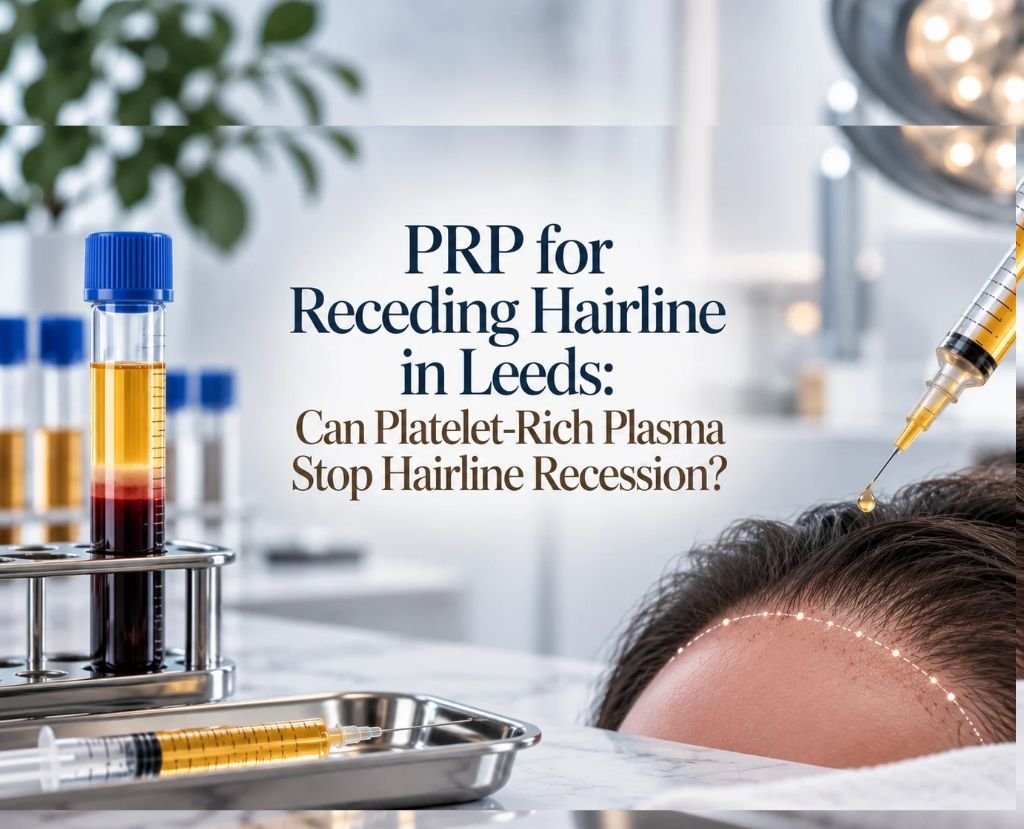
Our PRP hair treatment in Leeds uses your own platelet-rich plasma — concentrated via centrifuge and injected precisely into thinning scalp zones — to deliver a targeted growth factor stimulus directly to dormant and miniaturising hair follicles. Every session is individually mapped to your hair loss pattern.
GFC Hair Therapy Leeds
For patients who want a more powerful growth factor intervention than standard platelet-rich plasma therapy, GFC Hair Therapy in Leeds provides a more refined, higher-concentration preparation with a lower inflammatory response and consistently stronger outcomes — particularly for moderate to advanced androgenetic alopecia.
Red Light Therapy Leeds
Used alongside PRP or GFC, Red light therapy by increasing cellular energy in the scalp at the mitochondrial level, reducing perifollicular inflammation, and improving blood flow to thinning follicles — creating a significantly more receptive environment for platelet-rich plasma growth factors to work within.
Exosome Therapy Leeds
For patients who want to deepen their hair restoration response beyond what PRP or GFC alone can achieve, Exosome Therapy in Leeds delivers concentrated regenerative signals directly to follicular tissue — working synergistically with platelet-rich plasma to produce a more comprehensive biological stimulus.
Book a PRP Hair Consultation in Leeds
If you have noticed your hairline beginning to recede and want an honest clinical assessment of how far it has progressed, what PRP hair treatment in Leeds can realistically achieve, and what the complete range of options looks like for your specific situation, the most useful next step is a proper clinical assessment — not a generic online quiz or a sales call. At Cosmeticstar in Leeds, we assess your specific hair loss pattern, stage, and contributing factors before making any recommendation. Chat with us now on WhatsApp and our team will get back to you straight away.
Conclusion
PRP hair treatment in Leeds can slow hairline recession, improve the density and quality of existing hairline hair, and in some patients produce genuine partial regrowth — when treatment begins at an early stage and the follicles in the receding zones are still biologically active. At more advanced stages, the honest conversation includes when PRP and hair transplant are complementary rather than alternative options. At Cosmeticstar in Leeds, we give every patient with a receding hairline a clear, stage-based assessment of what is achievable and what the right approach is — without overpromising or unnecessarily steering towards surgical options when non-surgical treatment can produce meaningful results.
Privacy Notice: Your data is handled in accordance with UK GDPR. Please review our Privacy Policy for full details.
Disclaimer: This blog is for educational purposes only and does not constitute medical advice. Always consult a qualified practitioner before beginning any hair loss treatment.
Frequently Asked Questions
Q: Can PRP stop a receding hairline in Leeds?
A: PRP hair treatment in Leeds can meaningfully slow the rate of hairline recession and in some patients produce partial regrowth, particularly at early stages (Norwood 1 to 3) when follicles in the recession zone are still biologically active. It cannot restore a hairline where follicles have been permanently inactive for an extended period.
Q: Is PRP or a hair transplant better for a receding hairline in Leeds?
A: The choice depends on your stage of recession. At Norwood Stages 1 to 3, PRP hair treatment in Leeds is the appropriate non-surgical first-line option. At Norwood Stages 4 and above, a hair transplant becomes an increasingly important part of the conversation for the frontal zone, with PRP used to protect surrounding areas. Many patients use both as complementary approaches.
Q: How quickly does PRP work for a receding hairline in Leeds?
A: The earliest changes from PRP for a receding hairline in Leeds are reduced shedding in the hairline zone and improved strand quality within four to eight weeks. Measurable density improvements in the recession area develop over three to six months from the start of the PRP course.
Q: Does PRP work for temple recession in Leeds?
A: PRP hair treatment in Leeds for temple recession produces the best results at early stages when follicles in the temporal zones are still active. At later stages, the temples are often among the most advanced areas of recession, and realistic expectations for platelet-rich plasma treatment in this specific zone should be established through a proper assessment at Cosmeticstar in Leeds.
Q: Can I combine PRP with GFC for better results on my receding hairline in Leeds?
A: Yes — for patients at moderate stages of hairline recession (Norwood 3 to 4), GFC Hair Therapy in Leeds provides a more concentrated growth factor preparation than standard PRP and is increasingly the preferred option for the hairline zone at this stage. Combined with red light therapy, this represents one of the strongest non-surgical approaches available for receding hairline treatment in Leeds at Cosmeticstar.