
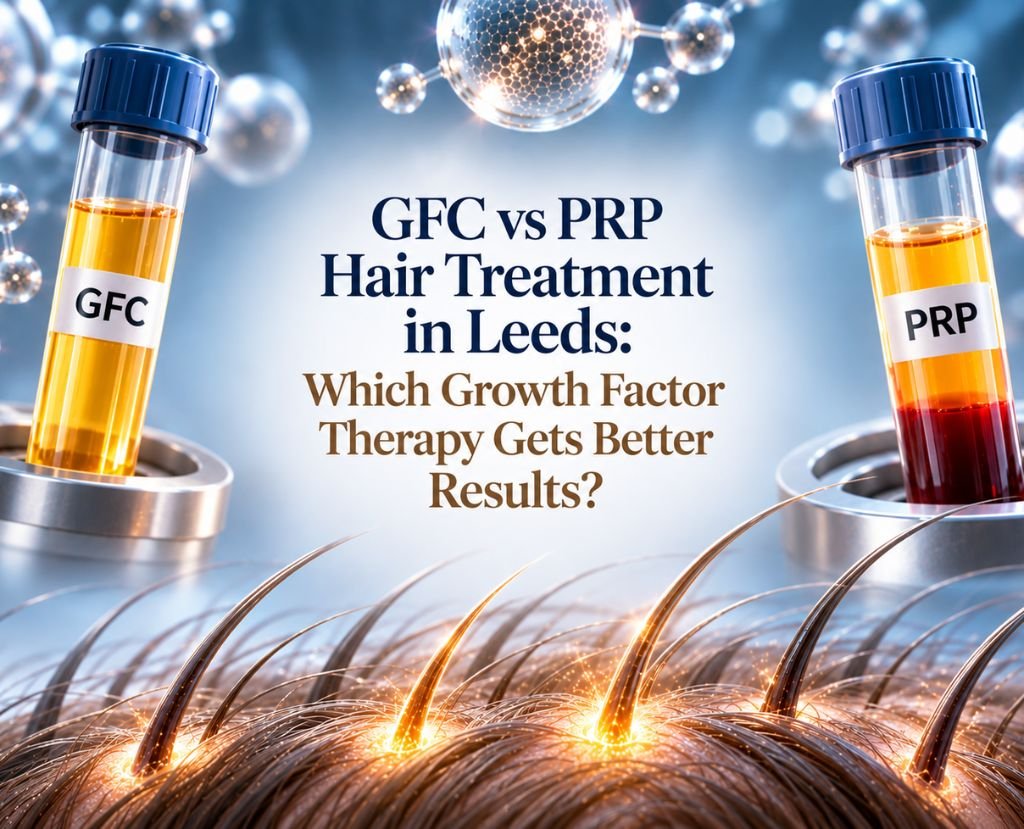
GFC vs PRP Hair Treatment in Leeds: Which Growth Factor Therapy Gets Better Results?
Both PRP and GFC hair treatment in Leeds use the growth factors found in your own blood to stimulate hair follicles. Both are non-surgical, both are well-tolerated, and both have clinical evidence supporting their use for androgenetic alopecia and other patterns of hair loss. So why does it matter which one you choose — and is GFC actually better than PRP for hair treatment in Leeds?
The honest answer is: it depends on your stage of hair loss, your rate of progression, and what you want from treatment. At Cosmeticstar in Leeds, we offer both PRP hair treatment in Leeds and GFC Hair Therapy in Leeds — and the reason we offer both is precisely because they are not the same product and they suit different clinical situations. This blog gives you the complete, evidence-based comparison.
What Is PRP Hair Treatment in Leeds?
PRP (Platelet-Rich Plasma) is prepared by drawing a small blood sample, centrifuging it to concentrate the platelet fraction, and injecting the resulting plasma into the scalp at the sites of thinning. The concentrated platelets carry a payload of growth factors — PDGF, VEGF, IGF-1, EGF, TGF-β — which stimulate dermal papilla cells, promote scalp vascularity, extend the anagen (growth) phase, and support the production of thicker strands from miniaturising follicles.
Standard PRP contains the platelet-rich plasma layer including its natural complement of growth factors at the concentration achieved by the centrifuge protocol used. The preparation also contains some red blood cells, white blood cells, and other plasma components depending on the specific protocol.
What Is GFC Hair Therapy in Leeds?
GFC (Growth Factor Concentrate) is a more refined, next-generation preparation that goes further than standard PRP. Starting from the same blood sample, GFC processing extracts and concentrates the specific growth factors themselves — at a significantly higher concentration and from a preparation that removes the red and white blood cells present in standard PRP. The result is a purer, more potent growth factor preparation that delivers a stronger biological stimulus per millilitre injected.
At Cosmeticstar in Leeds, GFC hair therapy is increasingly the first recommendation for patients at moderate to advanced stages of androgenetic alopecia, patients whose thinning is progressing at a faster rate, and patients who have had a limited response to standard PRP previously. The lower inflammatory response of GFC compared to whole-platelet PRP also makes it better tolerated across the scalp, with less post-injection soreness and swelling.
GFC vs PRP: The Clinical Differences That Matter
Growth Factor Concentration
GFC delivers a meaningfully higher concentration of the specific growth factors relevant to hair restoration than standard PRP. Studies comparing the two preparations consistently show higher concentrations of PDGF, VEGF, and EGF in GFC preparations compared to standard PRP from the same blood volume. A higher growth factor concentration means a stronger stimulus per session delivered directly to the follicular tissue.
Inflammatory Response
Standard PRP contains platelets, which when activated produce an inflammatory response at the injection site as well as releasing growth factors. This inflammation is generally mild and transient — but it is a real component of the post-treatment experience. GFC, because it removes the cellular components and delivers the growth factors in a more isolated form, produces a significantly lower inflammatory response. Patients receiving GFC hair therapy in Leeds at Cosmeticstar consistently report less post-injection scalp tenderness and faster return to complete comfort compared to standard PRP sessions.
Result Strength
For patients at early stages of hair loss (Norwood 1–2, Ludwig 1), standard PRP typically produces a strong and sufficient response. For patients at moderate stages (Norwood 3–4) or with faster-progressing androgenetic alopecia, GFC hair therapy in Leeds tends to produce stronger and more sustained improvements in density and shedding reduction — reflecting the higher growth factor concentration reaching the follicular tissue. Clinical observations at Cosmeticstar Leeds consistently support this pattern.
Cost
GFC hair therapy in Leeds is typically priced higher than standard PRP per session — reflecting the more sophisticated preparation process and the higher growth factor concentration delivered. For patients who need a stronger intervention, the additional investment typically produces proportionally stronger results, making the cost-per-result calculation favourable.
Who Should Choose PRP Hair Treatment in Leeds?
- Patients at Norwood Stages 1–2 (men) or Ludwig Stage 1 (women) with early, slow-progressing androgenetic alopecia.
- Patients starting hair loss treatment for the first time who want an evidence-based, well-established non-surgical option.
- Patients using PRP as part of a combination plan alongside GFC, red light therapy, and exosome therapy.
- Post-transplant patients using PRP for graft survival support and surrounding area maintenance.
Who Should Choose GFC Hair Therapy in Leeds?
- Patients at Norwood Stages 3–4 or Ludwig Stages 1–2 with moderate or faster-progressing androgenetic alopecia.
- Patients who have completed a standard PRP course with a good but not yet optimal response and want a stronger next intervention.
- Patients who want the strongest available non-surgical growth factor intervention without committing to surgical hair transplant.
- Patients with a lower tolerance for post-injection scalp tenderness who prefer the reduced inflammatory response of GFC.
Can PRP and GFC Be Combined in Leeds?
Yes — and at Cosmeticstar in Leeds, some patients use both in a sequenced or alternating protocol. An initial course of GFC sessions to establish a strong growth factor foundation, followed by a maintenance schedule that alternates between GFC and PRP, is one approach used for patients at moderate stages of androgenetic alopecia who want the strongest long-term maintenance programme. Both treatments may be complemented by how red light therapy supports hair restoration, which supports the scalp environment between sessions.
Hair Restoration Treatments at Cosmeticstar Leeds
PRP Hair Treatment Leeds
Our PRP hair treatment in Leeds uses your own platelet-rich plasma to deliver a targeted growth factor stimulus directly to thinning follicles — individually mapped to your hair loss pattern and stage.
GFC Hair Therapy Leeds
For a more concentrated growth factor intervention, GFC Hair Therapy in Leeds delivers a higher-potency, more refined preparation than standard PRP — with a lower inflammatory response and stronger outcomes for moderate to advanced androgenetic alopecia.
Exosome Therapy Leeds
At the cutting edge of non-surgical hair restoration, Exosome Therapy in Leeds delivers concentrated regenerative signals from mesenchymal stem cell-derived exosomes directly to follicular tissue — stimulating hair follicle stem cells, promoting angiogenesis, and working synergistically with PRP and GFC for the strongest combined biological response.
Red Light Therapy Leeds
Used alongside PRP, GFC, or exosome therapy, how red light therapy supports hair restoration increases cellular energy in the scalp, reduces perifollicular inflammation, and improves blood flow — creating a significantly more receptive environment for all growth factor treatments.
Book Your Hair Restoration Consultation in Leeds
If you are deciding between GFC and PRP hair treatment in Leeds and want an honest clinical assessment of which is more appropriate for your specific stage and pattern of hair loss, the most useful next step is a proper clinical assessment — not a generic online quiz. At Cosmeticstar in Leeds we assess your specific hair loss pattern, stage, and contributing factors before recommending anything. Chat with us on WhatsApp and our team will respond straight away.
Conclusion
GFC vs PRP hair treatment in Leeds is not a question of which is better in absolute terms — it is a question of which is better for your specific stage of hair loss and your clinical goals. PRP is an excellent first-line treatment for early-stage androgenetic alopecia. GFC is the stronger option for moderate to advanced stages, faster progression, or where a previous PRP course has not produced the desired response. At Cosmeticstar in Leeds, we recommend the right preparation for your individual situation — not the same option to every patient.
Privacy Notice: Your data is handled in accordance with UK GDPR. Please review our Privacy Policy for full details.
Disclaimer: This blog is for educational purposes only and does not constitute medical advice. Always consult a qualified practitioner before beginning any hair loss treatment.
Frequently Asked Questions
Q: Is GFC better than PRP for hair loss in Leeds?
A: GFC delivers a more concentrated and purer growth factor preparation than standard PRP, making it more effective for moderate to advanced androgenetic alopecia and faster-progressing hair loss. For early-stage hair loss, standard PRP typically produces excellent results and is a highly appropriate option. The right choice depends on your individual clinical picture at Cosmeticstar Leeds.
Q: How many GFC sessions do I need compared to PRP in Leeds?
A: The initial course structure is similar — three to four sessions spaced four to six weeks apart — but because GFC delivers a stronger per-session stimulus, some patients achieve their target outcome in fewer sessions than they would with standard PRP. Maintenance schedules are typically every six months for both, though this is personalised based on your individual response at Cosmeticstar Leeds.
Q: Is GFC hair therapy in Leeds more painful than PRP?
A: GFC typically produces a lower inflammatory response at the injection site than standard PRP, meaning most patients find it more comfortable. Both treatments use topical anaesthetic cream at Cosmeticstar Leeds before any injections begin.
Q: Can women have GFC hair therapy in Leeds?
A: Yes — GFC hair therapy in Leeds is effective for women with female androgenetic alopecia, postpartum hair loss, and perimenopausal thinning. The approach is adapted to the female hair loss distribution pattern and combined with nutritional assessment at Cosmeticstar.
Q: What is the difference between GFC and exosome therapy for hair in Leeds?
A: GFC uses your own concentrated growth factors; exosome therapy uses stem cell-derived exosomes that carry a broader regenerative signal including microRNAs and cytokines alongside growth factors. Both are available at Cosmeticstar Leeds, and combining them is one of the most advanced non-surgical hair restoration approaches currently available.