
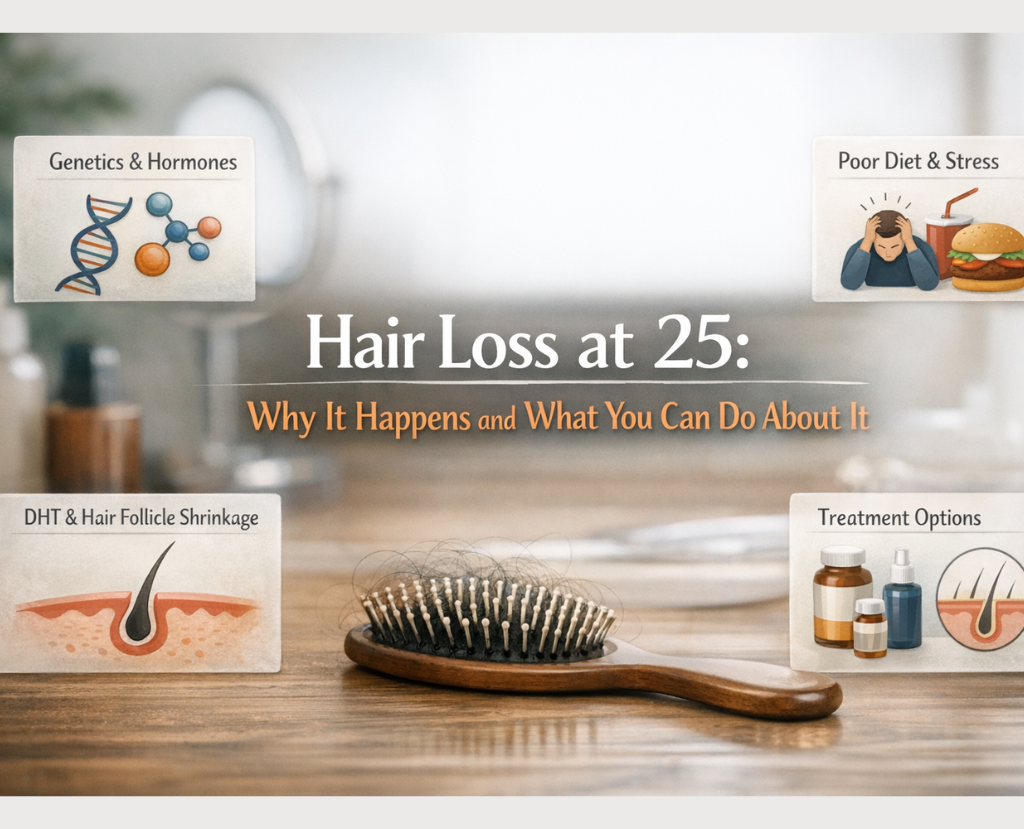
Hair Loss at 25: Why It Happens and What You Can Do About It
Waking up to strands of hair on your pillow at 25 can be deeply unsettling — and for many young men and women across the UK, it is an increasingly familiar experience. Hair loss is no longer a concern reserved for middle age. Thinning hair and excessive shedding are being reported by a growing number of people in their mid-twenties, often with little warning and no obvious cause.
The encouraging truth is that early-onset hair loss is highly treatable, particularly when addressed before the condition progresses. Understanding the root cause is the first and most critical step.
In this blog, the team at Cosmeticstar in Leeds breaks down the most common reasons behind hair loss at 25, the biology that drives it, and the non-surgical treatments that are helping people rebuild both their hair and their confidence.
Is Hair Loss at 25 Normal?
Whilst hair loss is widely associated with ageing, the science tells a more complex story. Thinning can begin as early as the late teens, and by their mid-twenties, a significant number of people are already noticing measurable changes in density, hairline definition, or overall volume.
Dermatological studies suggest that male pattern baldness affects approximately 25% of men before the age of 30. Among women, hormonal shifts, nutritional shortfalls, and stress-related conditions make early-onset hair loss equally prevalent — though far less openly discussed.
Hair loss at a young age is almost always linked to identifiable, treatable causes. The challenge is knowing which one applies to you.
Why Is Your Hair Falling Out at 25? The Most Common Causes
1. Androgenetic Alopecia — The Genetic Factor
The most prevalent cause of hair loss in both men and women is androgenetic alopecia — a hereditary condition driven by sensitivity to dihydrotestosterone (DHT), a hormone derived from testosterone. When DHT binds to susceptible hair follicles, it progressively miniaturises them, shortening the active growth cycle until the follicle ceases to produce visible hair.
In men, this typically manifests as a receding hairline or thinning at the crown. In women, it presents as a broader, diffuse thinning across the top of the scalp. A family history of hair loss significantly raises the likelihood of experiencing it yourself — but early intervention can dramatically alter the trajectory.
2. Hormonal Imbalances
Hormones are among the most powerful regulators of the hair growth cycle, and even modest imbalances can produce visible changes at the scalp. For women in their twenties, conditions such as polycystic ovary syndrome (PCOS), thyroid dysregulation, and fluctuations related to hormonal contraception are frequently responsible for hair thinning women report during this period.
Oestrogen and progesterone naturally extend the anagen (growth) phase of the hair cycle. When these hormones fall or become disrupted, follicles may shift prematurely into the resting phase, increasing the rate of shedding. In men, elevated DHT and testosterone imbalances are commonly implicated. A hormone profile forms an essential part of any thorough hair loss assessment.
3. Nutritional Deficiencies
Hair follicles are metabolically demanding structures that depend on a steady supply of key nutrients — particularly iron, ferritin, zinc, biotin, vitamin D, and B vitamins — to sustain healthy growth cycles. Deficiencies in any of these can disrupt follicular function and accelerate shedding.
This is a frequently underestimated cause of rapid hair loss in young adults, especially those following restrictive diets or managing gastrointestinal conditions that impair nutrient absorption. Low ferritin is particularly common among women experiencing excessive hair loss, even when standard blood results appear unremarkable.
4. Stress and Telogen Effluvium
Significant physical or emotional stress — from illness, bereavement, academic pressure, or lifestyle demands — can trigger a condition known as telogen effluvium. This occurs when a disproportionate number of follicles are simultaneously pushed into the resting phase, resulting in dramatic shedding that typically becomes noticeable two to four months after the triggering event.
For many young adults, this type of hair shedding appears to emerge out of nowhere, often coinciding with a particularly challenging period. Addressing the underlying stressor and supporting the body’s recovery is an essential component of effective hair shedding treatment in these cases.
5. Scalp Inflammation
The health of the scalp environment is a critical and often overlooked factor in hair loss. Conditions such as seborrhoeic dermatitis, scalp psoriasis, and folliculitis create a localised inflammatory response that disrupts nutrient delivery to the follicle and, if left unmanaged, can cause lasting follicular damage over time.
What Is Actually Happening to Your Hair Follicles?
Each hair follicle operates on a cyclical pattern comprising three phases: anagen (active growth), catagen (transition), and telogen (rest). Under normal conditions, the vast majority of follicles remain in the anagen phase at any given time, sustaining a healthy volume of hair on the scalp.
In hair loss conditions, this balance is disrupted. Follicles spend an increasing time in the dormant phase and a decreasing time growing. With each successive cycle, the hair produced becomes finer, shorter, and less pigmented — a process called miniaturisation. Without intervention, the follicle may eventually become inactive.
The important distinction is that in most early-to-moderate cases, the follicle is not dead — it is dormant. Given the right biological environment, it can be reactivated. This is the scientific basis behind regenerative hair treatments.
Non-Surgical Hair Restoration Treatments in Leeds
At Cosmeticstar in Leeds, we offer a range of evidence-informed, non-surgical treatments designed to address hair loss at the follicular level. These therapies work with your body’s own biology to support genuine, sustainable regrowth — without surgery, scarring, or significant downtime.
PRP Hair Treatment
Platelet-Rich Plasma (PRP) therapy draws on the regenerative power of your own blood. A small blood sample is processed to isolate a concentrated volume of growth-factor-rich plasma, which is then delivered directly into the scalp via fine injections. The growth factors contained within — including PDGF, VEGF, and IGF — stimulate dormant follicles, improve localised blood circulation, and extend the natural anagen phase.
PRP is particularly well-suited to individuals in the early-to-moderate stages of hair loss and has a well-established safety profile, given that it uses the patient’s own biological material. Learn more about PRP Hair Treatment in Leeds.
GFC Hair Therapy
Growth Factor Concentrate (GFC) therapy is an advanced refinement of the PRP process. Through a more sophisticated preparation method, GFC isolates a higher concentration of specific growth factors whilst removing the inflammatory components found in standard PRP. The result is a more targeted and often better-tolerated treatment that can deliver meaningful improvements in hair density and follicular health within a shorter treatment course.
GFC is particularly suited to patients with scalp sensitivity or those seeking enhanced results beyond standard PRP. Discover more about GFC Hair Therapy in Leeds.
Exosome Therapy
Exosome therapy represents the leading edge of regenerative hair medicine. Exosomes are microscopic vesicles released by stem cells, carrying growth signals, proteins, and messenger molecules that directly communicate with and reprogram target cells. When introduced to the scalp, exosomes have demonstrated a capacity to reactivate dormant follicles, modulate scalp inflammation, and accelerate the return of follicles to active growth — often with compelling results in patients who have had limited responses to other treatments.
Find out more about Exosome Therapy in Leeds.
Supporting Hair Regrowth from Within
Topical and injectable treatments work most effectively when the body’s internal environment supports healthy follicular function. This is why Cosmeticstar integrates targeted wellness therapies into our hair restoration approach.
IV Drip Therapy
Intravenous drip therapy delivers a precisely formulated blend of vitamins, minerals, and amino acids directly into the bloodstream, bypassing the digestive system for complete and immediate cellular uptake. Formulations can be tailored to include biotin, vitamin C, zinc, and B-complex vitamins — all of which play a direct role in sustaining an active, healthy hair growth cycle.
Explore our IV Drip Therapy in Leeds.
Vitamin Injections
For patients with specific nutritional gaps, intramuscular vitamin injections — particularly vitamin B12, vitamin D, and biotin — offer a highly efficient and fully absorbed alternative to oral supplementation. They are especially useful for individuals with known absorption difficulties or deficiencies that have failed to respond to dietary changes alone.
Learn more about our Vitamin Injections in Leeds.
Benefits of Non-Surgical Hair Restoration
- No surgery, no scarring, and minimal to no downtime
- Uses your body’s own biological material — significantly reducing risk
- Clinically informed, personalised treatment plans
- Natural-looking, progressive results that develop over time
- Suitable for both men and women across a range of hair loss patterns
- Treatments can be combined for improved and longer-lasting outcomes
- Supports overall scalp health, not just surface-level hair density
Practical Steps You Can Take Right Now
- Request a full blood panel, including ferritin, thyroid function, vitamin D, and zinc
- Reduce heat styling and avoid hairstyles that place consistent tension on the follicle
- Eat a varied diet with adequate protein, iron, and B vitamins
- Address chronic stress through sleep, structured routines, and professional support where needed
- Switch to a gentle, sulphate-free shampoo formulated for scalp health
- Stay consistent — hair growth cycles are slow, and results from any treatment take time
Begin Your Hair Restoration Journey at Cosmeticstar, Leeds
Whether you are noticing gradual thinning, sudden shedding, or changes to your hairline, the most effective course of action is an informed, professional assessment before the situation progresses.
At Cosmeticstar, our aesthetic specialists in Leeds will assess your hair loss in detail, identify any contributing factors, and design a personalised treatment plan built around your specific goals.
To get started, simply chat now — click the link and you will be redirected straight to WhatsApp, where our team is ready to help.
Conclusion
Hair loss at 25 is far more common than it is openly acknowledged, and in the vast majority of cases, it has a clear, addressable cause. Whether rooted in genetics, hormones, nutrition, or stress, early identification and the right treatment approach can make a significant difference to both outcomes and confidence.
With non-surgical options including PRP, GFC, and Exosome Therapy — supported by internal wellness treatments — sustainable hair regrowth is achievable. If you are in Leeds or the surrounding area, Cosmeticstar is here to help you take the next step with science-led, honest care.
Privacy Notice
Your data is handled in accordance with UK GDPR. Please review our Privacy Policy for full details.
Disclaimer
This blog is for educational purposes only. Always consult a qualified professional before beginning any treatment.
Frequently Asked Questions
Q: Can hair loss at 25 be reversed?
A: Yes — when caught early and treated appropriately, significant regrowth is achievable in most cases.
Q: How do I know if my hair loss is hormonal or genetic?
A: A clinical consultation and targeted blood tests will identify the cause accurately.
Q: Is PRP safe for someone in their twenties?
A: Absolutely — PRP uses your own blood, making it one of the safest treatments available at any adult age.
Q: How many sessions will I need to see results?
A: Most patients notice improvements within three to six months, with the exact number of sessions discussed during your consultation.
Q: Can stress alone cause significant hair loss?
A: Yes — telogen effluvium triggered by stress can cause substantial shedding, though it is typically reversible with the right support.