
5 PRP Myths Debunked (Does It Really Work?)
PRP hair treatment in Leeds has become increasingly well-known — and with that visibility has come a significant amount of misinformation. Some of it comes from clinics that overclaim. Some comes from people who had a poor experience with inadequate treatment and assumed the therapy itself was at fault. And some comes from the natural scepticism that any aesthetic treatment attracts when it becomes popular.
At Cosmeticstar in Leeds, we would rather give you an accurate picture than an impressive-sounding one. So here are the five most common myths about PRP hair treatment in Leeds — and the honest reality behind each of them.
Myth 1: PRP Hair Treatment Is Just a Trend With No Real Science Behind It
This is one of the most persistent myths about PRP hair treatment in Leeds, and it is demonstrably incorrect. Platelet-Rich Plasma therapy was originally developed in the 1970s for use in oral and maxillofacial surgery, wound healing, and orthopaedics. It has decades of medical use behind it. Its application to hair restoration is more recent — but the evidence base is real and growing.
Multiple randomised controlled trials have demonstrated statistically significant improvements in hair count, hair density, and hair shaft calibre in patients with androgenetic alopecia following PRP treatment compared to sham or placebo controls. The mechanism — growth factor-driven stimulation of the dermal papilla cells that regulate the hair growth cycle — is well-understood biologically. PRP hair treatment in Leeds at Cosmeticstar is delivered in line with this evidence, not despite it.
Myth 2: PRP Works for Everyone Equally
This is the other side of the overclaiming problem. PRP hair treatment in Leeds does not work equally well for all patients — and any clinic that suggests otherwise is not being straight with you. The effectiveness of PRP depends critically on the stage of hair loss, the number of biologically active follicles still present, the quality of the PRP preparation, the injection technique used, and whether any underlying nutritional or hormonal contributors to the hair loss have been identified and addressed.
PRP hair treatment in Leeds works best at early to moderate stages of androgenetic alopecia — when follicles are still present and capable of responding to growth factor stimulation. At very advanced stages, where the majority of follicles in a given area have been permanently inactive for years, the response is limited. Honest assessment at the outset — which is the starting point for every PRP hair treatment plan at Cosmeticstar in Leeds — determines whether you are likely to respond well before any treatment begins.
Myth 3: One Session of PRP Is Enough
PRP hair treatment in Leeds is not a one-and-done procedure. A single session delivers a useful growth factor stimulus — but not one that produces meaningful, sustained improvement in hair density on its own. The biological changes that PRP initiates — changes in dermal papilla cell activity, shifts in the proportion of follicles in the active growth phase, improvements in scalp circulation — need reinforcement over multiple sessions to produce the kind of result that is visible and lasting.
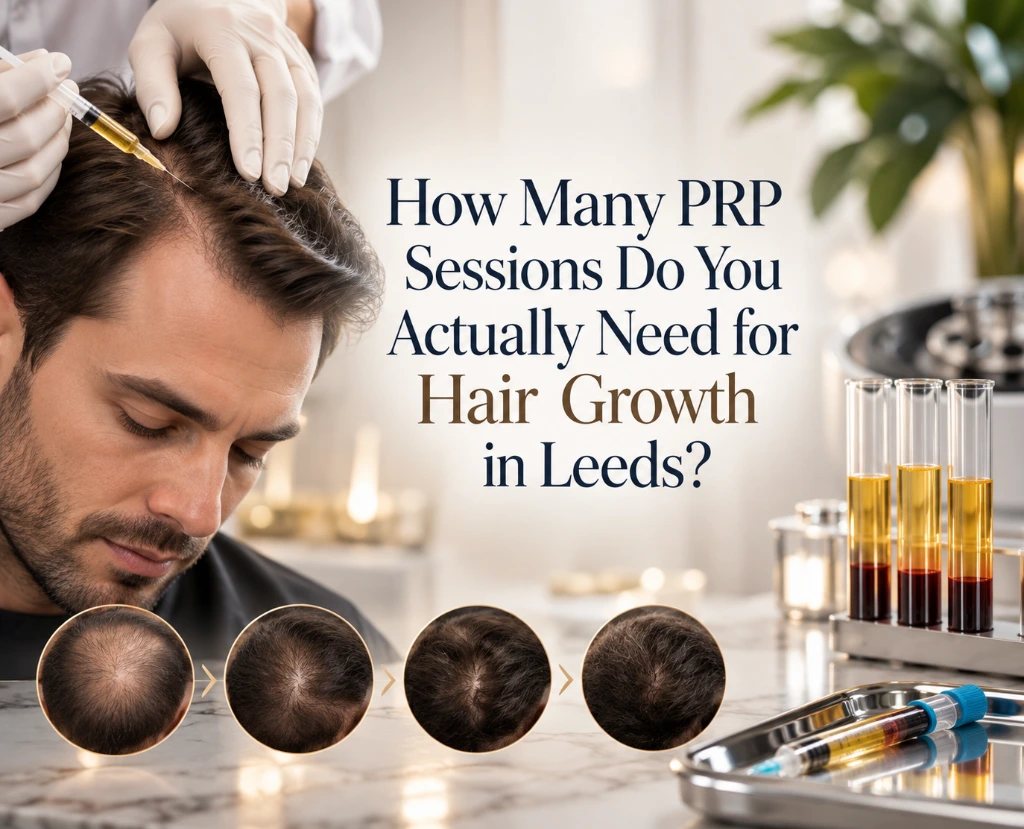
At Cosmeticstar in Leeds, the standard initial course of PRP hair treatment is three to four sessions, spaced four to six weeks apart, followed by a maintenance schedule. Patients who invest in a single session and report no result are frequently reporting accurately — not because PRP does not work, but because one session is not a complete treatment.
Myth 4: PRP Results Are Immediate
The follicular changes initiated by PRP hair treatment in Leeds are biological, not instant. The growth factors delivered through PRP stimulate processes — shifts in the hair growth cycle, changes in follicular cell activity, improvements in scalp vascularity — that take weeks to months to produce visible results at the surface level.
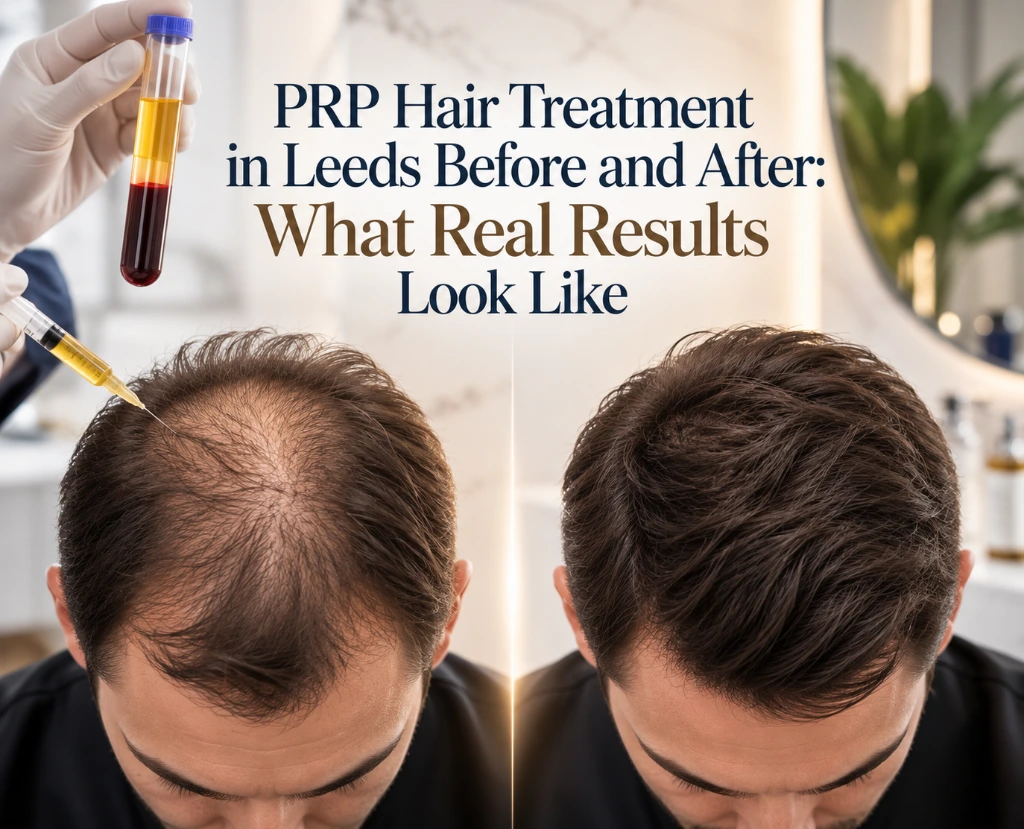
The typical timeline for PRP hair treatment in Leeds at Cosmeticstar: reduced shedding is often the first sign of response, appearing within four to eight weeks of the initial session. Visible improvement in density and strand quality typically becomes apparent between months two and four. The full result of an initial course is generally assessed at the three to six month mark after the final session. Patients who expect to see thicker hair immediately after a session are working with the wrong timeline — and this misunderstanding leads to premature conclusions about whether the treatment has worked.
Myth 5: All PRP Hair Treatment in Leeds Is the Same
This may be the most practically consequential myth of all. PRP hair treatment in Leeds varies enormously between clinics — in the centrifuge protocol used, the platelet concentration achieved, the injection technique applied, the expertise of the practitioner, and the supporting assessment and aftercare provided.
A PRP session that uses a low-grade centrifuge and achieves a minimal platelet concentration will produce a meaningfully weaker growth factor stimulus than one using a validated, high-concentration protocol. Injection technique — the depth, distribution, and volume of plasma delivered — directly affects how much of that stimulus reaches the follicles that need it. Practitioner experience in hair restoration specifically, rather than general aesthetic injectables, determines how well the treatment is mapped to your individual thinning pattern.
At Cosmeticstar in Leeds, our PRP Hair Treatment in Leeds protocol is designed around the clinical parameters that the evidence supports — not around minimising cost or maximising throughput.
Treatment Options at Cosmeticstar, Leeds
PRP Hair Treatment Leeds
Our PRP Hair Treatment in Leeds uses your own platelet-rich plasma to deliver a targeted growth factor stimulus directly to thinning follicles. Each session is individually planned around your hair loss pattern and current stage of thinning.
GFC Hair Therapy Leeds
For patients who want a more concentrated growth factor preparation or who have had a limited response to standard PRP, GFC Hair Therapy in Leeds delivers a more refined, higher-potency treatment with a lower inflammatory response and consistently stronger outcomes.
Red Light Therapy Leeds
Used alongside PRP or GFC, red light therapy supports hair restoration by increasing cellular energy in the scalp, reducing perifollicular inflammation, and improving blood flow to thinning areas — creating a significantly more receptive environment for growth factor treatments to work within.
Exosome Therapy Leeds
For patients who want to deepen their treatment response or who have not achieved the density improvement they were hoping for from PRP or GFC alone, Exosome Therapy in Leeds delivers concentrated regenerative signals directly to follicular tissue at the cellular communication level.
IV Drip Therapy & Vitamin Injections
Nutritional deficiencies in ferritin, vitamin D, and B12 are among the most common silent contributors to hair loss — and they limit how well any scalp treatment can perform. Our IV Drip Therapy in Leeds and Vitamin Injections in Leeds correct these deficiencies at the cellular level, giving your PRP treatment the internal environment it needs to produce its best results.
Ready to Take the Next Step?
If you have read conflicting things about PRP hair treatment in Leeds and want an honest, assessment-based conversation about whether it is genuinely right for your situation, the most useful thing you can do is speak to a clinic that takes the time to assess your specific situation properly before recommending anything. At Cosmeticstar in Leeds, that is exactly what we do. Chat now on WhatsApp — click the link and our team will be with you straight away.
Conclusion
PRP hair treatment in Leeds works — within a clearly defined clinical context, at the right stage of hair loss, delivered with the right preparation and technique, and with realistic expectations about the timeline and maintenance required. It is not a miracle, it is not a trend, and it is not the same everywhere. At Cosmeticstar in Leeds, we tell you what PRP can realistically do for your specific situation before any treatment begins — and we design a plan around that honest assessment.
Privacy Notice: Your data is handled in accordance with UK GDPR. Please review our Privacy Policy for full details.
Disclaimer: This blog is for educational purposes only. Always consult a qualified professional before beginning any treatment.
Frequently Asked Questions
Q: How do I know if PRP hair treatment in Leeds is right for me?
A: A proper clinical assessment at Cosmeticstar in Leeds — covering your hair loss pattern, stage, and any contributing nutritional or hormonal factors — is the only reliable way to determine whether PRP is likely to produce a meaningful response for your specific situation.
Q: What makes PRP hair treatment at Cosmeticstar in Leeds different?
A: The difference is in the detail — the quality of the PRP preparation protocol, the expertise of the practitioner, the thoroughness of the initial assessment, and the personalisation of the treatment plan. We do not apply a generic approach; we design each PRP plan around what the individual patient’s scalp actually needs.
Q: Can PRP fail even when done correctly?
A: Yes — not every patient responds to PRP hair treatment in Leeds, even when the preparation and technique are excellent. The most common reasons for limited response are a more advanced stage of hair loss than optimal for PRP, unaddressed nutritional deficiencies, or an underlying hormonal condition that has not been identified. If response is limited, the plan is reviewed and adjusted rather than simply repeated unchanged.
Q: Is the PRP used in Leeds different from PRP used elsewhere?
A: The underlying biology of PRP is the same everywhere, but the preparation quality varies. The platelet concentration, centrifuge protocol, and injection technique used at Cosmeticstar in Leeds are calibrated to the clinical evidence for what constitutes an effective growth factor stimulus for hair restoration.
Q: Does PRP stop hair loss permanently?
A: PRP hair treatment in Leeds slows and reduces hair loss while the treatment is ongoing and maintained — it does not stop androgenetic alopecia permanently. Regular maintenance sessions are needed to sustain the follicular improvements achieved through the initial course.