

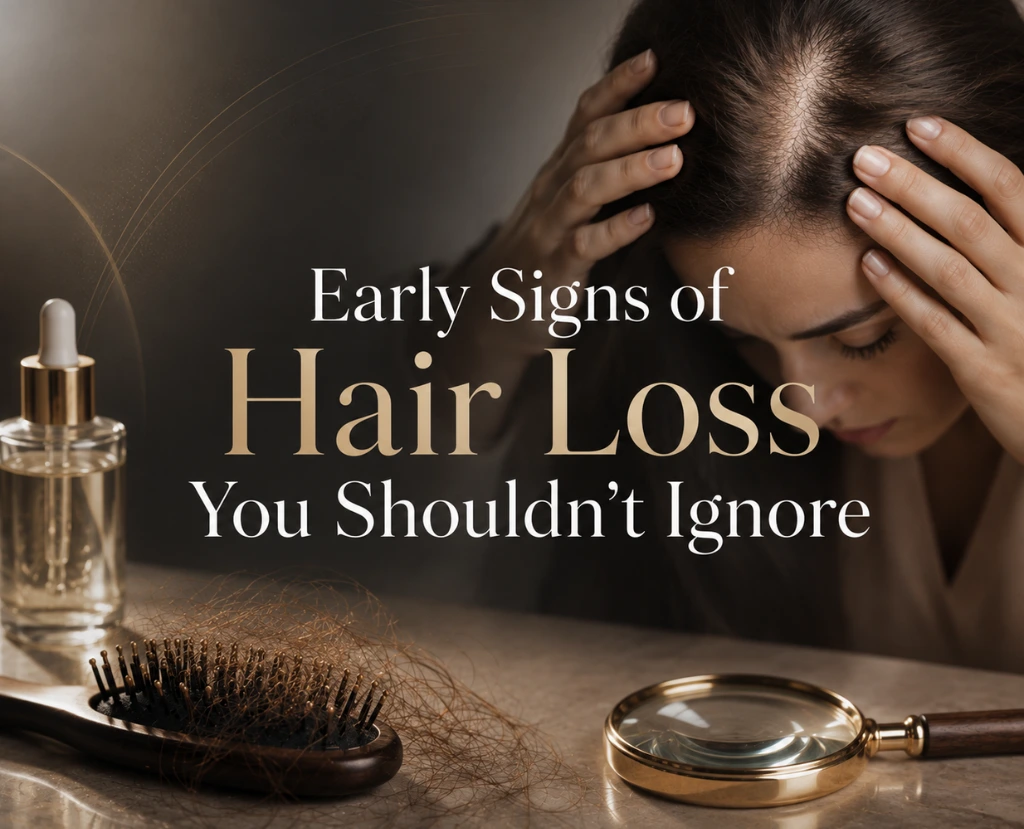
Early Signs of Hair Loss You Shouldn’t Ignore
Hair loss rarely announces itself dramatically. For most people, it begins gradually — a little more hair in the shower drain, a slightly thinner ponytail, a hairline that seems to have shifted. These early signs are easy to dismiss or attribute to stress, a new shampoo, or seasonal change. But the difference between catching hair loss early and addressing it after significant progression has occurred is the difference between reversing most of what has been lost and managing what is left.
At Cosmeticstar in Leeds, the patients who achieve the strongest hair restoration results are almost always those who came to us at an early stage. This blog explains the early signs of hair loss that are worth taking seriously — and why acting on them promptly, rather than waiting to see what happens, is almost always the right call.
Sign One: More Hair in the Shower or on Your Brush
Losing between 50 and 100 hairs per day is within the normal range of the hair growth cycle. But if you are noticing significantly more hair than usual collecting in the shower drain, on your pillow, or on your brush — particularly if this has been consistently elevated for more than a few weeks — it is worth paying attention. The key indicator is change from your personal baseline, not a fixed number.
Seasonal shedding in autumn can cause a temporary increase that resolves on its own. Shedding that persists beyond six to eight weeks, or that follows a significant stressor (illness, surgery, emotional trauma) two to three months earlier, is more likely to reflect a genuine change in your hair cycle that benefits from proper assessment.
Sign Two: A Wider Hair Part
One of the earliest visible signs of female pattern hair loss and diffuse thinning is a part that appears wider than it used to. Because the hairs in the parting zone are being replaced by finer, shorter strands — the classic miniaturisation pattern of androgenetic alopecia — the scalp becomes more visible through the parting over time. This change is subtle at first and easy to rationalise. Noticing it consistently across different lighting conditions is a sign worth acting on.
Sign Three: A Hairline That Appears to Have Moved
Hairline recession in men typically begins at the temples — producing the characteristic M-shaped recession of early androgenetic alopecia. This can begin in the early twenties and is easy to rationalise as a natural maturing of the hairline rather than progressive hair loss. The distinction matters: a maturing hairline typically stabilises; progressive recession does not. If your hairline appears to be moving backward over time — not just settling from a very straight juvenile line — it is worth having it assessed.
Sign Four: Scalp Visibility at the Crown
Increased scalp visibility at the crown — particularly under bright or overhead lighting — is one of the most commonly reported early observations by men with androgenetic alopecia. The crown zone is typically where DHT-driven miniaturisation produces the earliest density reduction in male pattern hair loss, and the overhead lighting observation is often the first time patients become aware of it. A crown that is becoming progressively more visible over months is not a coincidence — it is an early sign of ongoing follicular miniaturisation.
Sign Five: Hair That Feels Finer or More Fragile
Miniaturising follicles produce progressively thinner, shorter, more fragile hair strands before they stop producing hair entirely. If your hair has gradually started to feel lighter, limper, or breaks more easily than it used to — without an obvious product or styling change — this textural shift may reflect the early stages of follicular miniaturisation. It is easy to attribute this to damage or product build-up, but it warrants investigation if it is persistent.
Sign Six: More Scalp Showing in Photographs Over Time
Photographs from a few years ago compared to current ones can be a surprisingly objective way to assess whether hair density has genuinely changed. Most people’s perception of their own hair density is influenced by daily familiarity — the change happens slowly enough that it is difficult to perceive in day-to-day observation. Comparing dated photographs, particularly from similar lighting conditions, often reveals progressive change that was not consciously registered.
Sign Seven: Persistent Scalp Itching or Tenderness
Perifollicular inflammation — low-grade inflammation in the tissue surrounding the hair follicle — is increasingly recognised as a contributor to androgenetic alopecia and other forms of hair loss. Persistent scalp itching, tenderness, or a feeling of tightness or sensitivity across the scalp, particularly in the thinning zones, can be an early indicator of this inflammatory process. It is worth mentioning to a practitioner rather than treating as an unrelated scalp complaint.
Why Acting Early Matters So Much
Every month that progressive hair loss continues without treatment, more follicles miniaturise further toward permanent inactivity. The follicular window — the period during which treatment can produce a meaningful response — is finite. Hair loss treatment in Leeds at Cosmeticstar, including PRP, GFC, and red light therapy, works with the follicles that are still biologically active. The more follicular activity there is to work with, the stronger the treatment response.
Patients who present at Norwood Stage 1 to 2 (men) or Ludwig Stage 1 (women) consistently achieve stronger, more sustained results from non-surgical hair loss treatment than those who wait until Stage 3 or 4 to seek help. The difference is not always dramatic in appearance at the time of presentation — but it is significant in terms of what treatment can achieve.
Treatment Options at Cosmeticstar, Leeds
PRP Hair Treatment Leeds
Our PRP Hair Treatment in Leeds uses your own platelet-rich plasma to deliver a concentrated growth factor stimulus directly to thinning follicles — stimulating the dermal papilla cells that regulate the hair growth cycle and supporting the production of stronger, denser strands from follicles that are still biologically active.
GFC Hair Therapy Leeds
For patients who want a more powerful growth factor intervention or who have seen a limited response to standard PRP, GFC Hair Therapy in Leeds provides a more refined, higher-concentration preparation — with a lower inflammatory response at the injection site and consistently stronger outcomes for patients with more significant or faster-progressing thinning.
Red Light Therapy Leeds
Used alongside PRP or GFC, Red light therapy In leeds by increasing cellular energy in the scalp, reducing perifollicular inflammation, and improving blood flow to thinning areas — creating a significantly more receptive environment for growth factor treatments to work within, and maintaining that environment between sessions.
Exosome Therapy Leeds
For patients who want to deepen their treatment response, Exosome Therapy in Leeds delivers concentrated regenerative signals directly to follicular tissue at the cellular communication level — working synergistically with both PRP and red light therapy to produce a more comprehensive biological stimulus.
Ready to Take the Next Step?
If you have noticed one or more of these early signs and want a proper clinical assessment of what is happening and what the right response is, the most useful thing you can do is speak to a clinic that takes the time to assess your specific situation properly before recommending anything. At Cosmeticstar in Leeds, that is exactly what we do. Chat now on WhatsApp — click the link and our team will be with you straight away.
Conclusion
The early signs of hair loss are easy to miss, easy to dismiss, and genuinely worth acting on. The patients who achieve the best results from hair loss treatment in Leeds are those who come to us early — when follicular activity is still robust and the treatment response is strongest. At Cosmeticstar in Leeds, an honest initial assessment is always the starting point — and we will tell you clearly what we see and what we recommend, without overstating or understating what is there.
Privacy Notice: Your data is handled in accordance with UK GDPR. Please review our Privacy Policy for full details.
Disclaimer: This blog is for educational purposes only. Always consult a qualified professional before beginning any treatment.
Frequently Asked Questions
Q: How much daily hair loss is normal?
A: Losing between 50 and 100 hairs per day is within the normal range of the hair growth cycle. The key is change from your personal baseline — if you are noticing significantly more hair than you used to lose consistently over several weeks, it warrants investigation.
Q: Can early hair loss be reversed?
A: Hair loss caught at an early stage — when follicles are still active and responsive — has a much higher chance of meaningful reversal through PRP, GFC, or red light therapy than hair loss that is identified at a more advanced stage. The follicular window for treatment is finite, which is why early action matters.
Q: What is the earliest age at which hair loss can start?
A: Androgenetic alopecia can begin in the late teens or early twenties in individuals with a strong genetic predisposition. Noticing early signs of hairline recession or crown thinning in your twenties is not unusual and is worth assessing promptly rather than waiting to see how it progresses.
Q: How do I know if my hair loss is genetic or something else?
A: A proper clinical assessment at Cosmeticstar in Leeds — including a review of your family history, hair loss pattern, and nutritional status — is the most reliable way to determine the primary driver of your hair loss. Many patients have a combination of genetic and non-genetic contributing factors, and identifying all of them produces the best treatment outcomes.
Q: Should I see someone about hair loss if I am not sure it is actually happening?
A: Yes — the downside of having an assessment and being told your hair is within normal range is very low. The downside of delaying assessment for months or years while progressive hair loss continues is significant. At Cosmeticstar in Leeds, we give you an honest, clear picture of what is happening — whatever that picture turns out to be.