
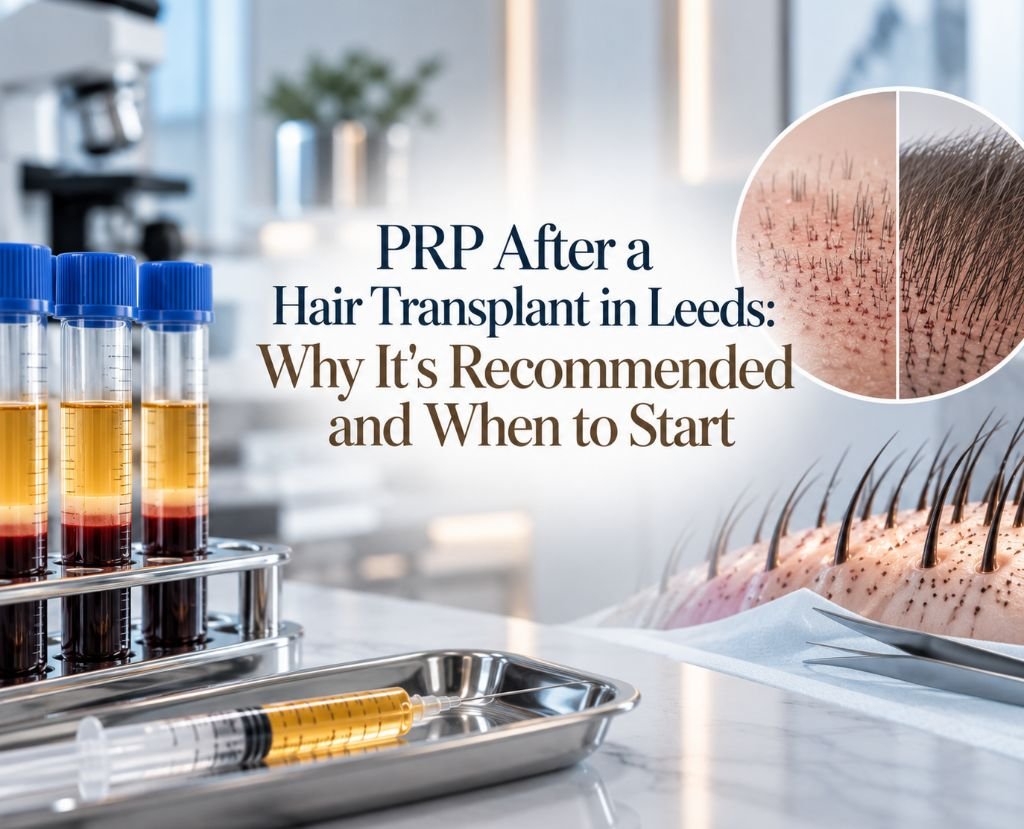
PRP After a Hair Transplant in Leeds: Why It’s Recommended and When to Start
A hair transplant is one of the most significant investments in appearance a person can make — in terms of cost, recovery time, and the months of anticipation that follow while the result develops. Given that investment, it makes complete sense to do everything clinically available to maximise the outcome. PRP hair treatment in Leeds after a hair transplant is one of the most consistently supported recommendations in non-surgical hair restoration — not as an optional add-on, but as a clinically coherent approach to improving graft survival, accelerating recovery, and protecting the non-transplanted areas that continue to be subject to natural hair loss.
At Cosmeticstar in Leeds, post-transplant PRP hair treatment in Leeds is a frequently recommended part of our hair restoration support offering. This blog explains the clinical reasoning, the timing, and what patients can realistically expect from PRP after a hair transplant in Leeds.
What Happens to Transplanted Grafts After Surgery — and Why PRP Helps
During a hair transplant, follicular units are extracted from the donor zone and implanted into recipient sites across the thinning areas. Each graft’s blood supply is interrupted during the extraction and implantation process. In the days and weeks that follow, the transplanted follicles are in a biologically vulnerable state — establishing new vascular connections in their new location, managing the inflammatory response of the procedure, and navigating the shock loss phase in which most transplanted hairs shed before regrowing.
The quality of the recovery environment during this critical window has a direct and measurable impact on how many grafts successfully establish, how quickly new growth emerges, and how dense the final result is. PRP hair treatment in Leeds after a hair transplant improves this recovery environment through several mechanisms simultaneously.
Why PRP After a Hair Transplant in Leeds Works
Faster Vascularisation Around the Grafts
The most critical factor in graft survival is how quickly transplanted follicles re-establish their blood supply. VEGF (vascular endothelial growth factor) — one of the key growth factors concentrated in platelet-rich plasma — is directly responsible for stimulating the formation of new blood vessels around the grafts. PRP hair treatment in Leeds delivered post-transplant upregulates VEGF in the treated tissue, accelerating the vascularisation process and increasing the proportion of grafts that receive adequate oxygen and nutrition during the vulnerable early weeks.
Reduced Post-Surgical Inflammation
Post-transplant inflammation is a natural and necessary part of healing — but when it is excessive or prolonged, it creates a less hospitable environment for graft survival. Platelet-rich plasma has well-documented anti-inflammatory properties, reducing the production of pro-inflammatory cytokines and accelerating the resolution of the inflammatory phase. Patients who receive PRP after their hair transplant consistently report reduced swelling, faster surface healing, and a more comfortable recovery overall.
Earlier Regrowth
The shock loss phase — in which transplanted hairs shed before the grafts re-enter the active growth phase — is one of the most psychologically difficult aspects of the post-transplant experience. The waiting period between shock loss and the emergence of new growth is typically three to four months. PRP hair treatment in Leeds after a hair transplant, by stimulating dermal papilla cell activity and enhancing cellular energy in the transplanted follicles, encourages re-entry into the anagen phase earlier than the standard timeline. Clinical observation consistently shows that patients using PRP post-transplant begin seeing new growth two to four weeks ahead of the typical schedule.
Protecting the Non-Transplanted Areas
A hair transplant addresses the areas treated — but androgenetic alopecia continues in the non-transplanted zones surrounding the grafted areas. Without ongoing treatment to these surrounding zones, progressive thinning can gradually undermine the natural appearance of the transplant result. PRP hair treatment in Leeds applied across the wider scalp, including the non-transplanted areas, simultaneously supports follicular health in these zones — reducing the rate of further thinning and contributing to a more uniform, natural-looking overall result.
When to Start PRP After a Hair Transplant in Leeds
Timing is important. The scalp needs adequate initial healing before additional biological stimulus is appropriate. At Cosmeticstar in Leeds, the standard recommendation is to begin PRP hair treatment two to four weeks post-transplant — once surface healing at the graft sites is well-established and the acute inflammatory phase has resolved. Starting too early risks disrupting the early graft healing process; starting too late misses the window in which PRP can most effectively support vascularisation and reduce inflammatory burden.
The typical post-transplant PRP protocol at Cosmeticstar in Leeds: three sessions beginning at four weeks, six weeks, and three months post-surgery, followed by six-monthly maintenance. This schedule is adapted based on individual recovery progress and the pace of new growth emerging.
PRP and Red Light Therapy After Hair Transplant in Leeds
Combining post-transplant PRP with Red light therapy creates a comprehensive recovery support protocol. Red light therapy is often safe to begin as early as 48 to 72 hours post-transplant for its anti-inflammatory effects on the broader scalp, and continues through the recovery period to maintain improved scalp circulation and cellular energy — complementing the growth factor stimulus of each PRP session. The combination is one of the most clinically coherent approaches to post-transplant recovery support available in Leeds.
Hair Loss Treatments at Cosmeticstar Leeds
PRP Hair Treatment Leeds
Our PRP hair treatment in Leeds uses your own platelet-rich plasma — concentrated via centrifuge and injected precisely into thinning scalp zones — to deliver a targeted growth factor stimulus directly to dormant and miniaturising hair follicles. Every session is individually mapped to your hair loss pattern.
GFC Hair Therapy Leeds
For patients who want a more powerful growth factor intervention than standard platelet-rich plasma therapy, GFC Hair Therapy in Leeds provides a more refined, higher-concentration preparation with a lower inflammatory response and consistently stronger outcomes — particularly for moderate to advanced androgenetic alopecia.
Red Light Therapy Leeds
Used alongside PRP or GFC, Red light therapy by increasing cellular energy in the scalp at the mitochondrial level, reducing perifollicular inflammation, and improving blood flow to thinning follicles — creating a significantly more receptive environment for platelet-rich plasma growth factors to work within.
Exosome Therapy Leeds
For patients who want to deepen their hair restoration response beyond what PRP or GFC alone can achieve, Exosome Therapy in Leeds delivers concentrated regenerative signals directly to follicular tissue — working synergistically with platelet-rich plasma to produce a more comprehensive biological stimulus.
Book a PRP Hair Consultation in Leeds
If you have recently had or are planning a hair transplant in Leeds and want to understand how PRP and other non-surgical treatments can be used to maximise your result and protect the non-transplanted areas, the most useful next step is a proper clinical assessment — not a generic online quiz or a sales call. At Cosmeticstar in Leeds, we assess your specific hair loss pattern, stage, and contributing factors before making any recommendation. Chat with us now on WhatsApp and our team will get back to you straight away.
Conclusion
PRP hair treatment in Leeds after a hair transplant is not a nice-to-have — it is a clinically grounded intervention that improves graft survival, accelerates regrowth, reduces recovery discomfort, and protects the surrounding areas that continue to be subject to natural hair loss. At Cosmeticstar in Leeds, we support post-transplant patients with a properly sequenced PRP and red light therapy protocol designed to give every transplant the best possible outcome.
Privacy Notice: Your data is handled in accordance with UK GDPR. Please review our Privacy Policy for full details.
Disclaimer: This blog is for educational purposes only and does not constitute medical advice. Always consult a qualified practitioner before beginning any hair loss treatment.
Frequently Asked Questions
Q: When should I start PRP after a hair transplant in Leeds?
A: At Cosmeticstar in Leeds, PRP hair treatment typically begins two to four weeks after a hair transplant — once surface healing at the graft sites is well-established. Exact timing is determined by individual recovery progress rather than a fixed calendar date.
Q: How many PRP sessions are needed after a hair transplant in Leeds?
A: A typical post-transplant PRP protocol at Cosmeticstar involves three sessions in the first three months post-surgery, followed by six-monthly maintenance. The schedule is adapted based on recovery progress and the emergence of new growth from the transplanted follicles.
Q: Does PRP improve hair transplant results in Leeds?
A: The clinical evidence supports a meaningful improvement in graft survival, growth timeline, and density from PRP hair treatment in Leeds after a hair transplant. Patients using PRP post-transplant at Cosmeticstar consistently experience faster recovery, earlier new growth emergence, and stronger final density compared to those who do not use PRP support.
Q: Can I use red light therapy alongside PRP after a hair transplant in Leeds?
A: Yes — and the combination is one of the most comprehensive post-transplant recovery protocols available. Red light therapy can begin within 48 to 72 hours of surgery for its anti-inflammatory effect, with PRP sessions added from two to four weeks onwards. The two approaches are synergistic and complement each other effectively throughout the recovery period.
Q: Is PRP needed for both FUE and FUT transplants?
A: Yes — the graft survival and recovery support that PRP hair treatment in Leeds provides is relevant and beneficial for both FUE (follicular unit extraction) and FUT (follicular unit transplant) procedures. The biological mechanisms of graft vulnerability during the recovery phase are the same regardless of the surgical technique used.