
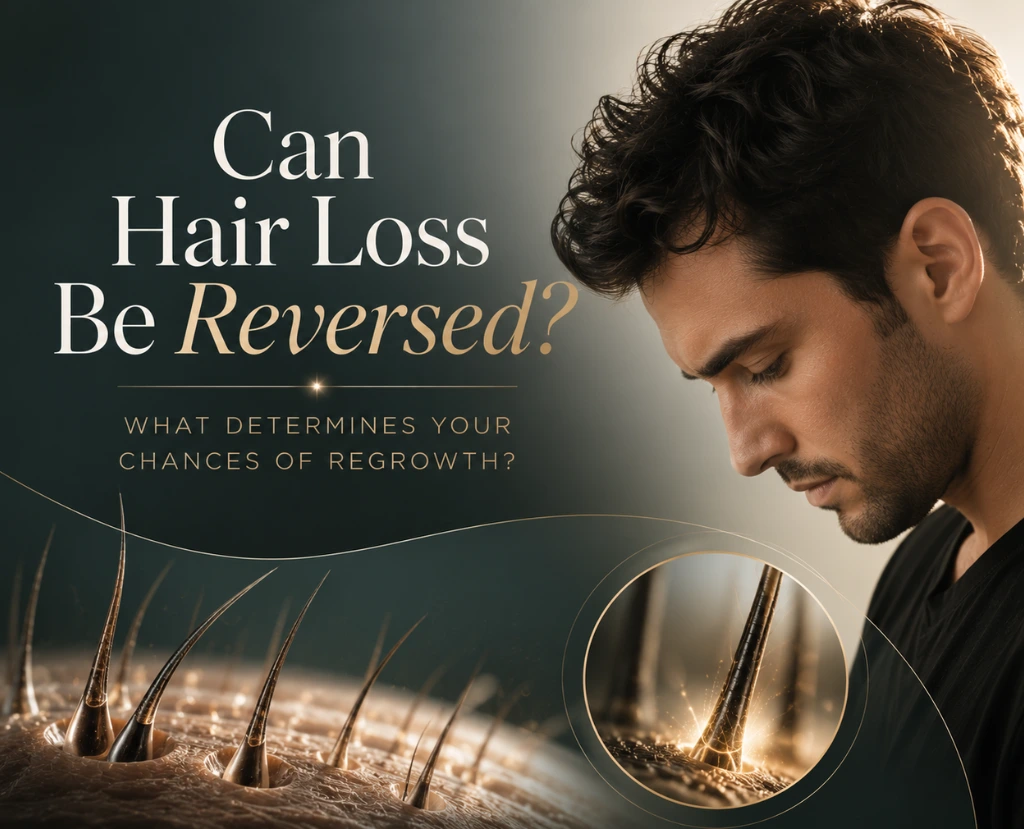
Can Hair Loss Be Reversed? What Determines Your Chances of Regrowth?
The question of whether hair loss can be reversed is one that deserves a straight answer rather than either false optimism or unnecessary pessimism. The honest answer is: it depends — on the type of hair loss, the stage it has reached, the biological activity still remaining in the affected follicles, and how promptly treatment is started. For many people, meaningful reversal or significant improvement is achievable. For others, the realistic goal is stabilisation and improvement rather than full restoration.
At Cosmeticstar in Leeds, we give every patient an honest assessment of their regrowth potential before any treatment begins. This blog explains the factors that determine whether hair loss can be reversed — and what hair loss treatment in Leeds can realistically achieve for your specific situation.
Factor One: The Type of Hair Loss
Different types of hair loss have fundamentally different reversal potential.
Telogen effluvium — stress-triggered or nutritionally driven diffuse shedding — has excellent reversal potential. The follicles are not permanently damaged; they have been temporarily suppressed. Once the triggering cause is resolved and the follicular environment is restored, most patients achieve full or near-full recovery of density. Hair loss treatment in Leeds focused on nutritional correction and follicular reactivation through PRP significantly accelerates this recovery.
Androgenetic alopecia — DHT-driven follicular miniaturisation — is a more complex picture. The follicular damage is progressive and cumulative, and full reversal becomes progressively less achievable as miniaturisation advances. At early stages, PRP and GFC hair treatment in Leeds can produce meaningful improvement in density — genuine regrowth in areas where follicles are still active. At advanced stages, the goal shifts from restoration to stabilisation and improvement of what remains.
Scarring alopecias involve permanent destruction of follicular tissue and cannot be reversed through any non-surgical approach. Early specialist management to arrest the inflammatory process is the appropriate response.
Factor Two: The Stage of Hair Loss
This is the single most important variable in determining regrowth potential. The hair follicle exists on a continuum: miniaturising follicles that are still producing some hair — however fine — are biologically active and capable of responding to treatment. Follicles that have been completely inactive for an extended period have significantly lower (and in some cases negligible) regenerative capacity.
This is why the advice to act early is not a marketing line — it is a clinical reality. Every month of untreated progressive androgenetic alopecia narrows the follicular window. Patients who present for hair loss treatment in Leeds at Norwood Stage 1 to 2 consistently achieve stronger regrowth than those who wait until Stage 4 or 5. The follicles that are still miniaturising but active at Stage 2 may be permanently inactive at Stage 5.
Factor Three: Duration of Hair Loss
How long hair loss has been progressing before treatment begins matters. A follicle that has been in a non-productive state for two years has a meaningfully lower chance of responding to PRP or GFC than one that has been miniaturising for six months. Duration is not the only factor — some follicles maintain biological potential for longer than others — but it is an important one. This is another argument for early presentation: the shorter the duration of untreated miniaturisation, the greater the regrowth potential.
Factor Four: The Quality of the Treatment Delivered
Not all hair loss treatment in Leeds is equivalent. The quality of PRP preparation, the expertise of the practitioner, the appropriateness of the treatment to the specific pattern, and whether contributing factors like nutritional deficiency have been addressed all significantly affect the outcome. Patients who have had poorly designed or poorly delivered treatment previously and concluded that PRP or other modalities do not work may not have had an accurate test of what well-designed treatment can achieve.
Factor Five: Combination Treatment Approach
The probability of meaningful regrowth improves significantly when multiple complementary approaches are used together. PRP Hair Treatment in Leeds combined with Red light therapy In leeds addresses the follicular environment from multiple angles simultaneously — creating conditions more conducive to genuine regrowth than any single modality can achieve alone.
Being Honest About What Treatment Can Achieve
At Cosmeticstar in Leeds, we make clear to every patient what the realistic expectation is for their specific situation. For some, that is genuine density recovery — new, stronger strands growing from follicles that have been responding to treatment. For others, it is a meaningful slowing of progression, a noticeable improvement in hair quality, and the maintenance of the density they currently have. For patients at very advanced stages, the conversation about hair transplant surgery as part of the overall plan is part of the honest assessment we provide.
Treatment Options at Cosmeticstar, Leeds
PRP Hair Treatment Leeds
Our PRP Hair Treatment in Leeds uses your own platelet-rich plasma to deliver a concentrated growth factor stimulus directly to thinning follicles — stimulating the dermal papilla cells that regulate the hair growth cycle and supporting the production of stronger, denser strands from follicles that are still biologically active.
GFC Hair Therapy Leeds
For patients who want a more powerful growth factor intervention or who have seen a limited response to standard PRP, GFC Hair Therapy in Leeds provides a more refined, higher-concentration preparation — with a lower inflammatory response at the injection site and consistently stronger outcomes for patients with more significant or faster-progressing thinning.
Red Light Therapy Leeds
Used alongside PRP or GFC, Red light therapy In leeds by increasing cellular energy in the scalp, reducing perifollicular inflammation, and improving blood flow to thinning areas — creating a significantly more receptive environment for growth factor treatments to work within, and maintaining that environment between sessions.
Exosome Therapy Leeds
For patients who want to deepen their treatment response, Exosome Therapy in Leeds delivers concentrated regenerative signals directly to follicular tissue at the cellular communication level — working synergistically with both PRP and red light therapy to produce a more comprehensive biological stimulus.
Ready to Take the Next Step?
If you want to understand honestly what hair loss treatment in Leeds can achieve for your specific type, stage, and duration of hair loss before committing to any approach, the most useful thing you can do is speak to a clinic that takes the time to assess your specific situation properly before recommending anything. At Cosmeticstar in Leeds, that is exactly what we do. Chat now on WhatsApp — click the link and our team will be with you straight away.
Conclusion
Whether your hair loss can be reversed depends on factors that can only be properly assessed through a proper clinical consultation — not a website, not a forum, and not the experience of someone with a different type or stage of loss. At Cosmeticstar in Leeds, we give you an honest picture of your regrowth potential and design a treatment plan around that reality — not around what you want to hear.
Privacy Notice: Your data is handled in accordance with UK GDPR. Please review our Privacy Policy for full details.
Disclaimer: This blog is for educational purposes only. Always consult a qualified professional before beginning any treatment.
Frequently Asked Questions
Q: Can PRP reverse hair loss completely?
A: PRP can produce genuine regrowth — new, stronger strands from follicles that have been stimulated by the growth factor delivery — particularly at early to moderate stages of androgenetic alopecia. Complete reversal of advanced hair loss is not a realistic expectation from any non-surgical treatment. The honest goal is meaningful improvement in density, a significant slowing of progression, and the best possible quality of hair from the follicles that are still biologically active.
Q: What percentage of hair loss patients see regrowth with treatment?
A: Response rates in published clinical trials for PRP hair treatment typically show meaningful improvement in hair count and density in the majority of patients at early to moderate stages of androgenetic alopecia. At Cosmeticstar in Leeds, the response rate is supported by proper assessment — we do not recommend treatment to patients for whom the evidence suggests a limited response is likely.
Q: Is there a point at which hair loss cannot be treated?
A: At very advanced stages of androgenetic alopecia, where large areas of follicles have been permanently inactive for many years, non-surgical hair treatment has limited capacity to produce significant regrowth in the denuded areas. Hair transplant surgery is the appropriate option for coverage of these zones. Non-surgical treatment remains useful for the surrounding areas and for post-transplant support.
Q: Does age affect whether hair loss can be reversed?
A: Age is less important than the stage of hair loss and the biological activity remaining in the affected follicles. Many patients in their forties, fifties, and beyond achieve meaningful improvement from hair loss treatment in Leeds at Cosmeticstar. Earlier stage is more predictive of a strong response than younger age.
Q: How do I find out if my hair loss is reversible?
A: A clinical assessment at Cosmeticstar in Leeds — covering your hair loss pattern, stage, duration, and the density of biologically active follicles in the thinning areas — is the only reliable way to determine your individual regrowth potential. Contact us via WhatsApp to arrange a consultation.