
PRP for Androgenetic Alopecia in Leeds: Does Platelet-Rich Plasma Actually Regrow Hair?
Androgenetic alopecia — the clinical term for male and female pattern hair loss — is the most common cause of hair loss in the UK, affecting the majority of men to some degree by their fifties and a significant proportion of women, particularly after the menopause. It is also the condition for which PRP hair treatment in Leeds has the strongest and most consistent evidence base. But the question patients ask most honestly is: does platelet-rich plasma actually regrow hair, or does it just slow the loss?
The honest answer is both — depending on your stage, your follicular activity, and the quality of the treatment you receive. At Cosmeticstar in Leeds, this is the conversation we have with every patient before recommending PRP hair treatment in Leeds for androgenetic alopecia, because managing expectations accurately is the foundation of a good clinical relationship.
What Androgenetic Alopecia Actually Does to Hair Follicles
Androgenetic alopecia is driven by dihydrotestosterone (DHT) — a potent androgen derived from testosterone by the enzyme 5-alpha reductase. In people with a genetic predisposition, DHT binds to androgen receptors in the hair follicle, progressively shortening each successive hair growth cycle. The follicle does not die immediately — it miniaturises. Each growth cycle produces a finer, shorter, less pigmented strand than the one before. This miniaturisation continues cycle by cycle until the follicle produces essentially invisible vellus hair, and eventually enters prolonged dormancy.
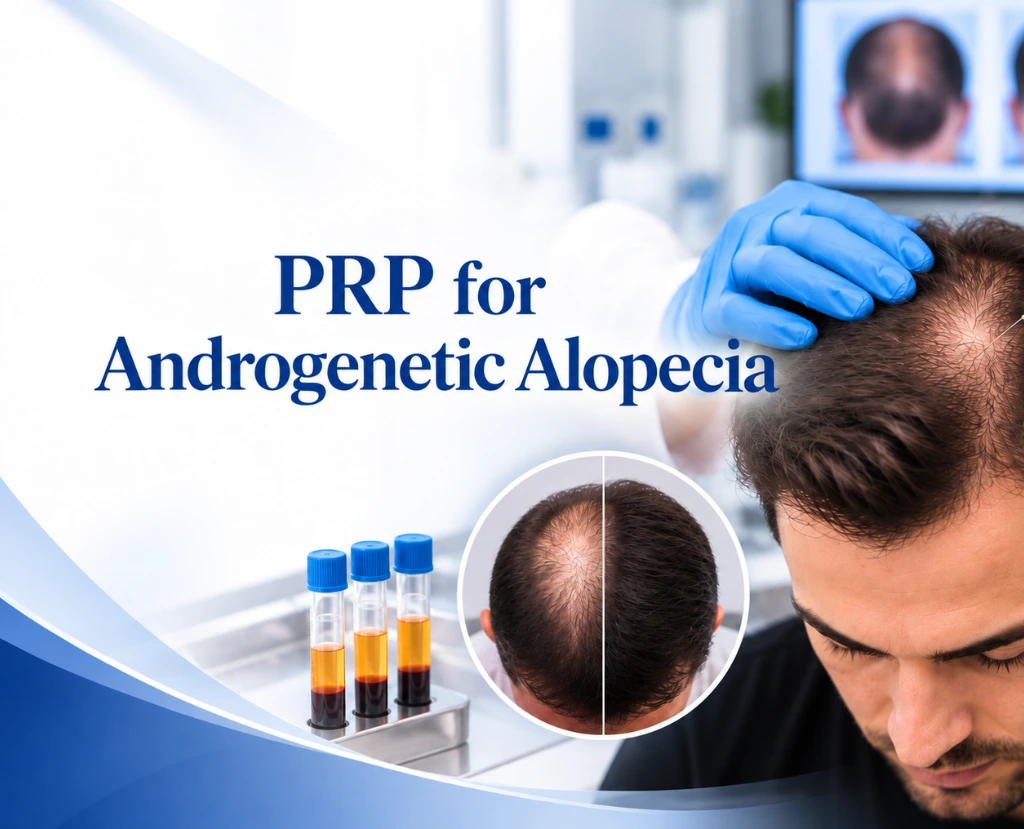
The clinical significance of this process for PRP hair treatment in Leeds is crucial: a miniaturising follicle that is still producing some hair — however fine — is biologically active and capable of responding to platelet-rich plasma growth factor stimulation. A follicle that has been in prolonged dormancy for years is not. This is why the stage of androgenetic alopecia at the time of starting PRP is the single most important predictor of how much regrowth is achievable.
What the Clinical Evidence Says About PRP for Androgenetic Alopecia
Multiple randomised controlled trials have investigated platelet-rich plasma therapy for androgenetic alopecia. The consistent finding across the better-quality studies is that PRP produces statistically significant improvements in hair density and hair shaft diameter in patients with early to moderate androgenetic alopecia, compared to placebo or sham controls. A 2024 systematic review identified that the majority of studies examining PRP for androgenetic alopecia demonstrated meaningful improvements in hair count and thickness, with a favourable safety profile.
The specific growth factors in platelet-rich plasma — particularly PDGF and VEGF — have known roles in hair follicle biology. PDGF stimulates dermal papilla cell proliferation and activity. VEGF promotes the formation of new blood vessels around the follicle, improving its oxygen and nutrient supply. IGF-1 extends the anagen (active growth) phase. Together, these effects translate to measurable improvements in follicular activity that the evidence consistently confirms.
Regrowth vs Stabilisation: The Honest Distinction
What PRP for Androgenetic Alopecia in Leeds Can Produce
At early stages (Norwood 1–3 in men, Ludwig 1–2 in women), platelet-rich plasma treatment in Leeds can produce genuine regrowth — new, thicker, stronger strands from follicles that were miniaturising but still biologically responsive. Patients at these stages frequently notice not just reduced shedding but visible improvements in density and coverage that represent actual follicular recovery, not just slowed loss.
At moderate stages (Norwood 3–4), PRP hair treatment in Leeds produces a combination of regrowth from still-active follicles and meaningful stabilisation — slowing the progression of androgenetic alopecia significantly and improving the quality and thickness of existing hair. The distinction between regrowth and stabilisation becomes more blurred at this stage, and both outcomes are clinically valuable.
What PRP for Androgenetic Alopecia in Leeds Cannot Produce
At advanced stages (Norwood 5–7), where large areas of the scalp have been follicle-free for extended periods, platelet-rich plasma treatment cannot restore what is no longer there. In these zones, the follicles have passed beyond the point of responsiveness to PRP. An honest conversation about hair transplant surgery as the appropriate option for these areas — combined with PRP for the surrounding areas that still have active follicles — is the right clinical response.
PRP for Male Pattern Baldness in Leeds
Male pattern baldness (androgenetic alopecia in men) presents along the Norwood Scale, typically beginning with temple recession and progressing to crown thinning and eventual confluence. PRP hair treatment in Leeds for male pattern baldness produces the strongest results at Norwood Stages 1 to 4, where follicles in the crown, mid-scalp, and residual hairline areas are still active and responsive.
For men with male pattern baldness in Leeds, the most effective approach at Cosmeticstar combines PRP with Red light therapy — which addresses the scalp inflammation component of androgenetic alopecia that platelet-rich plasma alone does not fully target — and with nutritional assessment to identify any deficiencies in ferritin, vitamin D, or B12 that are compounding the androgenetic process.
PRP for Female Pattern Hair Loss in Leeds
Female pattern hair loss (androgenetic alopecia in women) follows the Ludwig distribution — diffuse thinning across the crown and top of the scalp with the hairline typically preserved. It is driven by a combination of genetic predisposition and the relative influence of androgens, which increases as oestrogen declines during perimenopause and menopause.
PRP hair treatment in Leeds for female pattern hair loss consistently produces strong results, particularly when treatment begins at an early stage and is combined with assessment and correction of any nutritional deficiencies through IV Drip Therapy in Leeds or Vitamin Injections in Leeds. Women with female pattern hair loss at Cosmeticstar frequently report meaningful density improvements across the crown within three to five months of starting a platelet-rich plasma course.
Maximising PRP Results for Androgenetic Alopecia in Leeds
The probability of achieving genuine regrowth from PRP for androgenetic alopecia in Leeds is significantly improved by the right combination approach. At Cosmeticstar, the most effective protocol for androgenetic alopecia combines:
- Platelet-rich plasma or GFC hair therapy to deliver the primary growth factor stimulus directly to thinning follicles.
- Red light therapy to reduce perifollicular inflammation, improve scalp circulation, and enhance cellular energy in follicular tissue — creating a more receptive environment for PRP growth factors.
- Nutritional correction through IV Drip Therapy or Vitamin Injections where ferritin, vitamin D, or B12 deficiencies are identified as contributing factors.
- A maintenance schedule of PRP sessions every six months to sustain the follicular improvements achieved through the initial course.
Hair Loss Treatments at Cosmeticstar Leeds
PRP Hair Treatment Leeds
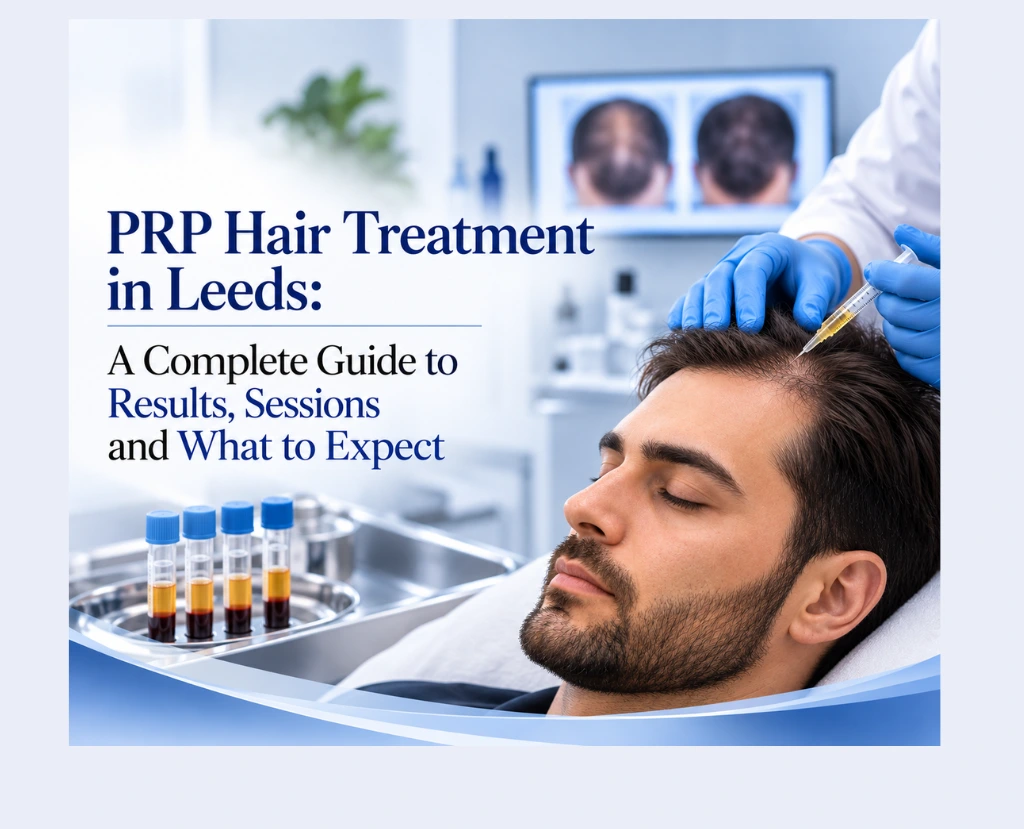
Our PRP hair treatment in Leeds uses your own platelet-rich plasma — concentrated via centrifuge and injected precisely into thinning scalp zones — to deliver a targeted growth factor stimulus directly to dormant and miniaturising hair follicles. Every session is individually mapped to your hair loss pattern.
GFC Hair Therapy Leeds
For patients who want a more powerful growth factor intervention than standard platelet-rich plasma therapy, GFC Hair Therapy in Leeds provides a more refined, higher-concentration preparation with a lower inflammatory response and consistently stronger outcomes — particularly for moderate to advanced androgenetic alopecia.
Red Light Therapy Leeds
Used alongside PRP or GFC, Red light therapy by increasing cellular energy in the scalp at the mitochondrial level, reducing perifollicular inflammation, and improving blood flow to thinning follicles — creating a significantly more receptive environment for platelet-rich plasma growth factors to work within.
Exosome Therapy Leeds
For patients who want to deepen their hair restoration response beyond what PRP or GFC alone can achieve, Exosome Therapy in Leeds delivers concentrated regenerative signals directly to follicular tissue — working synergistically with platelet-rich plasma to produce a more comprehensive biological stimulus.
IV Drip Therapy & Vitamin Injections Leeds
Nutritional deficiencies in ferritin, vitamin D, and B12 are among the most common silent contributors to hair loss in Leeds patients — and they limit how well platelet-rich plasma treatment can perform. Our IV Drip Therapy in Leeds and Vitamin Injections in Leeds correct these deficiencies at the cellular level, giving every PRP session the internal environment it needs to produce its strongest results.
Book a PRP Hair Consultation in Leeds
If you have been diagnosed with or suspect androgenetic alopecia and want to understand whether PRP hair treatment in Leeds can produce genuine regrowth for your specific stage of male or female pattern hair loss, the most useful next step is a proper clinical assessment — not a generic online quiz or a sales call. At Cosmeticstar in Leeds, we assess your specific hair loss pattern, stage, and contributing factors before making any recommendation. Chat with us now on WhatsApp and our team will get back to you straight away.
Conclusion
PRP for androgenetic alopecia in Leeds can genuinely regrow hair — not as a miracle, but as a clinically evidenced biological stimulus that is most effective when started early, delivered correctly, and combined with the right complementary approaches. At Cosmeticstar in Leeds, we give every patient an honest assessment of their androgenetic alopecia stage and regrowth potential — because the goal is a result you can actually see, not a promise that looks good on paper.
Privacy Notice: Your data is handled in accordance with UK GDPR. Please review our Privacy Policy for full details.
Disclaimer: This blog is for educational purposes only and does not constitute medical advice. Always consult a qualified practitioner before beginning any hair loss treatment.
Frequently Asked Questions
Q: Does PRP actually work for androgenetic alopecia in Leeds?
A: Yes — the clinical evidence for platelet-rich plasma in androgenetic alopecia is well-established, with multiple randomised controlled trials confirming improvements in hair density and thickness at early to moderate stages. At Cosmeticstar Leeds, we assess your stage before recommending treatment to ensure PRP is the right option for your specific pattern.
Q: How many PRP sessions does androgenetic alopecia need in Leeds?
A: An initial course of three to four PRP sessions, spaced four to six weeks apart, is standard for androgenetic alopecia at Cosmeticstar Leeds. Maintenance every six months is then recommended to sustain the follicular improvements and continue to counteract the ongoing DHT-driven miniaturisation process.
Q: Is PRP better than finasteride for androgenetic alopecia?
A: PRP and finasteride work through completely different mechanisms — finasteride reduces DHT production systemically; PRP delivers growth factors directly to follicular tissue. They are not directly comparable and are sometimes used in combination. At Cosmeticstar Leeds, we do not prescribe medications but work alongside any medical management our patients are receiving.
Q: Can women with androgenetic alopecia benefit from PRP in Leeds?
A: Yes — women with female pattern hair loss (Ludwig Stage 1 to 2) frequently achieve excellent results from PRP hair treatment in Leeds. The approach at Cosmeticstar is adapted to the diffuse thinning distribution of female androgenetic alopecia, with broader coverage across the crown and vertex zones.
Q: What is the difference between PRP and GFC for androgenetic alopecia?
A: GFC (Growth Factor Concentrate) delivers a more refined and more concentrated growth factor preparation than standard PRP, with a lower inflammatory response at the injection site. For patients with more significant or faster-progressing androgenetic alopecia, GFC Hair Therapy in Leeds is increasingly the preferred option at Cosmeticstar, producing a stronger and more sustained biological stimulus.