
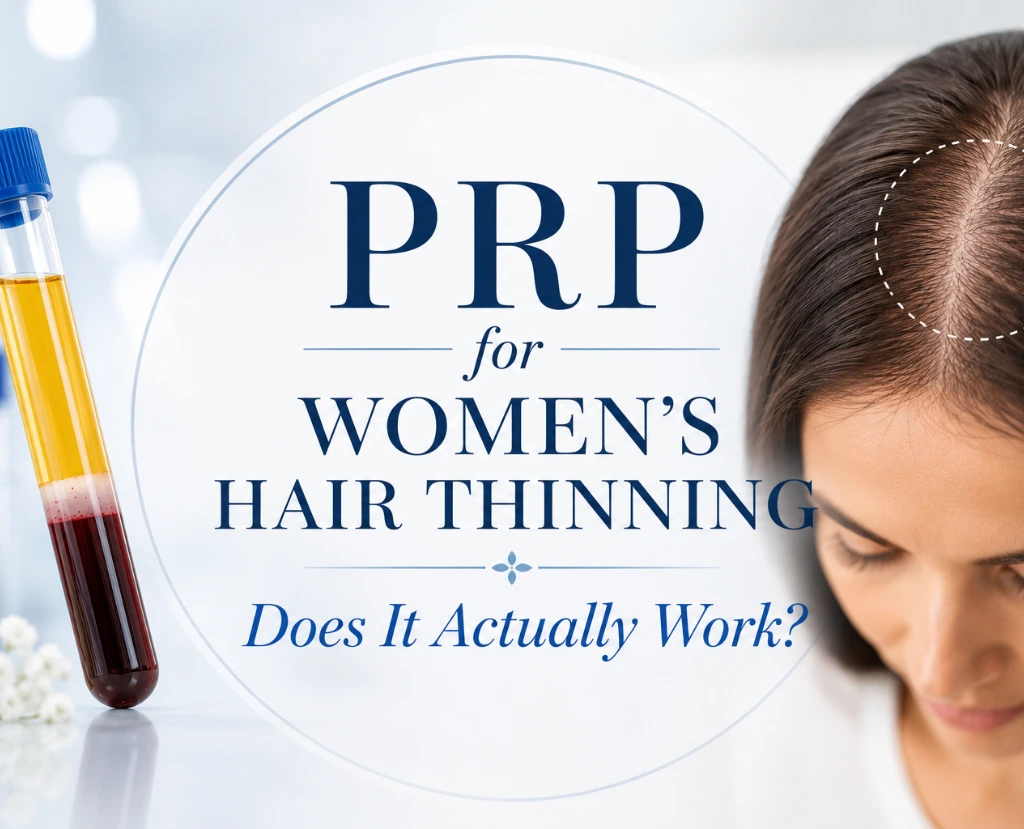
PRP for Women’s Hair Thinning — Does It Actually Work?
Women’s hair thinning tends to sneak up on you. It is not usually a sudden, dramatic loss — it is the ponytail that gets a little thinner, the parting that looks a little wider, the handful of hair in the shower drain that is noticeably more than it used to be. And then one day you catch the light at a particular angle and realise you can see your scalp in places you never used to.
At Cosmeticstar in Leeds, this is one of the most common presentations we see — and one of the most treatable. PRP hair treatment for women in Leeds is something we deliver regularly, with consistently encouraging clinical outcomes. But does it actually work? Here is the honest answer.
Why Women Lose Hair Differently
Female hair thinning is driven by a more complex and varied set of causes than male pattern baldness — and that complexity is one of the reasons it gets mismanaged so often. The most common driver is androgenetic alopecia in the female pattern, which tends to produce diffuse thinning across the top of the scalp rather than the receding hairline typically seen in men. But oestrogen fluctuations, thyroid dysfunction, low ferritin, postpartum hormonal shifts, and chronic stress can all produce significant shedding independently of or alongside genetic hair loss.
The reason this matters for PRP is that different causes of hair thinning respond at different rates and depths to growth factor treatment. A thorough clinical assessment at Cosmeticstar in Leeds — before treatment begins — identifies which factors are in play and shapes the treatment protocol accordingly.
What PRP Does for Women’s Hair
PRP hair treatment works by delivering concentrated growth factors from the patient’s own blood directly to the follicular layer of the scalp. In women, these growth factors address hair thinning in several clinically meaningful ways:
- They stimulate dermal papilla cells — the follicle’s control centre — to become more active and extend the growth phase of the hair cycle
- They improve vascular supply to the follicle, ensuring it receives adequate oxygen and nutrients to sustain healthy growth
- They counteract some of the miniaturising effects driving follicular decline — whether from DHT sensitivity, inflammation, or prolonged nutritional insufficiency
- They reduce the proportion of follicles stuck in the resting (telogen) phase, decreasing the daily shedding rate that most women with thinning hair notice first
The Honest Answer: Does It Work?
Yes — with an important qualification. PRP for women’s hair thinning in Leeds works most effectively when the right conditions are in place: follicles that are still biologically active (not permanently dormant), a treatment course that is properly completed rather than abandoned after one or two sessions, and underlying contributors — particularly nutritional deficiencies and hormonal factors — addressed alongside the scalp treatment.
For women with early-to-moderate hair thinning at Cosmeticstar in Leeds, the clinical picture is consistently encouraging. Most notice a reduction in daily shedding within six to eight weeks. Visible improvements in density and strand calibre typically develop between months three and five. A full course of three to four sessions produces results that are meaningful and — with maintenance — sustainable.
For women with more advanced or long-standing thinning, PRP can still deliver improvement, but realistic expectations are important: the focus shifts more towards stabilisation and preservation of existing density rather than dramatic regrowth in severely affected areas.
Treatment Options at Cosmeticstar, Leeds
PRP Hair Treatment
PRP hair treatment in Leeds at Cosmeticstar — tailored to the female pattern of hair thinning with a personalised injection protocol that targets the specific zones of concern. Learn more about PRP Hair Treatment in Leeds.
GFC Hair Therapy
For women whose thinning is more pronounced or progressing at a faster rate, GFC Hair Therapy in Leeds delivers a more potent and refined growth factor preparation — the stronger option for women who want the most out of non-surgical treatment.
Exosome Therapy
For complex or persistent cases of women’s hair thinning, Exosome Therapy in Leeds provides a cellular-level regenerative signal that goes beyond what PRP and GFC deliver independently.
Maximising Your PRP Results as a Woman
- Get a targeted blood panel before starting — ferritin, vitamin D, B12, zinc, and thyroid function are all worth checking
- Be consistent with your treatment course — two sessions is not enough to judge PRP’s effectiveness
- Tell your clinician about any hormonal changes — perimenopause, PCOS, or recent contraceptive changes can all affect the treatment response
- Protect your investment with maintenance sessions — every six to twelve months keeps results stable and progressive
Book at Cosmeticstar, Leeds
If you are a woman experiencing hair thinning in Leeds and you want an honest clinical opinion on what is driving it and what will actually help, Cosmeticstar offers thorough assessments and evidence-led treatment. Chat now — click the link and you will be redirected straight to WhatsApp.
Conclusion
PRP for women’s hair thinning in Leeds genuinely works — for the right patients, with the right approach. The key is matching the treatment to what is actually driving the hair loss, addressing nutritional factors alongside the scalp treatment, and committing to a complete course. Cosmeticstar in Leeds takes all of that seriously for every patient we see.
Privacy Notice: Your data is handled in accordance with UK GDPR. Please review our Privacy Policy for full details.
Disclaimer: This blog is for educational purposes only. Always consult a qualified professional before beginning any treatment.
Frequently Asked Questions
Q: How many PRP sessions do women need for hair thinning?
A: Most women complete an initial course of three to four PRP sessions at Cosmeticstar in Leeds, spaced four to six weeks apart, with maintenance every six to twelve months to sustain results.
Q: Is PRP or GFC better for women’s hair thinning?
A: Both are effective for women’s hair thinning. GFC is typically preferred for more pronounced or faster-progressing thinning due to its higher growth factor concentration. PRP is excellent for earlier-stage cases or as a complement to GFC.
Q: Can PRP work for postpartum hair loss?
A: Yes — postpartum telogen effluvium is one of the conditions that responds well to PRP, particularly when combined with nutritional correction to address the deficiencies that commonly accompany the postpartum period.
Q: What if my hair thinning is hormonal — will PRP still work?
A: PRP can deliver meaningful improvement even when hair thinning has a hormonal component, though addressing the underlying hormonal factor alongside treatment consistently produces better outcomes.