
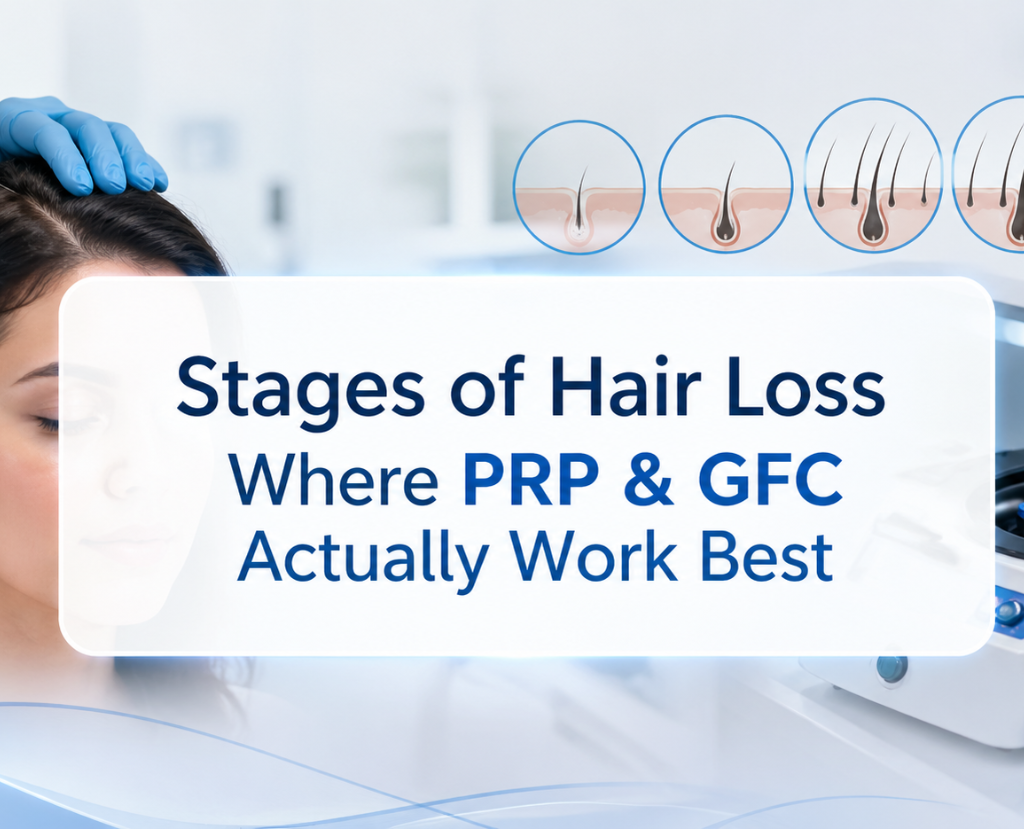
Stages of Hair Loss Where PRP & GFC Actually Work Best
One of the most important questions patients ask before committing to a hair restoration treatment is whether it will actually work for their level of hair loss. The honest answer is that both PRP (Platelet-Rich Plasma) and GFC (Growth Factor Concentrate) therapy produce their most significant and reliable results when applied at the right stage — and understanding that distinction can save patients both time and money.
At Cosmeticstar in Leeds, we use clinically recognised hair loss classification systems — the Norwood-Hamilton scale for men and the Ludwig scale for women — to assess every patient before recommending a treatment pathway. This blog explains how these scales work, which stages respond best to PRP and GFC therapy, and why early intervention is almost always the most effective approach.
Understanding Hair Loss Classification Scales
The Norwood-Hamilton Scale — Male Hair Loss
The Norwood-Hamilton scale classifies male androgenetic alopecia across seven stages. Stage I represents minimal or no recession; Stage II shows early temple recession; Stages III and IV reflect increasing hairline recession and crown thinning; Stages V and VI involve significant loss across both the frontal and crown regions; Stage VII describes near-total hair loss across the top of the scalp, with only a narrow band of hair remaining at the sides.
The Ludwig Scale — Female Hair Loss
The Ludwig scale categorises female pattern hair loss across three grades. Grade I reflects mild thinning at the crown and parting; Grade II indicates more pronounced diffuse thinning with widening of the central parting; Grade III represents advanced thinning across the entire top of the scalp, with the hairline typically preserved but greatly reduced in density.
Where PRP Hair Treatment in Leeds Works Best
PRP therapy works by concentrating your own blood’s growth factors — including Platelet-Derived Growth Factor (PDGF), Vascular Endothelial Growth Factor (VEGF), and Insulin-Like Growth Factor (IGF) — and delivering them directly to the scalp via fine injections. These growth factors stimulate dormant follicles, extend the anagen (growth) phase, and improve blood circulation to the scalp.
Clinical evidence consistently demonstrates that PRP produces its strongest outcomes in patients at the early-to-moderate stages of hair loss:
- Norwood Stage I–III: Excellent response — follicles are still largely active and highly receptive to growth factor stimulation.
- Norwood Stage IV: Good response — some follicular miniaturisation is present, but the majority of follicles remain viable.
- Norwood Stage V: Moderate response — results are variable; PRP can slow progression and improve density in existing hair, but full regrowth is less predictable.
- Norwood Stage VI–VII: Limited response — at this stage, significant follicular death has occurred and PRP alone is unlikely to produce meaningful regrowth. Hair transplantation may be more appropriate.
For women, PRP is most effective at Ludwig Grade I and Grade II, where follicles are thinning but still present and biologically active.
Where GFC Hair Therapy in Leeds Works Best
GFC therapy represents a more refined and concentrated form of growth factor delivery than standard PRP. Through an advanced preparation process, GFC isolates a significantly higher concentration of specific growth factors whilst eliminating the inflammatory components that can limit PRP’s effectiveness. The result is a more targeted biological signal delivered directly to the follicle.
GFC is particularly effective in the following scenarios:
- Patients at Norwood Stage II–IV who want a more potent alternative to PRP, or who have seen limited results from previous PRP sessions.
- Women at Ludwig Grade I–II experiencing diffuse thinning linked to hormonal changes or nutritional factors.
- Patients with scalp sensitivity who have not tolerated standard PRP well.
- Individuals seeking to maximise results within a shorter treatment timeframe.
At the more advanced stages — Norwood V and above, or Ludwig Grade III — GFC can still provide meaningful scalp health benefits and slow the rate of progressive loss, though expectations should be managed carefully and realistic outcomes discussed during consultation.
Why the Stage of Hair Loss Matters More Than the Treatment Alone
The single most influential factor in determining treatment success is not which therapy is selected — it is when that therapy is applied. Hair follicles that have been dormant for a short period respond far more readily to biological stimulation than follicles that have been miniaturised and inactive for years. Once a follicle has reached complete fibrosis — where the follicular structure itself has been replaced by scar tissue — no current non-surgical treatment can reverse that process.
This is precisely why Cosmeticstar in Leeds places such emphasis on early assessment. The sooner hair loss is evaluated and addressed, the wider the range of effective treatment options available — and the better the outcomes achievable.
Treatment Options at Cosmeticstar, Leeds
PRP Hair Treatment
Using your own platelet-rich plasma to stimulate follicular activity, PRP is a well-evidenced, widely used treatment for early-to-moderate hair loss. Discover PRP Hair Treatment in Leeds.
GFC Hair Therapy
A more concentrated and refined growth factor treatment, GFC is particularly suited to patients seeking stronger results or those who have not achieved their desired outcome from PRP. Explore GFC Hair Therapy in Leeds.
Exosome Therapy
For patients at more advanced stages, exosome therapy provides cellular-level regeneration that can reactivate dormant follicles and reduce scalp inflammation. Discover Exosome Therapy in Leeds.
IV Drip Therapy
Supporting follicular health from within through targeted intravenous nutrient delivery. View our IV Drip Therapy in Leeds.
Vitamin Injections
Correcting specific nutritional deficiencies that may be limiting your treatment response. Learn about our Vitamin Injections in Leeds.
Prevention and Maintenance
- Begin treatment at the earliest sign of hair loss — do not wait for the condition to advance.
- Use the Norwood or Ludwig scale as a reference when discussing your case with a specialist.
- Maintain treatment with periodic sessions once results are achieved to preserve and build upon them.
- Combine scalp treatments with nutritional and hormonal support for optimal follicular health.
Book a Hair Assessment at Cosmeticstar, Leeds
Knowing your hair loss stage is the starting point for choosing the right treatment — and getting results. At Cosmeticstar, we carry out a thorough clinical assessment of your hair loss before recommending any treatment. Chat now — click the link and you will be redirected straight to WhatsApp.
Conclusion
Both PRP and GFC therapy in Leeds are highly effective tools — but their effectiveness is directly linked to the stage at which they are applied. Early-stage hair loss responds best, and the results achieved at Stages II–IV are consistently the most impressive. If you are beginning to notice changes in your hair, now is the time to act. Cosmeticstar in Leeds is here to guide you with honest, science-led advice at every stage.
Privacy Notice: Your data is handled in accordance with UK GDPR. Please review our Privacy Policy for full details.
Disclaimer: This blog is for educational purposes only. Always consult a qualified professional before beginning any treatment.
Frequently Asked Questions
Q: At which Norwood stage is it too late for PRP or GFC to work?
A: At Norwood Stage VI and VII, results from PRP and GFC are significantly limited. A surgical consultation may be more appropriate at this stage.
Q: Can PRP slow down hair loss even if it cannot fully regrow hair at advanced stages?
A: Yes — PRP can reduce the rate of ongoing loss and improve scalp health even where full regrowth is not achievable.
Q: How many PRP sessions are needed to see results at Stage III?
A: Most patients at Stage III see meaningful improvement after three to four sessions, with results continuing to develop over six months.
Q: Is GFC more effective than PRP at every stage?
A: GFC is generally more potent due to its higher growth factor concentration, but both are effective — the right choice depends on your individual case.