
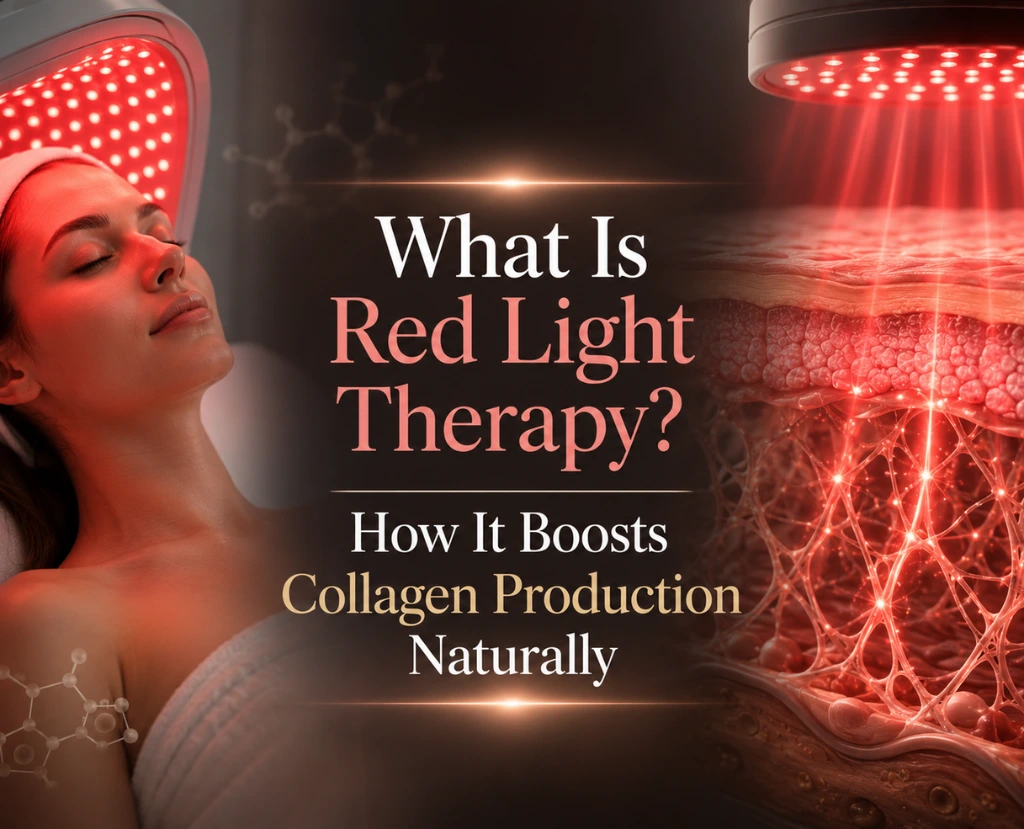
What Is Red Light Therapy? How It Boosts Collagen Production Naturally
Collagen is the structural protein that gives skin its firmness, resilience, and volume. It accounts for around 75 percent of the skin’s dry weight, and it is the primary reason that young skin looks and behaves the way it does. From the mid-twenties onwards, collagen production begins to decline — by around one percent per year — and the visible consequences accumulate gradually: fine lines, loss of firmness, a complexion that recovers more slowly from environmental stressors.
The cosmetic industry has built enormous commercial infrastructure around the promise of collagen. Most of it cannot deliver what it claims — collagen molecules are too large to penetrate the skin via topical application, and oral collagen supplements provide amino acids that the body uses according to its own priorities. Red light therapy is different. It is one of the very few non-invasive interventions with a genuine, documented mechanism for stimulating the body’s own collagen production from within.
What Red Light Therapy Actually Is
Red light therapy — more precisely called photobiomodulation (PBM) — uses specific wavelengths of visible red light (typically 630 to 660 nm) and near-infrared light (typically 810 to 850 nm) to penetrate the skin and stimulate biological activity in the cells beneath. The light is not UV, does not damage the skin, does not heat the tissue in any harmful way, and requires no anaesthetic or recovery period.
The key discovery underlying the entire field was that certain wavelengths of light are absorbed by a photoreceptive enzyme called cytochrome c oxidase in the mitochondria of cells. When this absorption occurs, it triggers an increase in adenosine triphosphate (ATP) production — alongside a reduction in reactive oxygen species (oxidative stress) and an upregulation of cellular signalling that promotes repair, regeneration, and collagen synthesis.
The Collagen Connection: How It Actually Works
Fibroblast Stimulation
Fibroblasts are the cells in the dermis responsible for producing collagen and elastin. When red light at the appropriate wavelengths penetrates to the dermal layer, it stimulates fibroblast activity directly. Energised fibroblasts produce collagen at a higher rate, and the collagen produced is of higher quality — more organised, more structurally coherent — than the fragmented collagen that characterises photoaged or depleted skin.
Reduced Matrix Metalloproteinase Activity
Matrix metalloproteinases (MMPs) are enzymes that break down collagen. In chronically inflamed or UV-damaged skin, MMP activity is elevated, which accelerates collagen loss. Red light therapy reduces the production and activity of these enzymes, slowing the breakdown of existing collagen at the same time as it stimulates new collagen production. The combined effect — more produced, less broken down — is a net increase in dermal collagen density over a course of treatment.
Improved Skin Hydration and Barrier Function
Collagen in the dermis also supports skin hydration by maintaining the structural environment in which hyaluronic acid retains water. As collagen density improves through red light therapy, skin hydration typically improves in parallel.
What Results Look Like and When
Collagen remodelling is not an immediate process. The fibroblast activity stimulated by each session takes weeks to produce new collagen and for that collagen to integrate into the existing dermal matrix. Most patients at Cosmeticstar in Leeds begin to notice improvements in skin texture and firmness after four to six sessions, with more significant changes in fine lines and overall skin quality becoming visible between weeks six and twelve of a consistent treatment course.
Red Light Therapy for Skin: Who It Suits
Red light therapy for collagen stimulation is appropriate for virtually all adults concerned about early to moderate signs of skin ageing — fine lines, loss of firmness, dull or uneven skin tone, and skin that recovers slowly from environmental stressors. It is suitable for all skin types and tones, can be used year-round, and complements other aesthetic treatments well.
Treatment Options at Cosmeticstar, Leeds
Red Light Therapy
Our red light therapy sessions in Leeds are delivered using clinical-grade devices calibrated to the wavelengths with the strongest evidence for hair follicle stimulation and skin rejuvenation. Learn more about Red Light Therapy in Leeds.
PRP Hair Treatment
For targeted follicular stimulation through your body’s own growth factors, PRP Hair Treatment in Leeds at Cosmeticstar is tailored to your specific thinning pattern and delivered with clinical precision.
GFC Hair Therapy
For patients with more significant thinning or faster progression, GFC Hair Therapy in Leeds delivers a more concentrated, more refined growth factor preparation than standard PRP — with a lower inflammatory response and stronger outcomes.
Exosome Therapy
Working at the cellular communication level, Exosome Therapy in Leeds carries regenerative signals directly to follicular tissue — and combines powerfully with both red light therapy and growth factor treatments.
IV Drip Therapy & Vitamin Injections
Scalp health depends on what the body is working with internally. Our IV Drip Therapy in Leeds and Vitamin Injections in Leeds correct nutritional deficiencies that can otherwise limit how well any hair treatment performs.
Ready to Take the Next Step?
If you are interested in how red light therapy could support your skin quality through natural collagen stimulation, the most useful thing you can do is get a proper assessment from a clinic that takes the time to understand your specific situation. That is exactly what we offer at Cosmeticstar in Leeds. Chat now — click the link and you will be redirected straight to WhatsApp where our team is ready to help.
Conclusion
Red light therapy’s ability to stimulate collagen production naturally — through a genuine, well-documented biological mechanism — sets it apart from the vast majority of products that make similar claims. At Cosmeticstar in Leeds, it is delivered at the clinical parameters the evidence supports, as part of a properly designed treatment plan tailored to your skin’s specific needs.
Privacy Notice: Your data is handled in accordance with UK GDPR. Please review our Privacy Policy for full details.
Disclaimer: This blog is for educational purposes only. Always consult a qualified professional before beginning any treatment.
Frequently Asked Questions
Q: How many red light therapy sessions are needed to see collagen improvement?
A: Meaningful improvements in skin firmness and texture typically become apparent after six to eight sessions. A full initial course of ten to twelve sessions produces the most significant dermal changes.
Q: Is red light therapy safe for all skin types?
A: Yes — red light therapy does not carry the pigmentation risks associated with some laser treatments and is suitable across all Fitzpatrick skin types.
Q: Can red light therapy replace cosmetic injectables for collagen stimulation?
A: Red light therapy and cosmetic injectables address skin ageing through different mechanisms and are not direct substitutes. Many patients use both as part of a complementary approach.
Q: How often should I have red light therapy for skin?
A: Two to three sessions per week during the initial course of eight to twelve sessions is typical, reducing to a maintenance schedule of one session per week once the initial course is complete.
Q: Does red light therapy help with acne as well as ageing?
A: Yes — the anti-inflammatory and cellular repair effects of red light therapy have relevance for acne-prone skin as well as for skin ageing. At Cosmeticstar, treatment protocols are adapted to the skin concern being addressed.