
PRP vs Hair Transplant: Which Is Better?
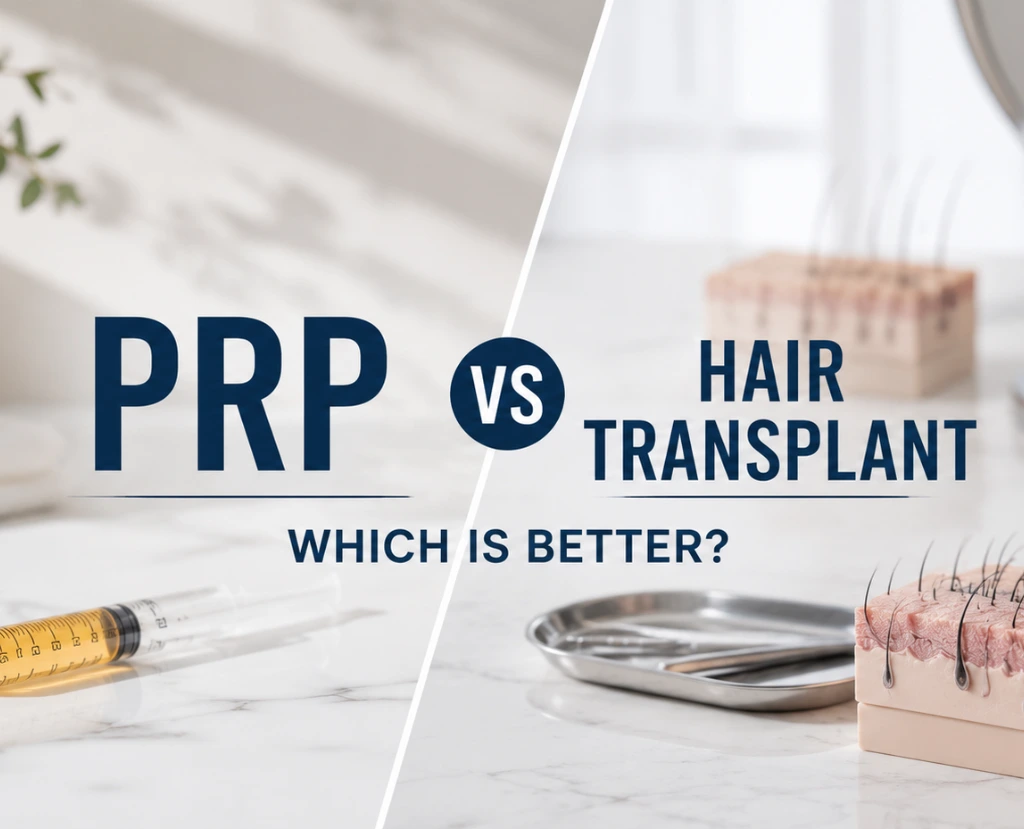
At some point in the hair loss journey, most people end up asking the same question: should I go for a transplant, or would PRP be a better option? It is a fair question, and honestly, the answer is different for every person depending on where they are with their hair loss, what they are hoping to achieve, and what they are willing to commit to in terms of time, recovery, and cost.
At Cosmeticstar in Leeds, we specialise in PRP hair treatment and advanced non-surgical hair restoration — we do not perform hair transplants. That means we have no financial reason to push you in either direction, and we can give you a straightforward comparison based purely on what is going to serve you best. So let us break it down properly.
What PRP Hair Treatment in Leeds Actually Does
PRP (Platelet-Rich Plasma) treatment works by taking growth factors from your own blood and delivering them directly into the scalp, where they stimulate existing follicles to become more active, grow thicker strands, and stay in the growth phase for longer. It does not transplant anything — it works with what you already have.
That is its biggest strength and also its main limitation. If your follicles are still present and still capable of responding biologically — even if they are miniaturised and underperforming — PRP can produce real, measurable improvements. If follicles in certain areas have been permanently inactive for many years with no trace of activity remaining, PRP cannot create new ones from scratch.
For most people who come to Cosmeticstar in Leeds at the early-to-moderate stages of hair loss, that is not the situation they are in. The majority of patients we see have follicles that are still there, still cycling, and still capable of a meaningful response to treatment. PRP for hair thinning in Leeds — delivered properly and consistently — can make a significant difference at this stage.
What a Hair Transplant Does
A hair transplant — most commonly performed as FUE (Follicular Unit Extraction) or FUT (Follicular Unit Transplantation) — physically relocates healthy follicles from the donor area at the back and sides of the scalp to areas of significant thinning or baldness. The relocated follicles are genetically resistant to DHT, meaning they continue to grow in their new position permanently once established.
The results can be impressive, particularly for people at advanced stages of hair loss where non-surgical treatments have limited impact. But there are significant considerations that many patients do not fully account for when they first start looking into transplants.
A transplant requires an adequate donor supply — which not everyone has. It involves a surgical procedure with associated risks, a recovery period of several days, careful aftercare for weeks, and a full cosmetic result that typically takes twelve to eighteen months to develop. Costs in the UK range significantly, and the outcome depends heavily on the skill of the surgeon and clinic performing the procedure.
Comparing the Two Honestly
Who Is Each Treatment For?
PRP hair treatment in Leeds is most clinically effective for people at Norwood Stages 1 to 4 or Ludwig Stages 1 to 2 — early-to-moderate hair loss where follicles are still biologically active.
Hair transplants are typically recommended for more advanced stages where significant baldness is present and the donor supply is sufficient to achieve meaningful coverage.
The Commitment Involved
PRP at Cosmeticstar in Leeds involves a course of three to four sessions over several months, followed by periodic maintenance. It is a clinical visit of roughly an hour — no anaesthetic, no recovery time, no restrictions on activity afterwards.
A hair transplant involves a full surgical day, several days of initial recovery, weeks of careful aftercare, and the patience to wait over a year for the full result.
Cost
PRP hair treatment in Leeds is considerably more accessible financially than surgical transplantation. A full course of PRP at Cosmeticstar represents a fraction of the cost of transplant surgery, which, depending on the extent of hair loss and number of grafts required, can run into thousands of pounds.
Results and Longevity
PRP results are real and measurable, but they are not permanent. Maintenance sessions every six to twelve months are needed to sustain the improvement, particularly in progressive hair loss conditions.
Hair transplant results in the transplanted zones are considered permanent, but hair loss in surrounding non-transplanted areas can continue, and many transplant patients still benefit from PRP treatment to manage those areas over time.
The Case for Combining Both
Here is something worth knowing: Many patients do not realise until they have already had a transplant that PRP and hair transplant surgery work extremely well together. PRP before a transplant helps to optimise the scalp environment and improve follicular density ahead of surgery. PRP after a transplant — starting from around four to six weeks post-procedure — has been shown to improve graft survival rates, reduce recovery time, and accelerate the growth timeline of the transplanted follicles. At Cosmeticstar in Leeds, we regularly work with patients who are planning transplant surgery and want to prepare their scalp properly beforehand.
Treatment Options at Cosmeticstar, Leeds
PRP Hair Treatment
For patients at early-to-moderate stages of hair loss, PRP hair treatment in Leeds is a clinically strong, non-surgical option that is accessible, evidence-backed, and effective. Learn more about PRP Hair Treatment in Leeds.
GFC Hair Therapy
GFC hair therapy in Leeds delivers a stronger, more refined growth factor preparation than standard PRP — often the better choice for patients who want to get the most out of non-surgical treatment, or who are preparing for or recovering from a transplant. Explore GFC Hair Therapy in Leeds.
Exosome Therapy
Whether you are choosing non-surgical treatment or using it alongside surgery, Exosome Therapy provides an advanced cellular-level regenerative stimulus that enhances follicular outcomes. Discover Exosome Therapy in Leeds.
Not Sure Which Route Is Right for You?
That is exactly the conversation we have at Cosmeticstar. We look at where you are with your hair loss, what your scalp is telling us, what you are hoping for, and we give you honest guidance — not a sales pitch. Cosmeticstar in Leeds is here to help you make a decision you will feel confident about. Chat now — click the link and you will be redirected straight to WhatsApp.
Conclusion
PRP and hair transplant surgery are not competitors — they suit different patients at different stages, and they can work together powerfully when the situation calls for it. For anyone still in the early-to-moderate stages of hair loss, PRP hair treatment in Leeds at Cosmeticstar offers a non-surgical, accessible, and clinically effective route that is well worth exploring before committing to surgery.
Privacy Notice: Your data is handled in accordance with UK GDPR. Please review our Privacy Policy for full details.
Disclaimer: This blog is for educational purposes only. Always consult a qualified professional before beginning any treatment.
Frequently Asked Questions
Q: Is PRP hair treatment in Leeds as effective as a hair transplant?
A: For early-to-moderate hair loss, PRP can produce comparable improvements in density without any surgical risk, downtime, or the significant cost involved in transplant surgery.
Q: Can PRP stop me from needing a hair transplant?
A: In many cases, yes. Starting PRP treatment in Leeds early can stabilise hair loss and restore enough density to avoid or significantly delay the need for surgery.
Q: How many PRP sessions are recommended before a transplant?
A: Typically, two to four sessions are recommended in the months before surgery to optimise the scalp condition and follicular health ahead of the procedure.
Q: Is GFC better than PRP before a hair transplant?
A: GFC hair therapy in Leeds offers a stronger growth factor preparation and is increasingly preferred as a pre-transplant scalp optimisation treatment for its enhanced follicular stimulation.
Q: Does PRP work after a hair transplant?
A: Yes — PRP and GFC are both well-established post-transplant support treatments that improve graft survival, reduce recovery time, and enhance the density of final transplant results.